
10 Signs Your Product Idea Is Ready for an MVP
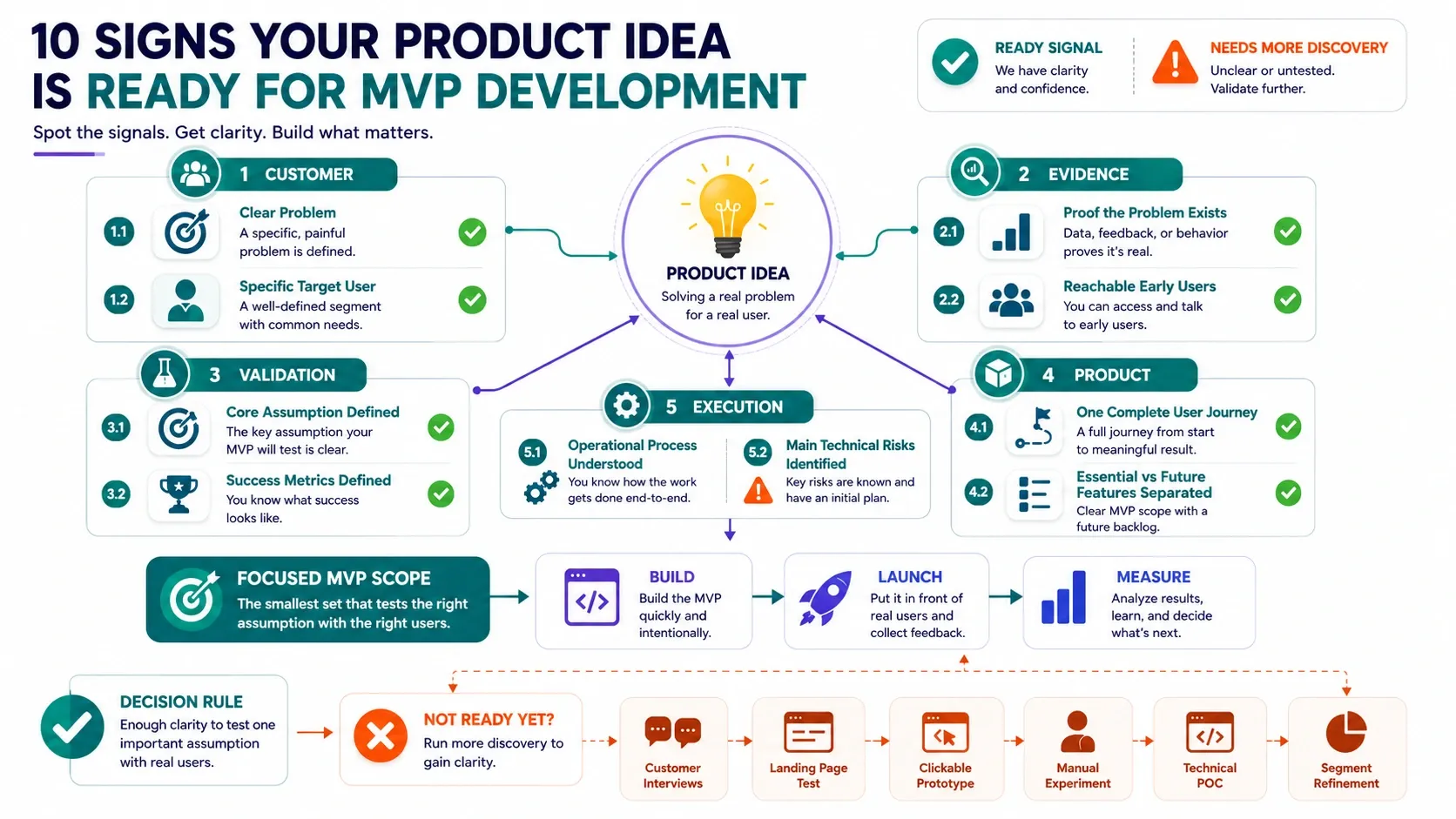
Having an exciting product idea does not automatically mean it is ready for development.
An MVP should begin when you understand the problem, target customer, core journey, and assumptions you need to test. You do not need complete certainty, but you need enough evidence and clarity to build a focused product rather than an expensive collection of guesses.
Here are ten signs your idea may be ready for MVP development.
1. You Can Clearly Explain the Problem
You should be able to describe the customer problem in one or two simple sentences.
A useful problem statement explains:
- Who experiences the problem
- What makes it difficult or costly
- How people currently manage it
- Why existing alternatives are insufficient
If your explanation begins with a long list of features instead of a customer problem, further discovery may be required.
2. You Have Identified a Specific Target Customer
“Everyone,” “all businesses,” or “anyone with a smartphone” is not a practical MVP audience.
Your first customer group should be specific enough to understand and reach. For example:
- Independent online tutors managing more than 50 students
- Small property managers operating several apartment buildings
- Recruitment agencies screening high volumes of applicants
- Local service providers still managing bookings manually
A focused customer group makes product decisions, messaging, and validation easier.
3. You Have Evidence That the Problem Exists
The idea should be supported by more than personal enthusiasm.
Useful evidence may include:
- Customer interviews
- Repeated complaints
- Existing manual workarounds
- Search or enquiry patterns
- Letters of intent
- Pilot-customer interest
- Pre-orders or waitlist sign-ups
- People already paying for an alternative
You do not need hundreds of customers before building, but you should have credible reasons to believe the problem is real.
4. You Know the Core Assumption to Test
Every MVP should answer an important business question.
Examples include:
- Will customers book this service online?
- Will tutors pay for a simpler class-management platform?
- Will businesses upload documents for automated analysis?
- Will homeowners request services from verified providers?
- Will users return weekly to monitor this information?
The MVP should be designed around generating evidence for that assumption.
5. You Can Define One Complete User Journey
A good MVP allows a customer to complete one meaningful action from beginning to end.
For a booking platform, the journey might be:
- Select a service.
- View availability.
- Choose a time.
- Submit the booking.
- Receive confirmation.
If the product requires numerous unfinished modules before delivering any value, the scope may need to be simplified.
6. You Can Separate Essential Features From Future Ideas
Your product may eventually require many capabilities, but the MVP should contain only what is needed for value, validation, safety, and reliable operation.
You should be able to divide features into:
- Must include
- Useful but not essential
- Postpone until after validation
Advanced reports, several integrations, complex automation, loyalty programmes, multiple currencies, and native mobile apps can often wait.
If every feature is considered essential, the idea is probably not ready for focused MVP development.
7. You Understand the Main Operational Process
Software rarely operates in isolation. People may need to approve requests, respond to customers, resolve exceptions, review content, or provide support.
Before development, identify:
- Who manages the product
- What happens behind the scenes
- Which processes can remain manual
- How will customer problems be handled
- What data must be collected
- What notifications are necessary
Manual operations are acceptable during early validation when they do not damage the customer experience.
8. The Main Technical Risks Are Understood
You do not need a complete technical architecture before scoping an MVP, but major uncertainties should be identified.
These may involve:
- AI accuracy
- Payment gateways
- External APIs
- Legacy-system integration
- Large-file processing
- Real-time communication
- Sensitive data
- Regulatory requirements
- Hardware or IoT devices
If a critical technology remains unproven, a Proof of Concept may be required before full MVP development.
9. You Can Reach Real Early Users
An MVP provides little value if no one is available to test it.
You should have a reasonable plan to reach early users through:
- Existing customers
- Professional networks
- Industry communities
- Partnerships
- Direct outreach
- Waitlists
- Targeted advertising
- Pilot programmes
A small group of relevant and engaged users can be more valuable than a large general audience.
10. You Know How Success Will Be Measured
Define success before development begins.
Depending on the assumption, useful metrics may include:
- Registration rate
- Onboarding completion
- Core journey completion
- Paid conversion
- Repeat usage
- Retention
- Booking or transaction volume
- Customer acquisition cost
- Support requests
- Customer referrals
Avoid relying only on page views, downloads, or positive comments. Stronger validation comes from behaviour such as completion, repeated use, and payment.
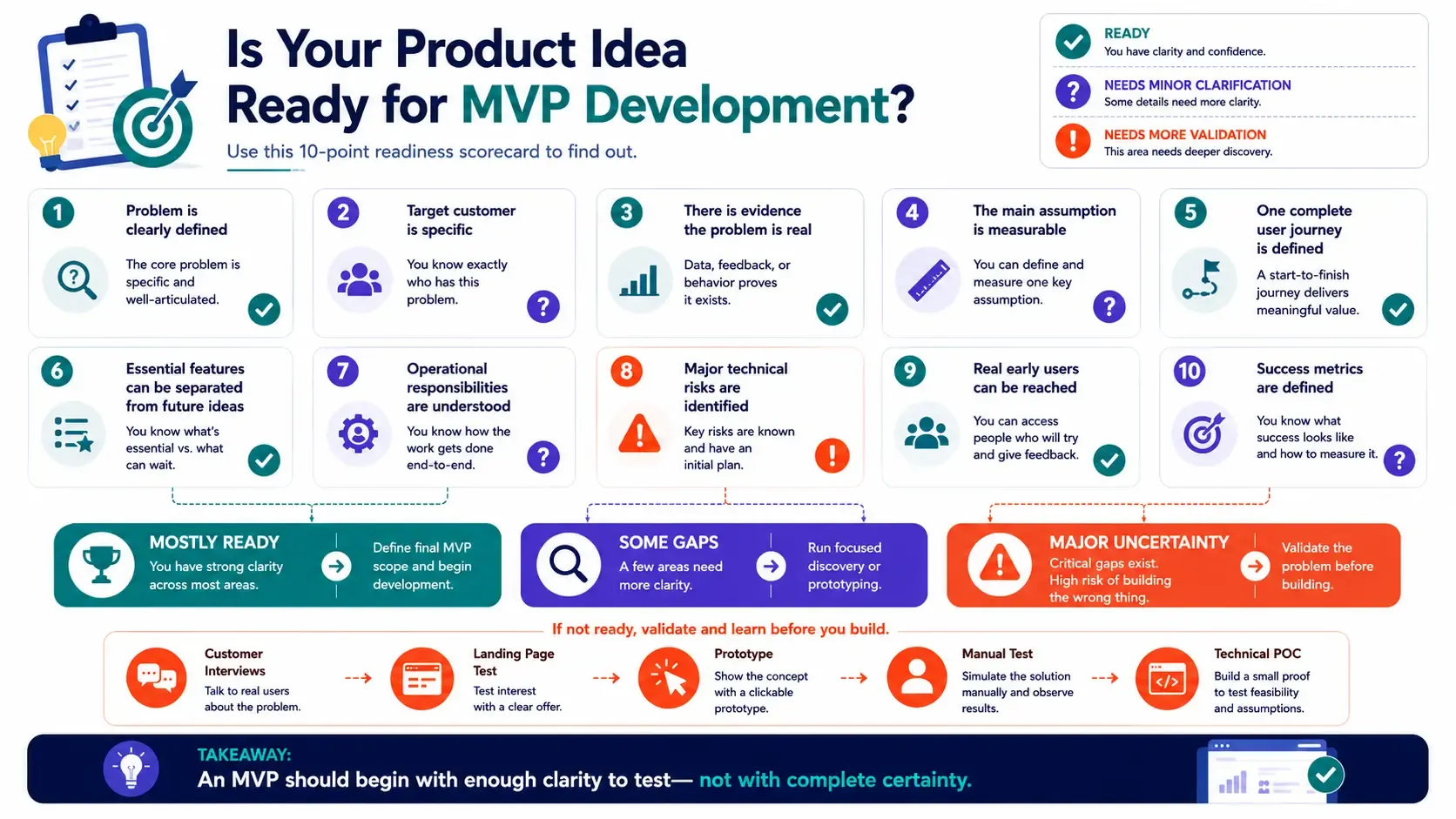
Quick MVP Readiness Checklist
Your idea may be ready when you can answer yes to most of these questions:
- Is the customer problem clearly defined?
- Is the initial target audience specific?
- Is there evidence that the problem exists?
- Is the central assumption measurable?
- Can one complete user journey deliver value?
- Can non-essential features wait?
- Are operational responsibilities understood?
- Have major technical risks been identified?
- Can you reach relevant early users?
- Do you know which metrics will determine success?
A few unanswered questions do not automatically prevent development. They should, however, be resolved through discovery, customer research, prototyping, or a technical POC before they create expensive rework.
What If Your Idea Is Not Ready?
Do not force it into development. The next step may be:
- Conducting customer interviews
- Testing demand with a landing page
- Building a clickable prototype
- Running a manual service experiment
- Creating a technical POC
- Refining the first customer segment
- Defining the core user journey
These activities are progress. They reduce uncertainty and help ensure that the eventual MVP tests the right idea.
Turn Clarity Into a Launchable Product
A product idea is ready for MVP development when you understand the customer, problem, core assumption, minimum journey, and evidence required next.
You do not need every future feature planned. You need enough clarity to build one reliable outcome for real customers.
Ready to Turn Your Idea Into Market Evidence?
MVPHUB helps founders validate, scope, design, develop, and launch focused production-ready MVPs using AI-accelerated delivery and accountable professional engineering. Book a free consultation with MVPHUB to assess your idea, identify the right MVP scope, and determine the fastest responsible path to market.
Book a free consultation with MVPHUBFrequently Asked Questions
How do I know if my idea is ready for an MVP?
Your idea is usually ready when you can clearly define the customer problem, target user, core assumption to test, essential user journey, and how success will be measured. You do not need every feature or technical detail finalized before starting.
Should I validate my idea before building an MVP?
Yes. Basic validation should happen before development. Customer interviews, landing-page tests, waitlists, manual experiments, competitor research, or early pilot interest can help confirm that the problem is worth solving before you invest in software development.
How much validation is enough before starting an MVP?
There is no universal number of interviews, sign-ups, or potential customers required. The goal is to gather enough evidence to reduce the biggest uncertainties around the problem, target customer, and proposed solution before committing to development.
What should be included in the first version of an MVP?
An MVP should include the minimum features required to deliver a complete and useful customer journey, test the main business assumption, and operate safely and reliably. Features that do not directly support validation can usually be postponed.
What is the difference between an MVP and a prototype?
A prototype is mainly used to explore or demonstrate how a product might work, while an MVP is a functioning product intended for real users. An MVP should allow users to complete a meaningful task and generate real-world evidence about demand and behaviour.
When should I build a Proof of Concept before an MVP?
A Proof of Concept is useful when the biggest uncertainty is technical rather than commercial. For example, you may need a POC first if your product depends on unproven AI accuracy, complex hardware integration, unusual data processing, or a critical third-party technology.
Can I start MVP development without a technical co-founder?
Yes. Non-technical founders can build an MVP by working with an experienced development partner, software agency, freelancer, or no-code/low-code platform. The founder should focus on understanding the customer problem, product priorities, and validation goals while technical specialists handle engineering decisions.
How many features should an MVP have?
There is no ideal number of MVP features. A simple product may require only a few capabilities, while another may need several interconnected functions. The better question is whether every included feature is necessary to complete the core user journey or test an important assumption.
How long should it take to build an MVP?
The timeline depends on product scope, technical complexity, integrations, platforms, and development approach. A focused MVP can sometimes be developed within a few weeks, while products involving complex workflows, AI, hardware, regulatory requirements, or multiple integrations may require longer.
What should I do after launching an MVP?
After launch, focus on observing real user behaviour rather than immediately adding more features. Measure activation, journey completion, repeat usage, retention, conversion, payments, and customer feedback. Use this evidence to decide what to improve, remove, automate, or build next.
