
AI-Built Prototype vs Professionally Engineered MVP
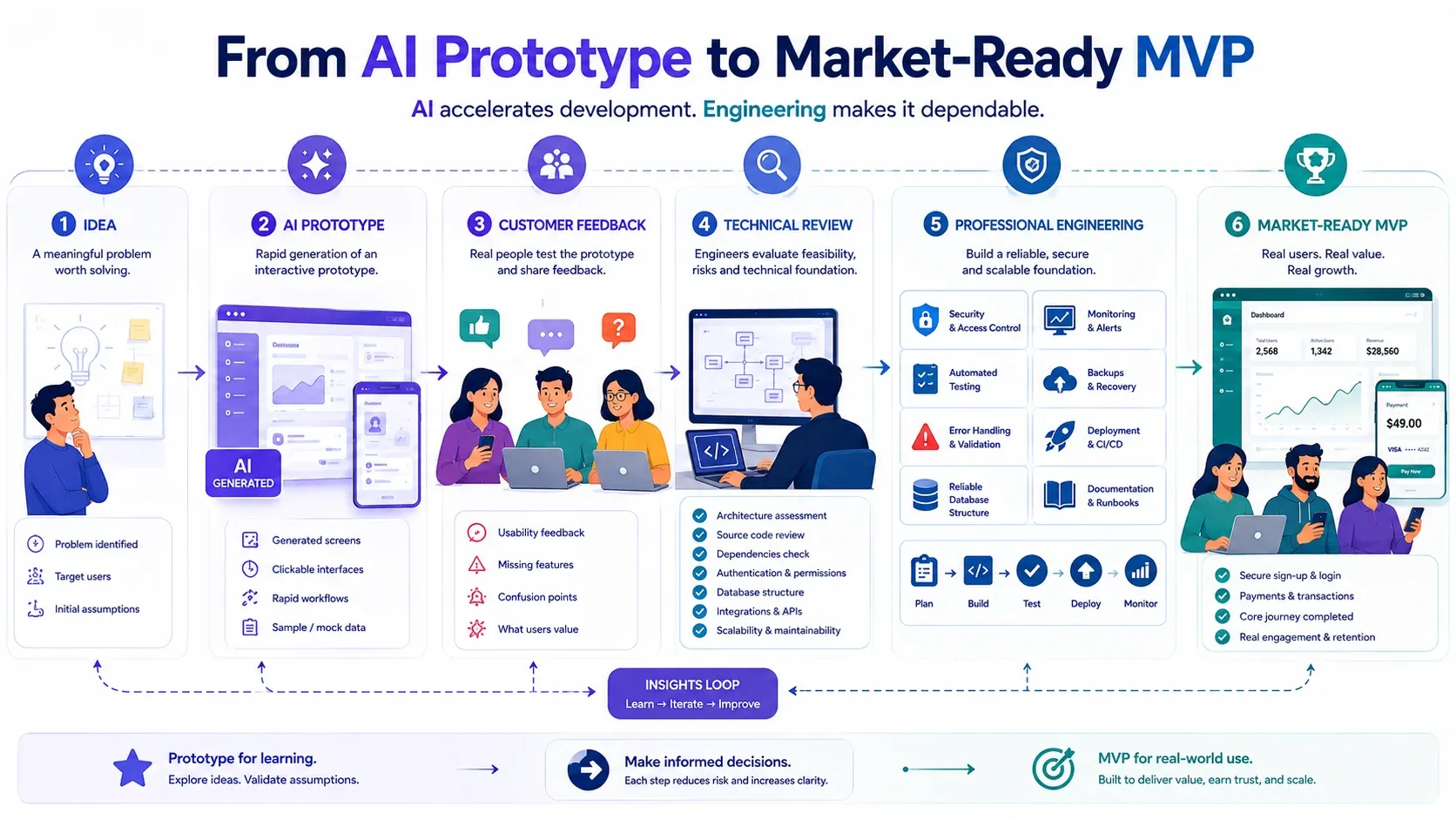
AI development tools have dramatically changed how quickly a product idea can become an interactive application.
A founder can now describe an idea in natural language and generate screens, workflows, database structures, integrations, and working features within hours or days. This makes AI-built prototypes extremely valuable for exploring ideas and collecting early feedback.
However, a working demonstration is not automatically a market-ready product.
If real customers will create accounts, submit personal information, make payments, or depend on the application, the product requires more than visible functionality. It needs appropriate architecture, security, testing, data protection, monitoring, and technical ownership.
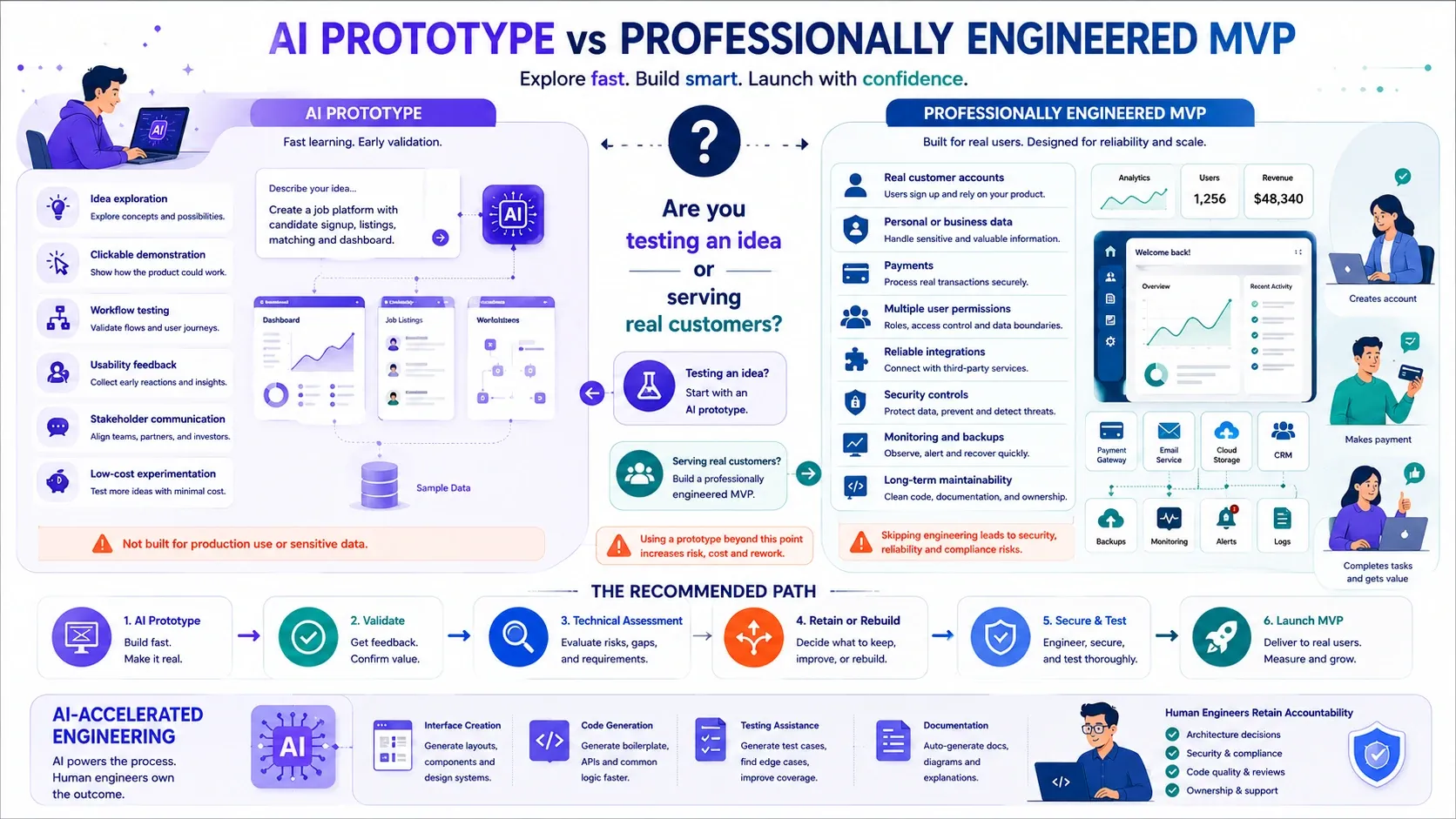
The important question is therefore not whether AI or professional developers should build your product. It is:
Are you testing an idea, or are you releasing software that real customers must be able to trust?
AI-Built Prototype vs Professionally Engineered MVP at a Glance
| Area | AI-built prototype | Professionally engineered MVP |
|---|---|---|
| Main purpose | Explore and demonstrate an idea | Validate demand with real users |
| Typical audience | Founders, stakeholders and test participants | Early adopters and pilot customers |
| Development approach | Prompt-driven generation and rapid iteration | Defined requirements, architecture, engineering and QA |
| Functionality | Simulated or selectively functional | Reliable core user journey |
| Security | Often limited unless deliberately implemented | Designed and verified according to product risks |
| Testing | Primarily manual demonstrations | Functional, integration, security and acceptance testing |
| Maintainability | May be difficult as complexity grows | Structured for controlled improvement |
| Production use | Usually unsuitable without review | Designed for a selected real-world audience |
| Best outcome | Faster learning and clearer requirements | Measurable market and customer validation |
What Is an AI-Built Prototype?
An AI-built prototype is an early version of a product created primarily through AI-assisted design or coding tools.
It may include:
- User-interface screens
- Clickable navigation
- Basic database operations
- Sample dashboards
- Simple authentication
- Generated content
- Demonstration workflows
- Limited third-party integrations
Its purpose is to make an idea visible and testable quickly.
For example, a founder planning a recruitment platform could use an AI builder to create candidate-registration screens, an employer dashboard, vacancy listings, and a simulated matching feature. The founder could then demonstrate the proposed experience to recruitment agencies and collect feedback.
This is a powerful form of validation. Potential users can react to something tangible instead of trying to imagine the product from a written explanation.
However, the prototype may still rely on sample data, incomplete permissions, temporary integrations, limited error handling, or code that has not been independently reviewed.
What Is a Professionally Engineered MVP?
A professionally engineered MVP is the smallest reliable version of a product that real users can use to receive its core value.
Like a prototype, it deliberately limits the initial feature set. The difference is that the MVP is designed for operation in a real environment.
Atlassian describes an MVP as a basic product containing the core features needed to serve early adopters, validate the idea, and collect real-world feedback.
Professional engineering typically covers more than writing code. It includes:
- Clarifying requirements and acceptance criteria
- Selecting an appropriate technical architecture
- Structuring the database and application correctly
- Implementing access controls and data protection
- Reviewing third-party dependencies
- Handling errors and unexpected conditions
- Testing the complete user journey
- Establishing deployment and backup processes
- Adding monitoring and analytics
- Documenting the system
- Planning post-launch support
A professionally engineered MVP may still use AI extensively. Engineers can use AI to accelerate interface creation, development, documentation, code review, and testing. What makes the product professionally engineered is the accountability and verification surrounding the output.
Where AI-Built Prototypes Perform Well
Rapid idea exploration
AI allows founders to explore multiple versions of an idea without committing to a full development project. Screens, workflows, and feature concepts can be generated and changed quickly.
Early usability feedback
A prototype can show whether users understand the navigation, terminology, and proposed journey. This feedback can prevent expensive design changes during later development.
Stakeholder communication
Investors, partners, customers, and development teams can understand an interactive demonstration more easily than a written concept document.
Requirement discovery
Founders frequently discover missing steps and unclear assumptions only after interacting with the proposed product. An AI prototype helps convert an abstract idea into more precise requirements.
Lower-cost experimentation
If the initial concept is uncertain, prototyping helps determine whether the opportunity deserves further investment.
Where an AI Prototype May Become Risky
Security and privacy
A generated application may function correctly during a demonstration while containing weak access controls, insecure data handling, exposed credentials, or vulnerable dependencies.
GitHub’s own guidance warns that AI-generated code can appear valid while still being inaccurate or insecure. It recommends careful human review and testing rather than using AI review as a replacement for professional oversight.
Research published by Veracode found security flaws in 45% of the AI-generated code samples it evaluated. This does not mean every AI-built application is insecure, but it demonstrates why generated code should not be trusted merely because it works during a demonstration.
Incomplete business logic
AI can implement the workflow described in a prompt, but the prompt may not cover refunds, duplicated transactions, permission conflicts, failed integrations, invalid data, or unusual customer behaviour.
Professional engineering evaluates what should happen when the normal journey fails.
Scalability and performance
A prototype may work with five test accounts but perform poorly when hundreds of users access it simultaneously. Database queries, file handling, background processes, and external integrations require appropriate design.
Maintainability
Prompt-driven development can generate duplicated logic, inconsistent structures, unnecessary dependencies, and tightly connected components. New features then become progressively harder to add safely.
False market feedback
If an application crashes, loses information, or creates security concerns, users may reject it because of execution quality rather than the underlying business idea. An unreliable MVP can therefore produce misleading validation results.
Do You Need to Rebuild an AI Prototype?
Not always.
An experienced engineering team should inspect the existing application before deciding whether to retain, improve, or replace it.
The prototype may be reusable when:
- The source code is accessible and properly owned.
- The technology is appropriate for the product.
- The code structure is understandable and maintainable.
- Dependencies are legitimate and supported.
- Security controls can be implemented without extensive rework.
- The core architecture supports the intended MVP.
A controlled rebuild may be more practical when:
- The prototype was generated through repeated prompts without a defined architecture.
- Critical features depend on insecure or temporary workarounds.
- The platform prevents source-code or data portability.
- Authentication and permissions are unreliable.
- Automated tests and documentation are absent.
- Fixing the code would cost more than rebuilding the focused journey properly.
The decision should be based on a technical assessment—not on an assumption that all AI-generated code must be discarded.
The Strongest Approach: AI-Accelerated Professional Engineering
The most effective approach combines the speed of AI with accountable product engineering.
A practical process is:
- Use AI to explore the product idea and generate an early prototype.
- Test the prototype with potential customers.
- Identify the core problem and most important assumptions.
- Define the smallest market-ready scope.
- Review the prototype’s design, code, dependencies, and architecture.
- Retain useful components and replace unsuitable ones.
- Implement security, testing, analytics, and deployment controls.
- Launch the professionally engineered MVP to a controlled audience.
- Use real behaviour to guide the next investment.
This approach preserves the speed advantage of AI without allowing speed to replace quality assurance.
NIST’s Secure Software Development Framework recommends integrating security practices throughout the development lifecycle, including code review, vulnerability analysis, secure configuration, and verification. These responsibilities remain relevant regardless of whether code was written manually or generated by AI.
How to Choose the Right Option
Choose an AI-built prototype when:
- You are still exploring the concept.
- You need to demonstrate the proposed experience.
- You are collecting design or workflow feedback.
- You are not processing real or sensitive customer information.
- The application will remain within a controlled testing environment.
Choose a professionally engineered MVP when:
- Real customers will register and use the product.
- The application will store personal or business information.
- Payments or financial transactions are involved.
- Different users require different permissions.
- External systems must integrate reliably.
- Product failures could damage trust or operations.
- You plan to extend the product after validation.
Final Thoughts
An AI-built prototype and a professionally engineered MVP are not competing approaches. They solve different problems at different stages.
Use an AI prototype to explore, demonstrate, and refine the idea. Use a professionally engineered MVP to test real customer behaviour through a product that is focused, reliable, secure, and maintainable.
AI can accelerate both stages. What it cannot provide independently is accountability for the final result.
The goal should not be to avoid AI or avoid professional engineering. It should be to combine rapid generation with the technical judgment required to release trustworthy software.
MVPHUB combines AI-accelerated development with professional product engineering, QA, security review, and accountable delivery to turn promising prototypes into production-ready MVPs.
💡 Already built your idea with AI?
Let MVPHUB assess your prototype and turn it into a secure, market-ready MVP.
💡 Have a software idea?
Receive a focused MVP scope, fixed price and achievable delivery timeline.
Book a free consultation with MVPHUBFrequently Asked Questions
Can an AI app builder create a complete MVP?
It can create significant parts of an MVP, particularly for straightforward workflows. However, the product still requires appropriate requirements analysis, architecture, security review, testing, and deployment preparation before real customers depend on it.
Is AI-generated code always insecure?
No. Security depends on the code, architecture, configuration, dependencies, and review process. AI-generated code should be treated as unverified until it has been properly inspected and tested.
Can my AI-built prototype be converted into an MVP?
Yes. Useful designs and code may be retained after technical assessment. Some parts may need to be refactored or rebuilt depending on their quality and suitability.
What makes an MVP production-ready?
A production-ready MVP reliably completes its core user journey and includes appropriate security, testing, data protection, error handling, deployment, monitoring, documentation, and support.
Will professional developers still use AI?
Often, yes. Professional teams use AI to accelerate development while applying human judgment, technical standards, testing, and accountability to the generated output.
