
AI + Professional Engineering: The Smarter Way to Build an MVP
Artificial intelligence has transformed how quickly a software idea can become a working product.
Modern AI development tools can generate user interfaces, database structures, application code, documentation, and tests within a fraction of the time previously required. Founders can now turn written requirements into interactive prototypes in hours or days.
However, speed alone does not make software ready for real customers.
A product that handles user accounts, personal information, payments, business processes, or third-party integrations also requires appropriate architecture, security, testing, deployment, monitoring, and long-term maintainability.
This is why the most effective approach is not choosing between AI and professional software engineering.
It is combining them.
An AI-accelerated, professionally engineered MVP brings together the speed and efficiency of AI with the technical judgment, quality control, and accountability of an experienced product team.
What Is an AI-Accelerated, Professionally Engineered MVP?
An AI-accelerated, professionally engineered MVP is a focused, market-ready product developed using AI tools under the direction and verification of experienced product specialists, designers, software engineers, and quality-assurance professionals.
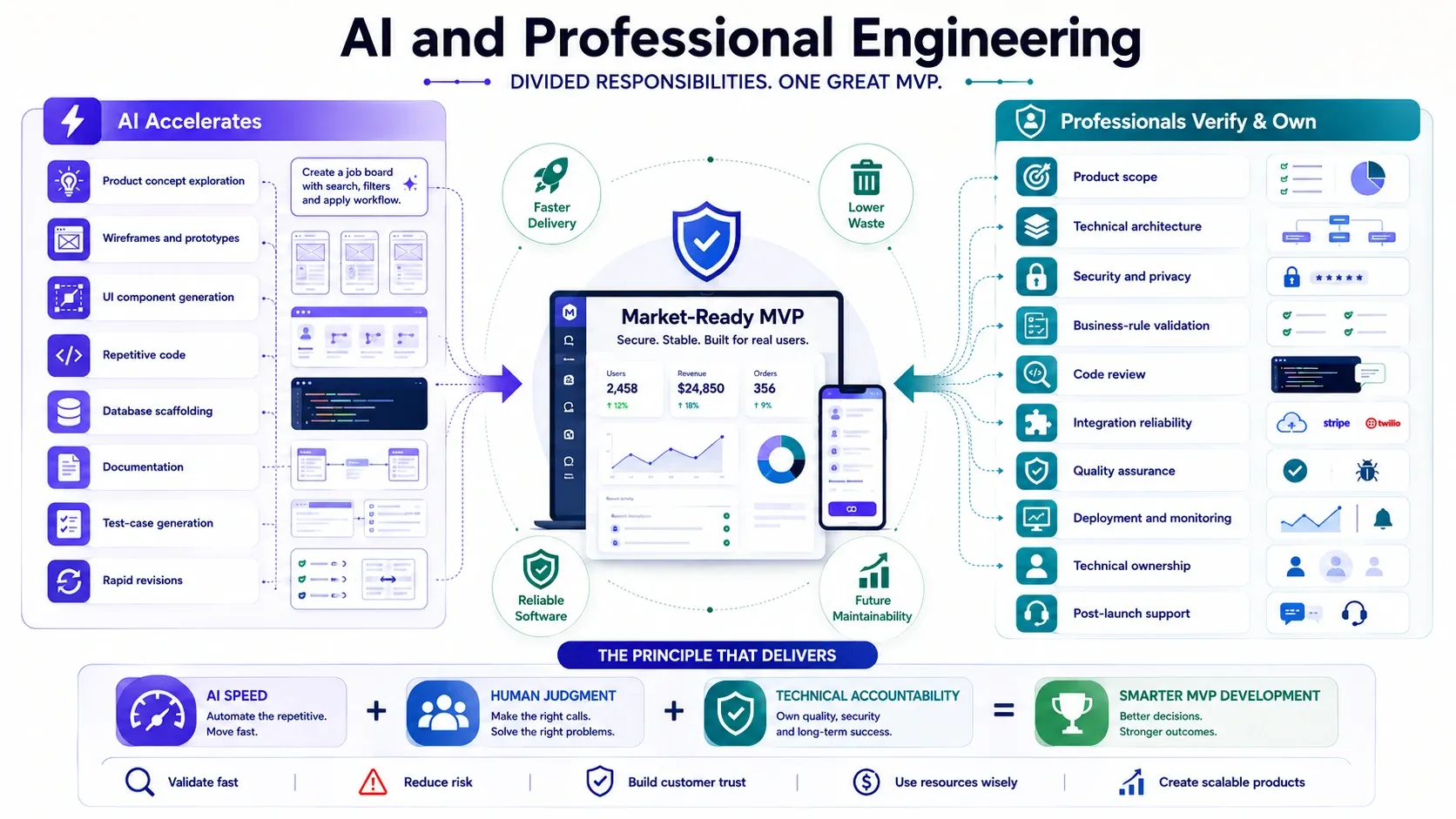
AI may assist with:
- Exploring product concepts
- Creating early wireframes and prototypes
- Generating interface components
- Producing repetitive application code
- Preparing database structures
- Creating technical documentation
- Generating test cases
- Identifying potential code issues
- Accelerating revisions
Professional engineering provides:
- Product-scope definition
- Technical architecture
- Security and privacy controls
- Code review and verification
- Business-rule validation
- Integration reliability
- Quality assurance
- Deployment and monitoring
- Technical documentation
- Post-launch support
- A sustainable path for future development
The result is a faster development process without treating unverified AI output as production-ready software.
Why AI Alone Is Not Always Enough
AI tools are highly effective at generating visible functionality. A founder may describe an application and quickly receive login screens, dashboards, forms, database connections, and basic workflows.
This is extremely useful for prototyping and early product exploration.
However, an application can appear functional while still containing problems that are difficult for a non-technical founder to identify.
These may include:
- Weak authentication or authorization
- Insecure handling of customer data
- Exposed credentials
- Incomplete error handling
- Duplicated or inconsistent code
- Unreliable integrations
- Incorrect business logic
- Poor database design
- Unsupported dependencies
- Limited testing
- Scalability constraints
AI usually implements the requirements described in the prompt. It may not automatically identify requirements that were never mentioned.
For example, an AI tool may successfully create a payment workflow but overlook duplicate transactions, failed payments, refunds, interrupted connections, user-permission conflicts, or reconciliation requirements.
These hidden scenarios are where professional engineering becomes essential.
Why Traditional Development Alone May Be Inefficient
A completely traditional development process may provide strong engineering control, but it can also require more time and manual effort than necessary.
Developers may spend considerable time creating common interface components, repetitive application structures, basic test cases, documentation, and standard integrations that AI can help accelerate.
This can increase:
- Development time
- Initial cost
- Time spent on repetitive tasks
- Delay before customer testing
- Cost of early product changes
Professional teams that use AI appropriately can automate or accelerate routine work and spend more time on the decisions that genuinely require human judgment.
These include understanding the customer problem, prioritizing features, designing the architecture, handling unusual scenarios, reviewing security, and ensuring that the product supports its intended business outcome.
The objective is not to replace engineers. It is to make professional engineering more efficient.
How the Hybrid Approach Creates More Value
1. Faster idea exploration
AI can quickly transform a product concept into wireframes, interfaces, user journeys, and interactive prototypes.
Founders can review the experience, collect stakeholder feedback, and identify missing requirements before investing heavily in development.
2. More efficient MVP development
Once the scope has been validated, AI can accelerate common development tasks while professional engineers control the implementation.
This shortens the journey from idea to launch without sacrificing technical oversight.
3. Lower development costs
AI reduces the manual effort required for repetitive work. Professional product planning also prevents unnecessary features from entering the initial release.
Cost is reduced through efficiency and scope control—not through lower engineering standards.
4. Better product decisions
AI can generate many possible solutions, but experienced professionals determine which solution is appropriate for the customer, market, budget, and long-term product direction.
The team can distinguish between features that look impressive and features that are actually required to validate the business idea.
5. Stronger security and reliability
Professional engineers review generated code, dependencies, authentication, permissions, data handling, and infrastructure configurations before the product reaches customers.
Security practices must remain part of the complete development lifecycle regardless of whether code was written manually or generated by AI.
6. Easier future development
Unstructured AI-generated code may become difficult to extend after repeated prompt-based modifications.
Professional engineering introduces consistent architecture, coding standards, version control, documentation, testing, and technical ownership. This creates a more sustainable foundation for future product development.
7. Clear accountability
An AI tool cannot take responsibility for a failed deployment, data-loss incident, unreliable integration, or security weakness.
A professional engineering team remains accountable for reviewing the output, making technical decisions, verifying the product, and supporting it after launch.
Hybrid MVP Development at a Glance
| Area | AI contribution | Professional contribution |
|---|---|---|
| Product discovery | Generates ideas and explores alternatives | Validates the problem and prioritizes assumptions |
| Prototyping | Rapidly creates screens and workflows | Reviews usability and business alignment |
| Development | Accelerates code and component generation | Defines architecture and verifies implementation |
| Security | Helps identify common issues | Assesses risks and implements appropriate controls |
| Testing | Generates test cases and scripts | Validates coverage, results, and real-world scenarios |
| Deployment | Assists with configurations and automation | Controls infrastructure, backups, and monitoring |
| Documentation | Produces initial technical documentation | Verifies accuracy and completeness |
| Product growth | Accelerates new iterations | Protects maintainability and strategic direction |
A Practical Hybrid MVP Process
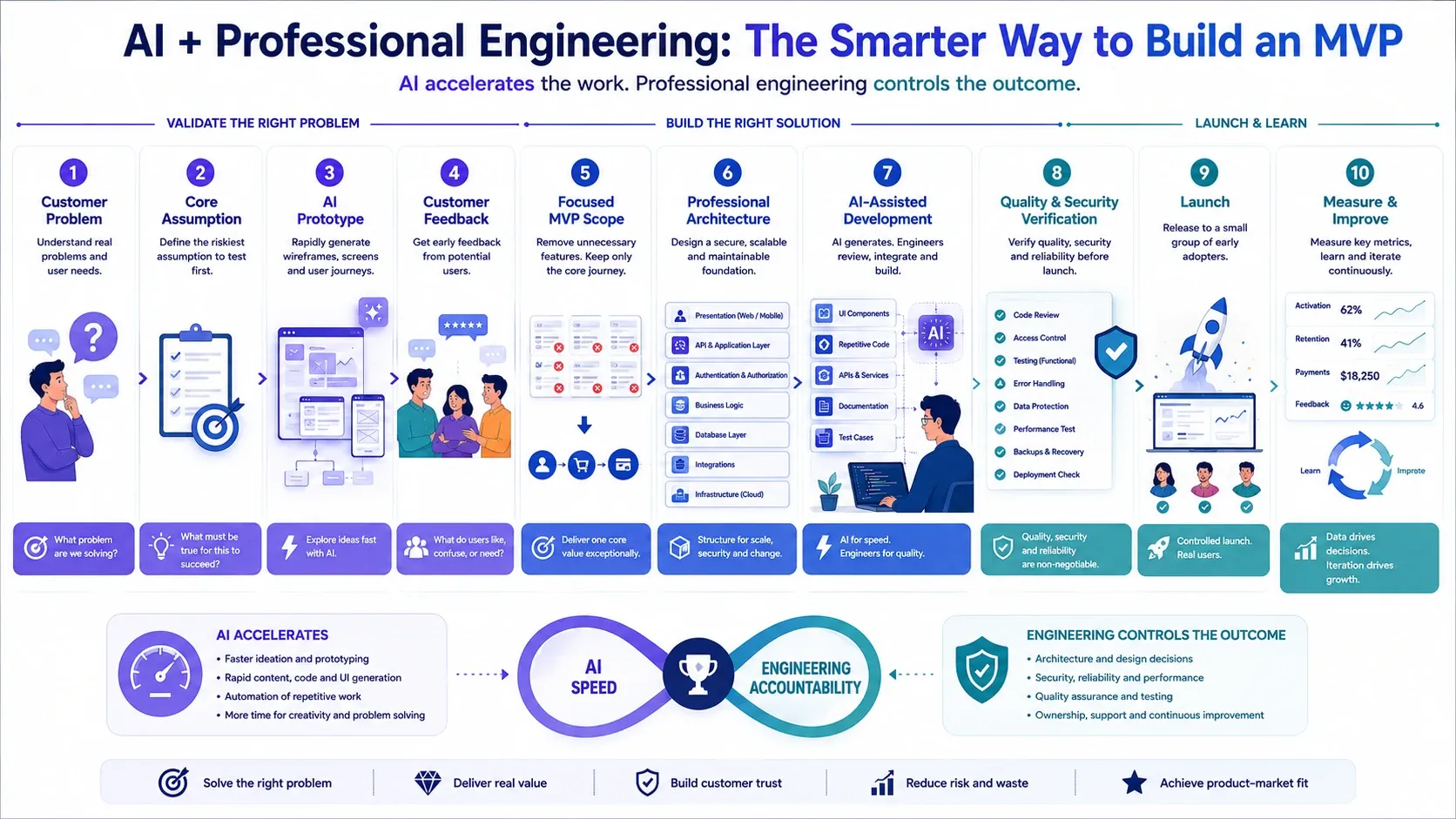
1. Define the customer problem
The process begins with a specific customer group and a clearly understood problem.
AI can assist with research, idea organization, and initial documentation, but the founder and product team must validate the problem through real customer conversations and market evidence.
2. Identify the core assumption
The team determines what must be proven before further investment is justified.
This may involve testing whether customers will complete a transaction, adopt a workflow, pay for a service, return regularly, or replace their current solution.
3. Create an AI-accelerated prototype
AI tools can rapidly create wireframes, user journeys, interface concepts, and interactive demonstrations.
Potential customers can then review the proposed experience and provide feedback before full implementation begins.
4. Define the focused MVP scope
Product specialists convert the validated concept into a controlled feature set with clear requirements and acceptance criteria.
Only the functionality required to deliver the core value and test the main business assumption should enter the first release.
5. Design the technical foundation
Professional engineers select the technology, database structure, integrations, access controls, deployment environment, and application architecture.
The architecture should support the validation audience while providing a sensible path for future growth.
6. Develop with AI assistance
AI accelerates interface development, common application logic, documentation, test generation, and repetitive coding tasks.
Engineers review, correct, integrate, and optimize the generated output.
7. Verify quality and security
The MVP is tested for:
- Functional accuracy
- User permissions
- Data protection
- Integration reliability
- Error handling
- Performance
- Browser and device compatibility
- Backup and recovery requirements
- Core security risks
- Acceptance criteria
AI can assist with testing, but experienced professionals remain responsible for determining whether the product is ready to launch.
8. Launch and measure
The MVP is released to a controlled group of early users.
Analytics and customer feedback are used to measure activation, successful journey completion, retention, referrals, willingness to pay, and other relevant validation signals.
9. Improve according to evidence
AI can help the team develop and test improvements faster. However, new features should be prioritized according to real customer behaviour rather than assumptions.
This keeps the product focused and prevents unnecessary complexity.
When Is the Hybrid Approach Most Valuable?
AI-accelerated professional engineering is particularly valuable when:
- The MVP must be delivered quickly.
- Real customers will use the application.
- The product stores personal or business information.
- Payments or financial transactions are involved.
- Different user roles require controlled permissions.
- Multiple external systems must be integrated.
- Reliability can affect customer trust.
- The product will continue evolving after validation.
- The founder does not have an internal technical team.
- An existing AI prototype must be prepared for production.
For very early idea exploration, an AI-generated prototype may be sufficient. However, once the product moves from demonstration to real-world use, professional verification becomes increasingly important.
Can an Existing AI Prototype Become the MVP?
Yes. An existing AI-built prototype does not automatically need to be discarded.
A professional technical assessment can determine which parts should be retained, improved, refactored, or rebuilt.
The prototype may be reusable when:
- The complete source code is accessible.
- The founder owns the code and associated accounts.
- The selected technology is suitable.
- The application structure is understandable.
- Dependencies are supported and trustworthy.
- Security controls can be added effectively.
- The core architecture supports the planned MVP.
A controlled rebuild may be more efficient when the prototype relies on insecure workarounds, unsuitable technology, poor database structures, unavailable source code, unreliable permissions, or highly duplicated logic.
The decision should be based on technical evidence rather than a general assumption about AI-generated software.
Efficiency Without Sacrificing Sustainability
The fastest way to produce a demonstration is not necessarily the fastest way to build a sustainable product.
If a team launches unverified code and later spends months repairing security problems, replacing the architecture, or rewriting essential features, the apparent initial saving may disappear.
The hybrid approach creates efficiency across the complete product lifecycle:
- Faster prototyping
- Shorter development cycles
- Lower repetitive development effort
- Earlier customer feedback
- Reduced unnecessary scope
- Better technical decisions
- Fewer expensive corrections
- Easier future development
This makes it more sustainable than relying entirely on unmanaged AI generation or unnecessarily slow manual development.
Final Thoughts
AI and professional engineering should not be treated as competing approaches.
AI provides speed, rapid experimentation, automation, and development efficiency. Professional engineering provides product judgment, architecture, security, quality assurance, maintainability, and accountability.
Combining them creates a stronger MVP-development model.
Founders can reach the market faster, control initial costs, test their ideas with real customers, and retain a reliable technical foundation for future growth.
The future of MVP development is therefore not AI instead of engineers. It is AI-accelerated engineering led by experienced professionals.
MVPHUB combines AI-assisted development with professional product strategy, engineering, QA, and security review to deliver focused, production-ready MVPs faster and more sustainably.
💡 Turn your idea or AI-built prototype into a secure, scalable, and market-ready MVP.
Validate your idea with MVPHUB’s AI-accelerated professional engineering approach.
💡 Have a software idea?
Receive a focused MVP scope, fixed price and achievable delivery timeline.
Book a free consultation with MVPHUBFrequently Asked Questions
Is the hybrid approach more expensive than building entirely with AI?
It may require a higher initial investment than an unmanaged AI-built prototype. However, professional oversight helps prevent security issues, technical debt, unreliable functionality, and expensive redevelopment.
Does professional engineering make AI development slower?
Not necessarily. Engineers can use AI to accelerate development while concentrating their effort on architecture, business logic, security, testing, and other high-value decisions.
Can AI-generated code be used in a production-ready MVP?
Yes, provided it is reviewed, tested, secured, and integrated appropriately by experienced professionals.
Will the MVP be scalable?
The MVP should support its expected validation audience and provide a practical path for growth. It does not need expensive infrastructure designed for millions of users before demand has been proven.
Why is the hybrid approach more sustainable?
It combines rapid delivery with maintainable architecture, verified code, technical documentation, testing, security controls, and accountable post-launch support.
