
Can You Build an MVP Without a Technical Co-Founder?
You have identified a meaningful problem, spoken with potential customers, and developed an idea for an application. However, you cannot write code and you do not have a technical co-founder.
Does that mean your startup cannot move forward?
No. You can build and launch an MVP without having a technical co-founder on your founding team. No-code platforms, AI-assisted development tools, freelancers, and specialized MVP-development companies have made software creation more accessible than ever.
However, being able to produce an application is not the same as building the right product reliably. A non-technical founder must still define the problem, control the product scope, select the right development approach, and protect the business from technical and commercial risks.
What Is the Role of a Technical Co-Founder?
A technical co-founder is not simply a developer who writes code. They normally share responsibility for:
- Translating the business vision into a technical product
- Selecting the technology and architecture
- Managing development priorities
- Evaluating technical risks
- Protecting product quality and security
- Building or managing the engineering team
- Supporting the product as the business grows
This can be highly valuable, especially when technology is the startup’s central competitive advantage.
However, you should not select a co-founder only because you need someone to build the first version of your application. A co-founder is a long-term business partner who may receive significant ownership and influence over the company.
The right co-founder should share your vision, commitment, values, risk tolerance, and long-term goals not simply possess programming skills.
What Can a Non-Technical Founder Contribute?
Not knowing how to code does not mean you have nothing to contribute to product development.
During the MVP stage, some of the founder’s most important responsibilities are non-technical:
- Understanding the customer problem
- Selecting a specific target audience
- Interviewing potential users
- Defining the product’s core value
- Prioritizing essential features
- Recruiting early adopters
- Testing pricing and demand
- Selling the product
- Collecting and interpreting feedback
A technically impressive application will still fail if it solves an unimportant problem. Your understanding of the customer, industry, workflow, or business model may be more valuable during early validation than your ability to program the product yourself.
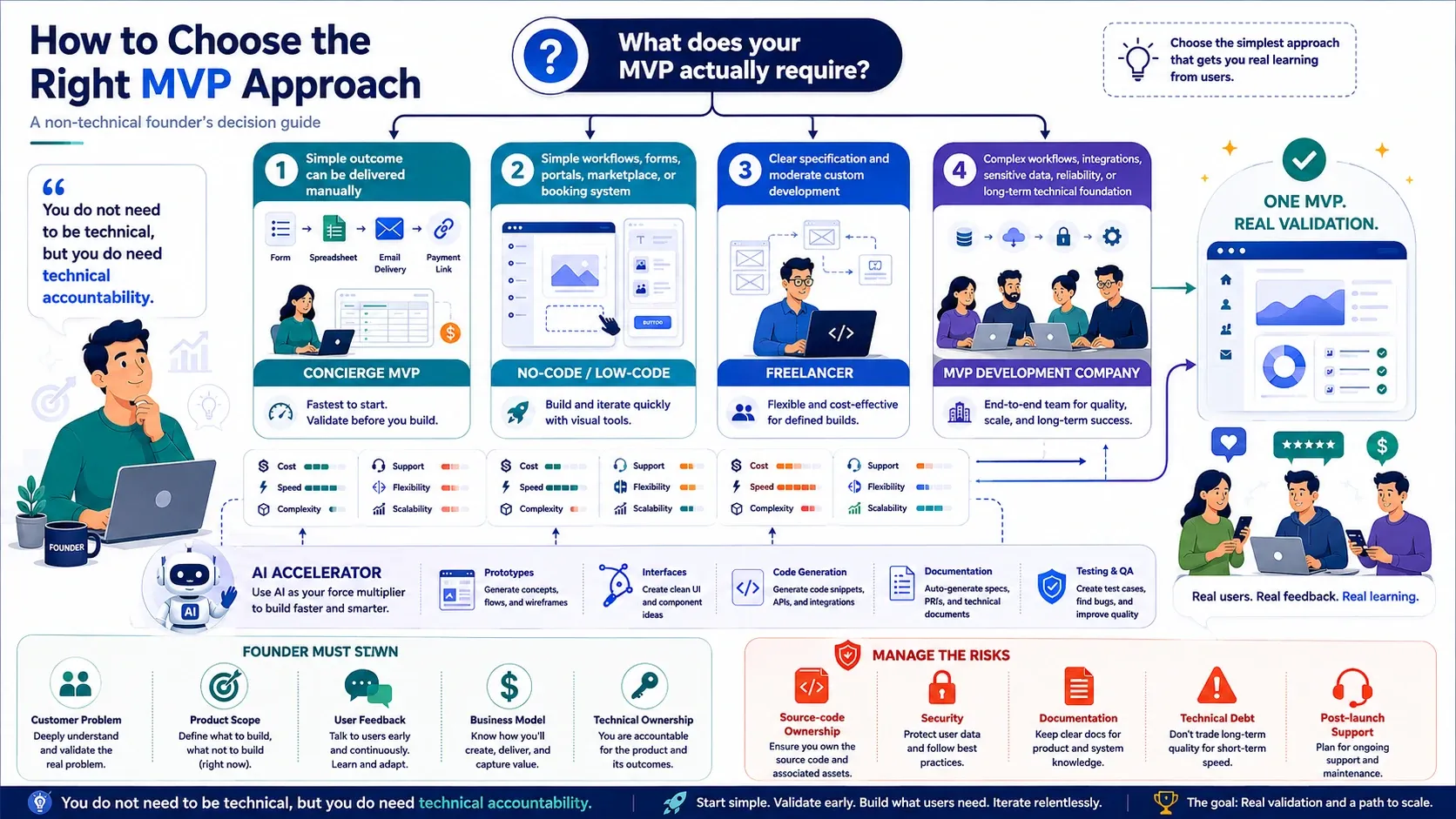
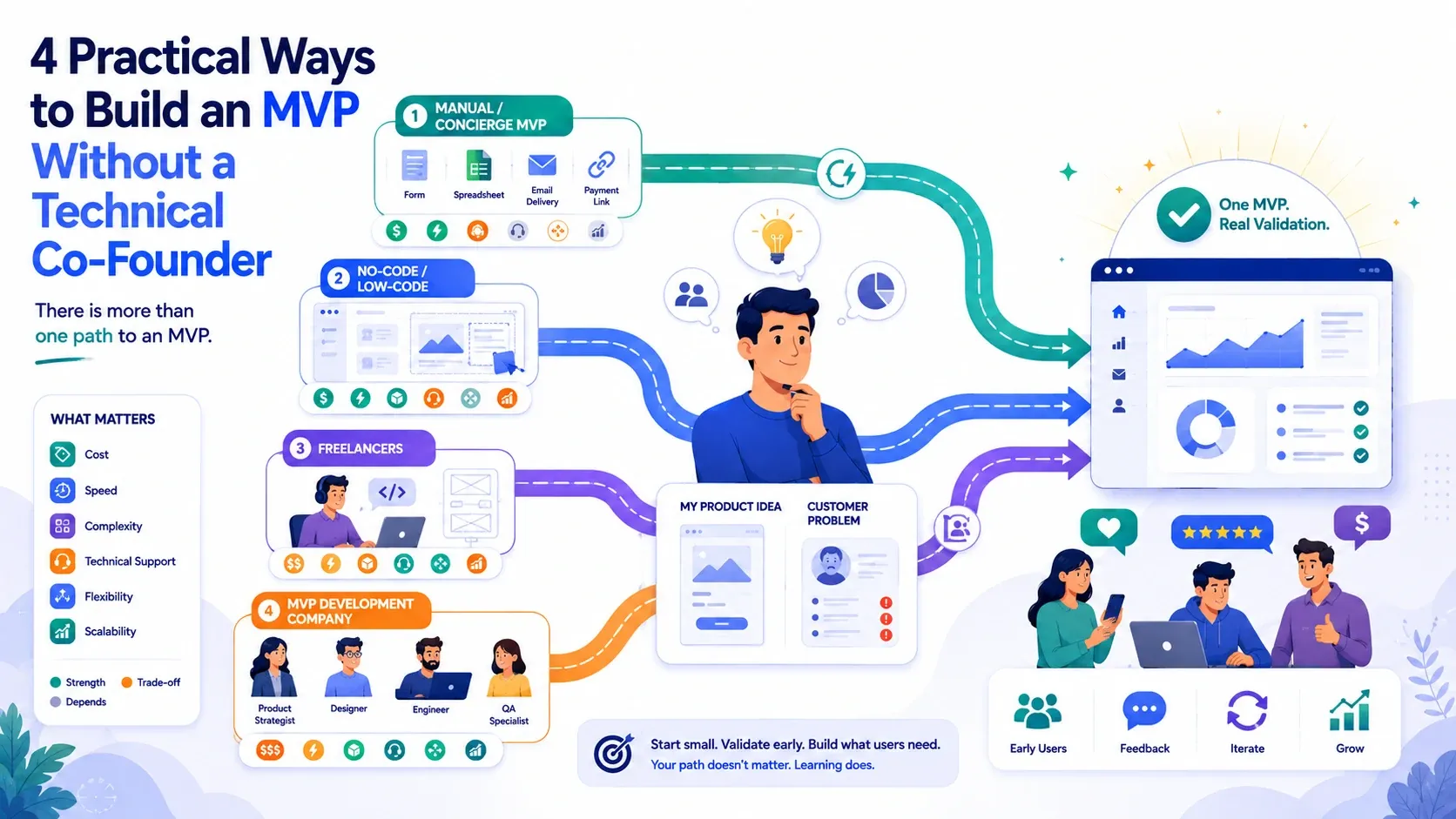
Four Ways to Build an MVP Without a Technical Co-Founder
1. Start with a manual or concierge MVP
Your first MVP may not need extensive software.
A concierge MVP delivers the proposed service manually while presenting it to customers as a structured experience. For example, before developing an automated recommendation platform, you could collect customer information through a form, prepare recommendations manually, and deliver them through email or a basic portal.
This helps test whether customers value the outcome before you invest in automation.
A landing page, waiting list, manual service, spreadsheet, and payment link may be enough to test:
- Customer interest
- Willingness to provide information
- Demand for the proposed outcome
- Pricing
- Repeat usage
- Willingness to pay
This approach is inexpensive, but it only works when the product’s core value can be delivered manually.
2. Use no-code or low-code platforms
No-code tools allow founders to build websites, workflows, databases, marketplaces, internal tools, and basic applications using visual interfaces.
Stripe’s startup checklist recommends using tools such as Bubble or Webflow to launch a simple digital product and measure whether customers genuinely engage with it.
No-code can be suitable for:
- Landing pages
- Customer portals
- Directories
- Booking systems
- Simple marketplaces
- Internal workflow tools
- Basic subscription products
However, the limitations should be considered. A no-code platform may become difficult to maintain when the product requires complex business rules, specialized integrations, advanced security, high performance, or significant customization.
Before selecting a platform, investigate data ownership, export options, vendor pricing, scalability, integrations, and the difficulty of migrating to another technology later.
3. Work with freelancers
A capable freelance developer or small freelance team can build an MVP without requiring you to offer company equity.
This approach may provide flexibility and lower initial costs. It is most effective when you already have:
- A clearly defined product scope
- Wireframes or user journeys
- Written acceptance criteria
- A realistic delivery plan
- Someone capable of reviewing technical quality
The main risk is that freelancers may concentrate only on the assigned development tasks. Product strategy, architecture, testing, deployment, documentation, and long-term support may remain your responsibility.
Avoid selecting a developer solely based on the lowest quotation. Review relevant past work, communication ability, availability, development process, testing practices, and willingness to transfer the complete source code and documentation.
4. Partner with an MVP-development company
A specialized product-development company can provide the capabilities normally distributed across several roles, including product strategy, UI/UX design, software engineering, quality assurance, deployment, and technical guidance.
This approach generally costs more than building independently with no-code tools, but it may be more suitable when:
- Customers will use the MVP in a real environment.
- The product handles personal or financial information.
- Multiple user roles or complex workflows are involved.
- External systems must be integrated.
- Reliability and security affect market feedback.
- You want a foundation that can be expanded after validation.
The key is to choose a partner that understands MVP development. A traditional development company may simply build every feature you request. A good MVP partner should challenge unnecessary functionality and help identify the smallest reliable product capable of testing your central assumption.
Can AI Build Your MVP?
AI-assisted development tools can generate interfaces, database structures, APIs, tests, and application code considerably faster than traditional manual development.
This creates valuable opportunities for non-technical founders. AI can help you:
- Explore product concepts
- Generate early prototypes
- Create landing pages
- Test different workflows
- Accelerate repetitive development
- Prepare technical documentation
However, AI-generated software still requires judgment and verification.
Code that appears functional may contain security weaknesses, inefficient database queries, fragile integrations, inconsistent logic, or dependencies that become difficult to maintain. A non-technical founder may not recognize these problems until customers begin using the product.
AI should therefore be treated as an accelerator, not as a replacement for product decisions, architecture, security review, quality assurance, and accountable technical oversight.
Risks Non-Technical Founders Should Manage
Losing ownership of the product
Your contract should clearly confirm that your company owns the source code, designs, database structures, documentation, accounts, and custom intellectual property after payment.
Important services such as hosting, domains, source-code repositories, analytics, and third-party integrations should ideally be registered under accounts controlled by your company.
Building more than the market requires
A development partner cannot validate the business on your behalf. Without customer research and clear priorities, you may still build an expensive product that nobody needs.
Begin with one customer group, one important problem, and one core user journey.
Receiving an unsupported application
Clarify what happens after launch. Confirm whether the provider includes bug fixes, monitoring, backups, deployment support, technical documentation, and knowledge transfer.
Creating technical debt
An MVP does not need infrastructure designed for millions of users. Nevertheless, it should have appropriate security, maintainable code, reliable data handling, and a practical path for future development.
“Minimum” should describe the scope—not the engineering standard.
When Do You Need a Technical Co-Founder?
You may not need a technical co-founder to validate and launch the first MVP. However, long-term technical leadership becomes increasingly important when:
- Proprietary technology is the main competitive advantage.
- The product depends on advanced AI or complex algorithms.
- Security, compliance, or performance requirements are substantial.
- The company needs to recruit and manage an internal engineering team.
- Technical decisions strongly influence the business strategy.
- Continuous product innovation is required.
The practical distinction is this: you may not need a technical co-founder to test the opportunity, but a growing software company will eventually require strong and accountable technical leadership. That leadership could come from a co-founder, a senior hire, an experienced product partner, or a fractional CTO.
A Practical Development Process
A non-technical founder can follow this sequence:
- Define the customer and problem clearly.
- Validate the problem through customer interviews.
- Identify the most important business assumption.
- Map the shortest journey that delivers value.
- Create wireframes or a clickable prototype.
- Choose between no-code, freelancers, or a development partner.
- Agree on the scope, timeline, cost, ownership, and acceptance criteria.
- Build and test the focused MVP.
- Launch it to a controlled group of early users.
- Measure activation, retention, referrals, and willingness to pay.
- Decide whether to improve, pivot, expand, or stop.
Final Thoughts
You do not need to wait indefinitely for a technical co-founder before testing your startup idea.
A non-technical founder can build an MVP through manual validation, no-code platforms, AI-assisted tools, freelancers, or a specialized development partner. The right approach depends on the product’s complexity, budget, security needs, and long-term plans.
Your job is not necessarily to write the code. Your job is to ensure that the team builds the smallest reliable product capable of testing a real customer need.
MVPHUB helps non-technical founders define, design, and launch production-ready MVPs with clear scope, accountable engineering, and no unnecessary complexity.
💡 Have an app idea but no technical co-founder?
Stop waiting and start validating your business.
💡 Have a software idea?
Receive a focused MVP scope, fixed price and achievable delivery timeline.
Book a free consultation with MVPHUBFrequently Asked Questions
Do I need to learn coding before starting an MVP?
No. Basic technical knowledge can help you communicate and evaluate decisions, but you can validate and develop an MVP without becoming a software engineer.
Is no-code suitable for every MVP?
No. It works well for many straightforward workflows, but highly customized, regulated, data-intensive, or technically complex products may require custom engineering.
Should I offer equity to a developer?
Not automatically. Equity is normally appropriate for a genuine long-term co-founder who shares business risk and responsibility—not simply as payment for completing development work.
How can I protect my idea when outsourcing development?
Use appropriate confidentiality and intellectual-property agreements, control critical accounts, and ensure the contract clearly transfers ownership of the deliverables. However, execution and customer insight generally provide stronger protection than secrecy alone.
Can an outsourced MVP attract investors?
Yes. Investors can evaluate a working MVP, customer traction, revenue, retention, and the founder’s ability to execute. You should also be able to explain who owns the technology and how future development will be managed.
