
10 Common MVP Development Mistakes Founders Should Avoid
Building a Minimum Viable Product (MVP) can help you test a product idea before committing to a much larger development roadmap. But simply calling a first release an “MVP” does not automatically make it focused or useful.
An MVP is the smallest usable version of a product that delivers meaningful value to a defined customer group while allowing you to test important business assumptions with real users. The goal is not to build a cheap or incomplete product. It is to learn before investing heavily in functionality that customers may not need.
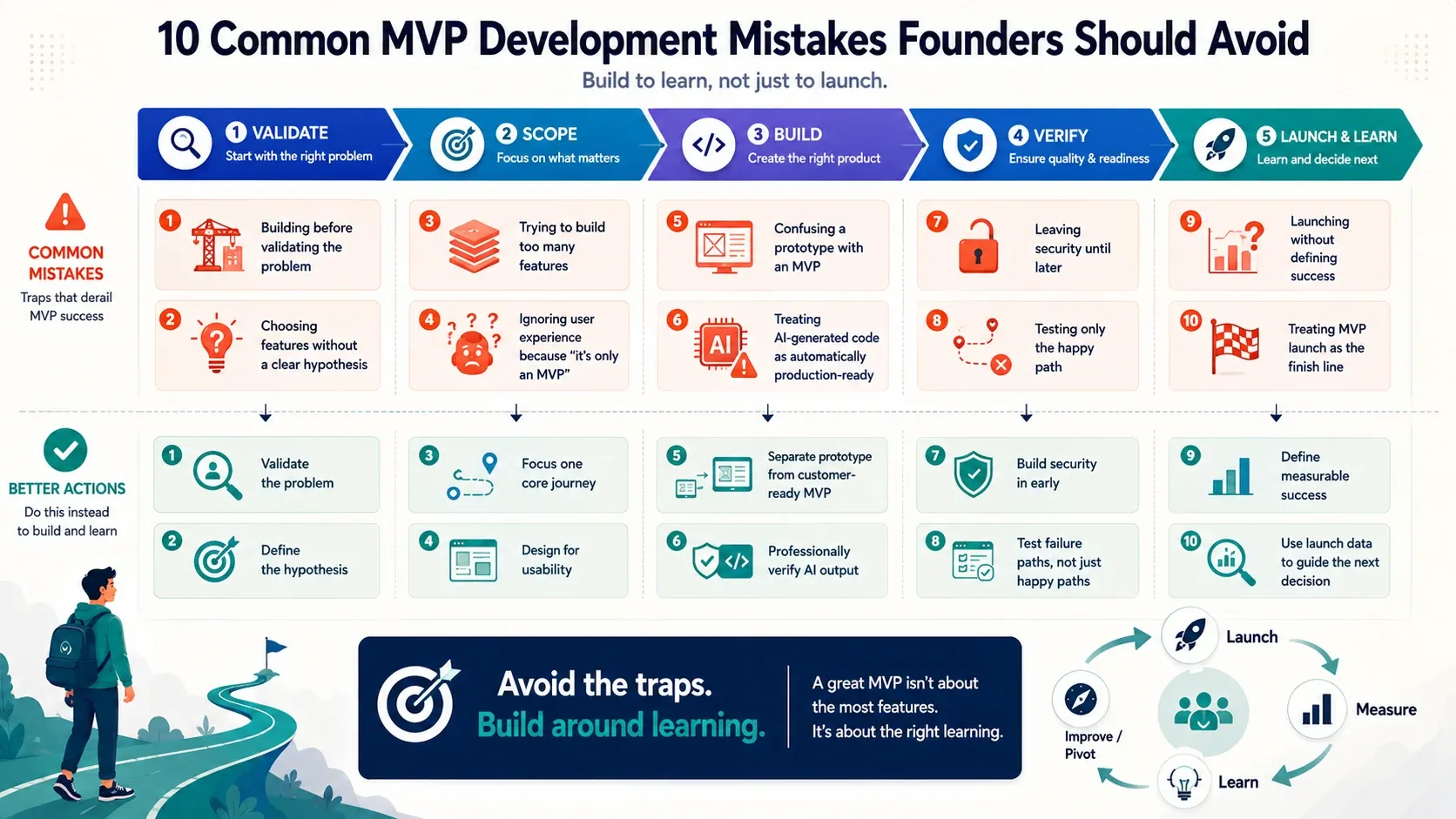
Here are 10 common MVP development mistakes founders should avoid.
1. Building Before Validating the Problem
One of the biggest mistakes is starting development simply because an idea sounds promising.
Before building, establish who experiences the problem, how they solve it today, and why your proposed solution might be valuable.
Useful evidence can come from customer interviews, a committed pilot customer, a clearly defined operational problem, or a measurable product hypothesis. MVPHUB’s product validation principles recommend seeking this type of evidence before extensive development begins.
The first objective is to validate the problem, not prove that your original idea was correct.
2. Trying to Build Too Many Features
Feature creep is one of the most common MVP mistakes.
Founders naturally think about everything their future product could offer: dashboards, notifications, integrations, AI features, advanced reporting, multiple user roles, referral programs, and more.
But an MVP should be intentionally limited.
Identify the single essential user journey and prioritize the functionality needed to complete it. Features that do not support that journey or test an important assumption can usually move to a later roadmap.
A focused MVP helps you launch earlier and learn what users actually value.
3. Confusing a Prototype With an MVP
A clickable Figma design, no-code demonstration, or AI-generated application can look impressive without being ready for real customers.
A prototype is primarily designed to demonstrate or explore an idea. It may use mock data and have limited reliability.
An MVP, however, is intended to test a business assumption with real users. Its essential workflow should be usable and appropriately verified for the environment in which it will operate.
Visible functionality alone does not prove that authentication, permissions, data handling, error scenarios, or deployment are ready.
4. Choosing Features Without a Clear Hypothesis
Every important MVP feature should have a reason to exist.
Suppose you are building an appointment marketplace. Your key hypothesis might be:
Customers will use the platform to find an available provider and make a booking.
Your MVP should therefore focus on enabling and measuring that journey.
If you cannot explain what you are trying to learn from a feature, consider whether it belongs in the first release.
5. Ignoring User Experience Because “It’s Only an MVP”
Minimum does not mean difficult to use.
Users still need to understand what the product does, navigate the core workflow, enter information, and complete the intended action without unnecessary confusion.
You do not necessarily need elaborate animations, dozens of screens, or extensive customization. But the essential experience should be clear enough that poor usability does not undermine your validation.
At MVPHUB, the standard engagement flow puts design before development, with wireframes or UI designs reviewed within the approved scope.
6. Treating AI-Generated Code as Automatically Production-Ready
AI-assisted development can significantly accelerate exploration, prototyping, repetitive development work, and iteration. However, speed should not be confused with readiness.
AI-generated applications can still contain weak access controls, exposed secrets, poor data models, missing tests, inconsistent code, dependency issues, and weak failure handling.
The better approach is to use AI as an accelerator while maintaining professional responsibility for architecture, security, QA, maintainability, and deployment.
AI-accelerated should still be expert-verified.
7. Leaving Security Until Later
Security should not suddenly appear on the roadmap after the MVP becomes successful.
If your first release handles user accounts, payments, business information, or personal data, appropriate security controls should be considered from the beginning.
Depending on the product, this can include authentication, authorization, secrets management, secure data handling, session management, and access permissions.
The appropriate level depends on context. A controlled pilot and a public platform handling sensitive information will have very different security and operational requirements.
8. Testing Only the Happy Path
It is easy to test an application by following exactly the journey developers expect users to follow.
Real users rarely behave that predictably.
What happens when a payment fails? What if someone submits invalid information, loses their connection, tries to access something they are not authorized to view, or encounters a failed third-party integration?
MVPHUB’s readiness framework recommends considering invalid inputs, failure paths, expired sessions, unauthorized access, failed integrations, server errors, and similar scenarios when assessing an application for real-user use.
Testing these situations can uncover problems before customers do.
9. Launching Without Defining Success
Getting an MVP live is a milestone, not the final objective.
Before launch, determine what evidence would make the MVP successful.
Depending on your business model, that could include registrations, completed bookings, transactions, subscriptions, core-journey completion, repeat usage, customer feedback, or reduced manual work.
The metric should connect directly to the hypothesis you are testing.
Otherwise, you may finish your pilot with plenty of activity but little evidence about whether you should invest further.
10. Treating MVP Launch as the Finish Line
An MVP exists to generate evidence for your next decision.
After launch, collect quantitative and qualitative feedback. Identify where users struggle, which functionality they value, and whether the original problem and solution assumptions still hold.
Then decide whether to improve the product, add features, change direction, scale, reposition—or stop.
MVPHUB’s recommended post-launch approach is to use feedback and core-hypothesis measurements to prioritize improvements and determine the next phase.
Build Your MVP Around Learning
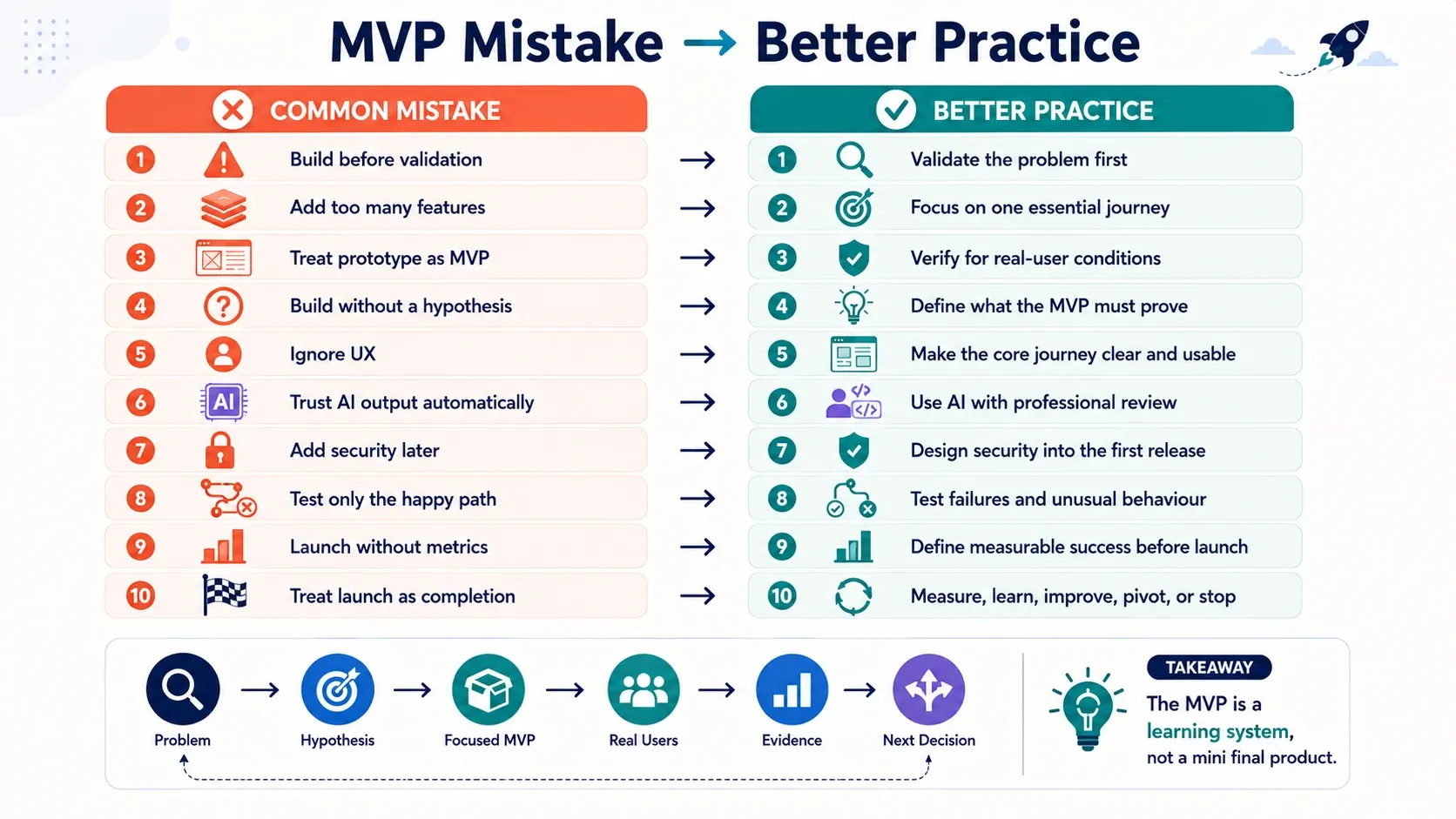
Most MVP development mistakes come from treating an MVP as a smaller version of the final product rather than a controlled way to learn.
Start with a real customer problem. Define your target user and core hypothesis. Reduce the scope to one essential journey. Build it to an appropriate level of quality and security, measure how real users respond, and use that evidence to decide what comes next.
The best first release is not necessarily the one with the most features.
It is the one that helps you learn what is worth building next.
🚀 Ready to find out what your MVP really needs?
Avoiding costly MVP mistakes starts with getting the scope, validation strategy, and essential user journey right from day one.
Whether you have an early-stage idea, Figma design, no-code prototype, or AI-built application, MVPHUB can help you define the right first release and turn it into a focused, professionally verified, market-testable MVP.
Book a free consultation with MVPHUBFrequently Asked Questions
What are the most common MVP development mistakes?
Common mistakes include skipping problem validation, adding too many features, confusing a prototype with an MVP, ignoring security and UX, inadequate testing, and launching without measurable success criteria.
Why do founders put too many features in an MVP?
Founders often have a clear vision for the eventual product and naturally want to include everything that could make it competitive. However, the first release should prioritize functionality needed to test the core business assumption.
Should I validate my idea before developing an MVP?
Yes. Validation should establish that you are addressing a meaningful customer or business problem. Customer interviews, pilot commitments, operational evidence, and measurable hypotheses can provide useful signals before significant development investment.
Can an AI-generated app be used as an MVP?
Potentially, but an application should not be considered ready for real customers solely because its screens and basic functionality work. Architecture, authentication, authorization, security, failure handling, testing, deployment, and maintainability may require professional review.
Does an MVP need to be production-ready?
Readiness depends on the intended environment. A limited pilot does not necessarily require the same engineering, compliance, availability, and operational controls as a large public platform. However, an MVP should be reliable and appropriately verified for the real-user environment in which it will be tested.
What should happen after an MVP launch?
Measure the core hypothesis, gather feedback, identify problems and opportunities, and use that evidence to determine whether to iterate, add features, scale, reposition, or stop. An MVP is the beginning of a learning cycle rather than the end of product development.
