
How Many Customer Interviews Are Needed Before an MVP?
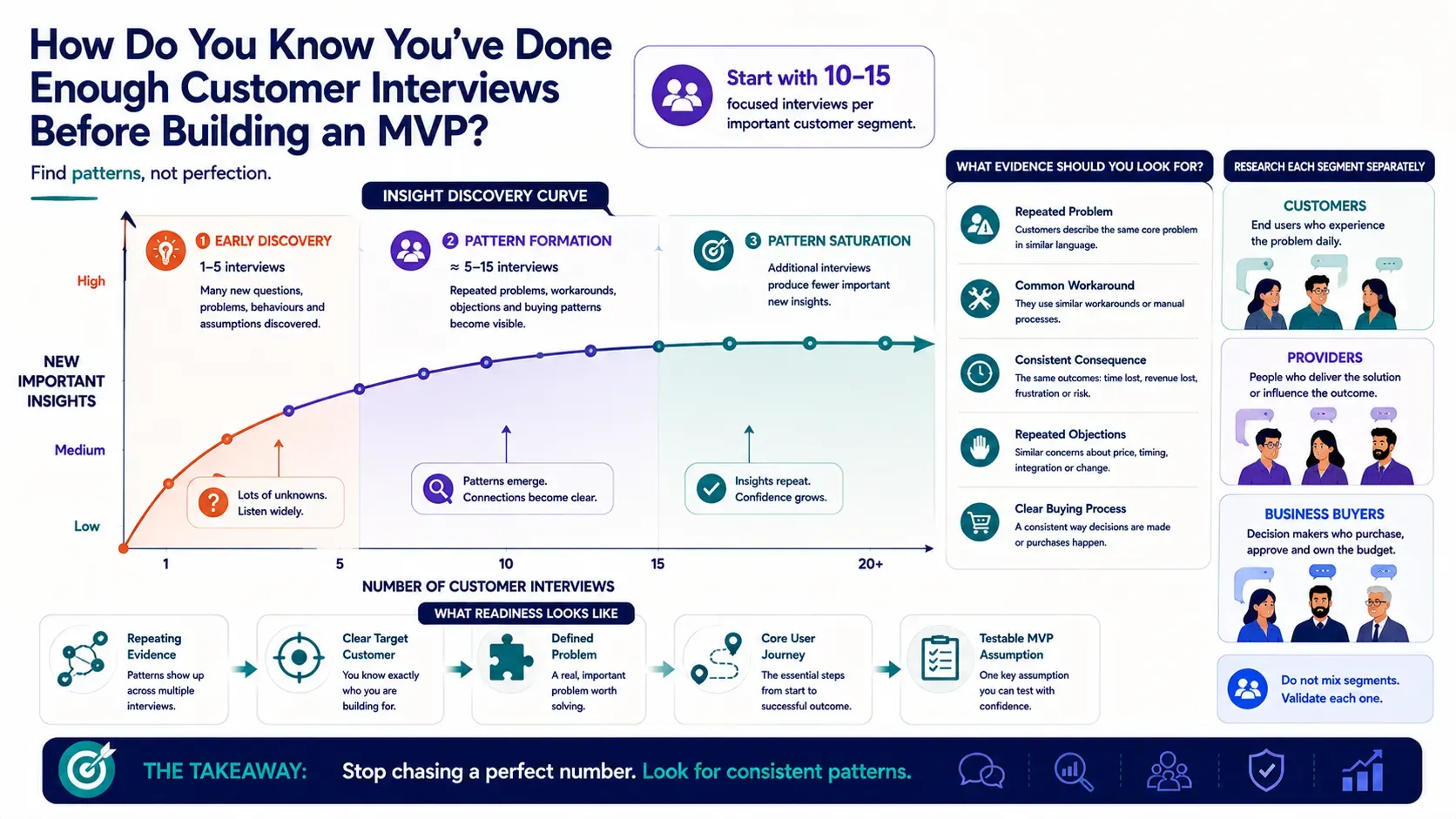
There is no universal number of customer interviews required before building an MVP. However, 10 to 15 focused interviews per customer segment can provide a practical starting point.
Many founders may need approximately 15 to 30 interviews in total before they identify reliable patterns. More may be necessary when the product serves multiple customer groups, operates in a complex industry, or involves an unfamiliar problem.
The goal is not to reach an arbitrary number. It is to reach pattern saturation, the point where additional interviews produce fewer important new insights.
Start With 10 to 15 Interviews
For a narrowly defined customer segment, begin with 10 to 15 relevant participants.
This may be enough to discover:
- Whether the problem occurs repeatedly
- How customers currently solve it
- Which frustrations matter most
- How frequently does the problem occur
- What customers already spend
- Who makes the purchasing decision
- What could prevent adoption
After the first interviews, review the findings. If every conversation reveals completely different needs, your segment may be too broad or your understanding of the problem may still be weak.
Interview Each Customer Segment Separately
Do not combine different customer groups and treat their answers as one dataset.
For example, a marketplace may involve:
- Customers
- Service providers
- Administrators
- Business purchasers
Each group has different goals, problems, incentives, and adoption barriers. Conduct a separate set of interviews for every segment that is essential to the MVP.
A two-sided marketplace may therefore require 10 to 15 interviews with customers and another 10 to 15 with providers.
Quality Matters More Than Quantity
Thirty interviews with unsuitable participants are less valuable than ten conversations with people who genuinely experience the problem.
Prioritize participants who:
- Match the intended customer profile
- Have recently experienced the problem
- Currently use an alternative or workaround
- Influence or make purchasing decisions
- Can describe real past behaviour
- Have a practical reason to solve the problem
Friends and colleagues may provide convenient feedback, but they can be overly supportive and may not represent the market.
Ask About Behaviour, Not Opinions
Avoid asking:
- Do you like my idea?
- Would you use this app?
- Do you think this could be successful?
- How much would you hypothetically pay?
These questions encourage speculation and polite answers.
Instead, ask:
- When did you last experience this problem?
- What happened?
- How did you solve it?
- How often does it occur?
- What does the current process cost?
- Which tools have you tried?
- Who approves a new solution?
- Have you paid for an alternative?
- What prevented previous solutions from working?
Evidence from past behaviour is generally more reliable than predictions about future behaviour.
How Do You Know When You Have Interviewed Enough?
You may be approaching sufficient customer discovery when:
- The same problems appear repeatedly.
- Customers describe similar workarounds.
- The problem has a consistent consequence.
- Purchasing roles are becoming clear.
- Common objections repeat.
- New interviews provide fewer major surprises.
- You can describe the target customer precisely.
- You can define one valuable user journey.
- You know which assumption the MVP must test.
You do not need complete certainty. You need enough consistent evidence to design a focused and measurable experiment.
When Should You Conduct More Interviews?
Continue interviewing when:
- Participants describe unrelated problems.
- Your target customer remains unclear.
- You are exploring several industries.
- The buyer and user are different people.
- The product requires major behavioural change.
- Customers express interest but show no urgency.
- Willingness to pay remains uncertain.
- The product operates in a regulated industry.
- Several stakeholders influence purchasing.
- Your first interviews came mostly from personal contacts.
Enterprise products may require conversations with users, managers, IT teams, security teams, procurement, and budget owners before the buying process is properly understood.
Turn Interview Findings Into Evidence
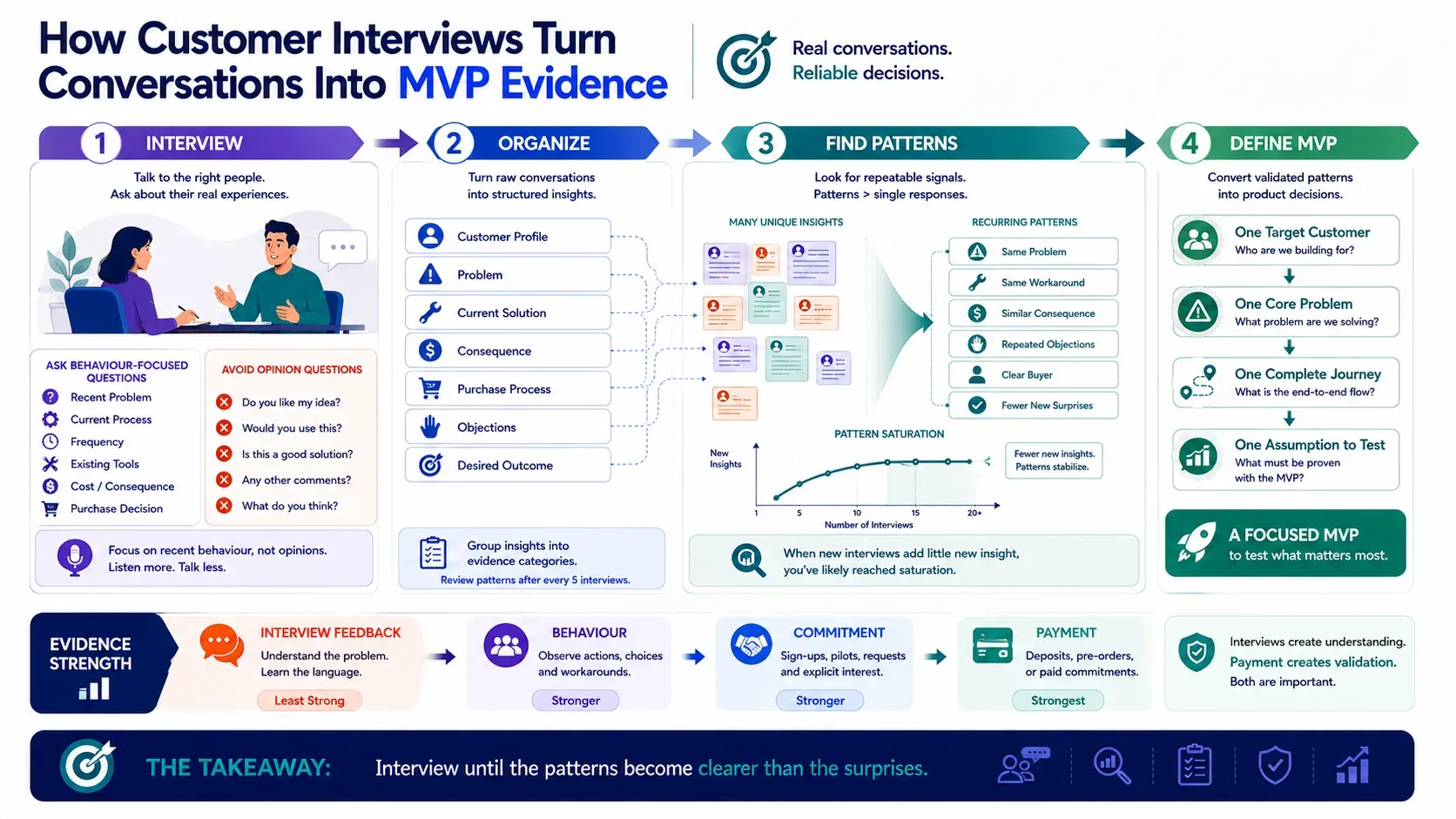
After every five interviews, organize the findings into a simple table.
| Evidence area | What to record |
|---|---|
| Customer profile | Role, industry, size and behaviour |
| Problem | Frequency, severity and recent examples |
| Current solution | Tools, workarounds and alternatives |
| Consequence | Time, money, risk, or missed opportunity |
| Purchase process | Buyer, budget, and approval steps |
| Objections | Trust, price, security, and switching concerns |
| Desired outcome | What meaningful improvement looks like |
Do not count how many people “liked” the idea. Count repeated problems, existing spending, behavioural evidence, and genuine commitments.
Interviews Are Only the First Validation Step
Customer interviews help validate the problem, but they do not prove that customers will use or pay for your product.
Strengthen the evidence through:
- Landing-page conversions
- Prototype testing
- Waitlist registrations
- Manual service delivery
- Pilot applications
- Letters of intent
- Deposits
- Pre-orders
- Paid pilots
A useful evidence progression is:
Interview feedback → Behaviour → Commitment → Payment
The further customers move along this path, the stronger your validation becomes.
Continue Interviews After Launch
Customer discovery should not stop when development begins.
After launching the MVP, interview:
- Users who completed the core journey
- Users who abandoned onboarding
- Paying customers
- Customers who cancelled
- Prospects who chose a competitor
- Users who repeatedly requested support
These conversations explain the behaviour shown in your product analytics and help prioritize future improvements.
Focus on Patterns, Not a Perfect Number
Begin with 10 to 15 interviews per important customer segment. Continue until the same problems, behaviours, objections, and desired outcomes repeat consistently.
The right number is the smallest sample that gives you enough reliable evidence to define one target customer, one core problem, and one focused MVP journey.
Turn Customer Insight Into a Focused MVP
MVPHUB helps founders convert customer research into clear product requirements and production-ready MVPs through strategic scoping, AI-accelerated delivery, and professional engineering. Book a free consultation with MVPHUB to turn your interview findings into an MVP scope built around real customer evidence.
Book a free consultation with MVPHUBFrequently Asked Questions
Are ten customer interviews enough before building an MVP?
Ten relevant interviews can reveal early patterns within a focused segment. Continue if important new insights are still appearing, or the findings remain inconsistent.
Should I interview potential customers or existing customers?
Interview people who genuinely match the target profile. Existing customers of a manual service or related offering can be particularly valuable because they have demonstrated relevant behaviour.
Can customer interviews prove that people will pay?
Not by themselves. Interviews help assess the problem and the buying process. Deposits, pre-orders, paid pilots, and actual purchases provide stronger payment evidence.
Should I show participants my product idea?
Begin by discussing their problem and current behaviour. Introduce the proposed solution later so it does not influence their initial answers.
How often should customer interviews continue after launch?
Conduct them regularly during early validation and whenever analytics reveal significant drop-offs, cancellations, support issues, or unexpected user behaviour.
