
How Long Does It Take to Build an MVP?
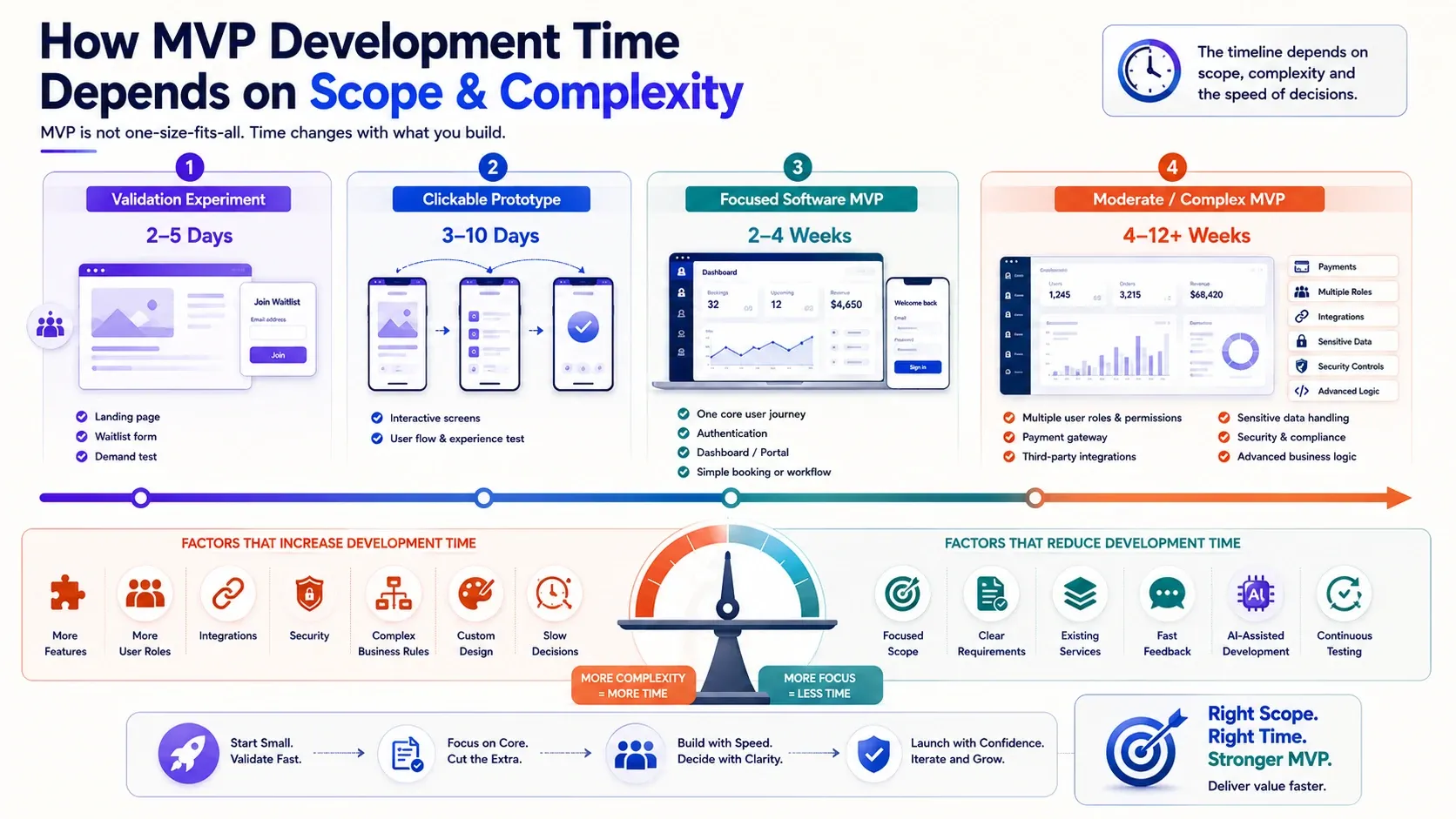
A focused software MVP can typically take 2 to 12 weeks to design, develop, test, and launch. The actual timeline depends on the product’s scope, technical complexity, number of user roles, integrations, security requirements, and how quickly decisions are made.
A simple MVP with one core customer journey may be developed in around two weeks. A product involving multiple roles, payments, complex integrations, sensitive data, or specialized business rules may require six weeks or longer.
The key is not simply asking how quickly you can build an MVP. Instead, the better question is: What is the smallest production-ready product that can test the business idea with real users?
AI-assisted development can make the MVP development process faster by supporting design, coding, testing, and documentation. However, professional engineering is still required to ensure the final product is secure, reliable, and ready for real customers.
Typical MVP Development Timelines
| MVP Type | Typical Timeline | Examples |
|---|---|---|
| Validation experiment | 2 - 5 days | Waitlist, demand test |
| Clickable prototype | 3 - 10 days | Investor demo, usability testing |
| Focused software MVP | 2 - 4 weeks | Booking tool, customer portal |
| Moderate-complexity MVP | 4 - 8 weeks | Payments, dashboards, multiple roles |
| Complex or regulated MVP | 8 - 16+ weeks | Fintech, healthcare, advanced AI |
These are planning ranges rather than fixed industry standards. Two products that appear similar can require different development timelines because of business rules, integrations, security, and operational requirements.
Can an MVP Be Built in Two Weeks?
Yes, two-week MVP development is possible when the scope is tightly controlled.
A two-week MVP is more realistic when:
- There is one clearly defined target customer.
- The product solves one specific problem.
- There is one primary user journey.
- Requirements are available before development starts.
- Decision-makers provide quick feedback.
- Integrations are limited and accessible.
- Complex administrative features are postponed.
- Existing technologies can support the solution.
- AI is used to accelerate suitable development tasks.
- Experienced engineers review the implementation.
For example, a simple booking MVP could allow a customer to create an account, view available services, select a time, make a booking, and receive confirmation. An administrator could then manage bookings.
Features such as loyalty programs, advanced reports, multiple payment providers, automated rescheduling, or AI recommendations can be introduced later.
This approach allows businesses to validate the core idea before investing heavily in the complete product.
What Does “Built” Actually Mean?
One important consideration when discussing the cost and timeline to build an MVP is understanding what “built” means.
A product can be considered built when a prototype exists, when the core workflow works, when it is deployed to a test environment, or when real customers can safely use it. These are very different milestones.
For MVPHUB, a production-ready MVP should have its agreed core journey developed, tested, deployed, and prepared for controlled customer use.
It should include appropriate authentication, permissions, data protection, validation, error handling, quality assurance, deployment configuration, monitoring, backups, and technical ownership.
Production-ready does not mean that every future feature has already been developed. It means the first release is reliable enough to generate meaningful customer feedback.
The Main Factors Affecting the MVP Timeline
1. MVP Scope Planning
Scope is one of the biggest factors affecting the MVP development timeline.
An MVP serving one customer group and one journey is usually much faster than a platform serving customers, vendors, administrators, support teams, and business partners.
Effective MVP scope planning should answer:
- Who is the first customer?
- What problem are we solving?
- What action should the customer complete?
- What assumption are we testing?
- Which features are essential?
- Which features can wait?
Reducing unnecessary scope allows teams to focus development resources on the outcome that matters most.
2. Requirement Clarity
Development becomes faster when requirements, business rules, user journeys, and acceptance criteria are clear.
A request such as “build a modern marketplace” creates unanswered questions around sellers, payments, cancellations, inventory, disputes, and approvals.
Resolving these questions early reduces rework and helps the team follow a more predictable MVP development process.
3. User Roles
Every additional user role introduces more screens, permissions, workflows, and testing requirements.
A platform with customers, administrators, vendors, and support agents therefore requires more development and testing than a single-user application.
4. Integrations
Third-party integrations can significantly affect the timeline.
Common examples include payment gateways, SMS and email services, accounting platforms, CRM systems, mapping services, social login, AI services, and existing enterprise systems.
The timeline can depend on API documentation, credentials, sandbox access, external testing, and third-party response times.
5. Design Requirements
A focused MVP does not need a huge design system, but it still requires a clear and usable experience.
The timeline can increase when the product requires many screens, complex dashboards, animations, custom illustrations, accessibility requirements, responsive designs, or multiple stakeholder approval rounds.
6. Security and Compliance
Security requirements are especially important for applications handling financial information, healthcare information, identity documents, confidential business records, or regulated workflows.
Security affects architecture, permissions, data storage, logging, integrations, and testing from the beginning.
7. Technical Complexity
Real-time communication, advanced search, machine learning, IoT, offline synchronization, complex scheduling, multi-tenant architecture, and legacy-system migration can extend the MVP development stages.
Whenever possible, these capabilities should be simplified without affecting the business assumption being tested.
8. Feedback and Decision-Making
Even an experienced development team can face delays when decisions remain unanswered.
Common causes include unapproved designs, changing business rules, conflicting stakeholder feedback, unavailable integration credentials, late content, and postponed acceptance testing.
Having one authorized product owner can significantly reduce these delays.
A Practical MVP Development Timeline
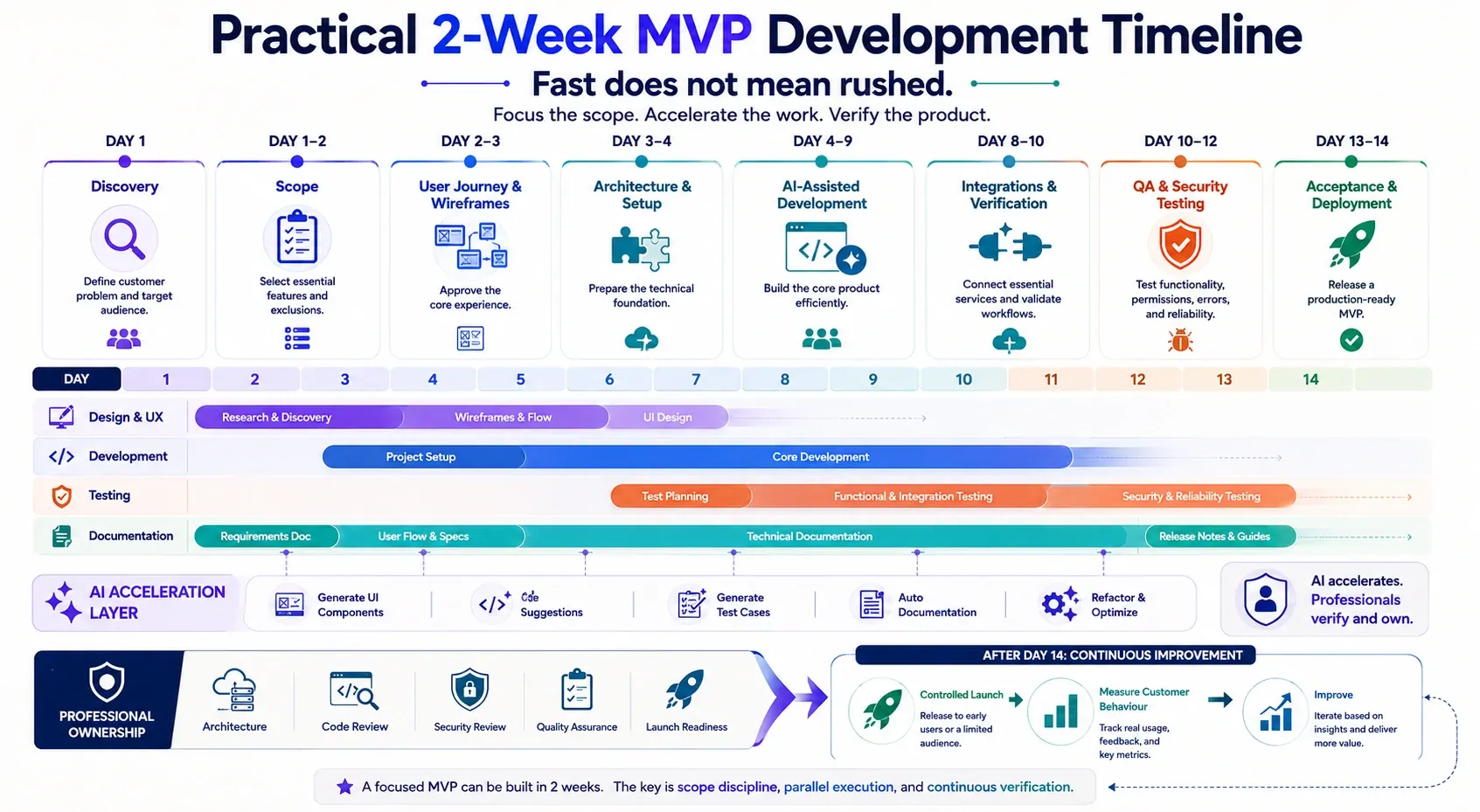
A focused two-week development plan could look like this:
| Stage | Timing | Main Output |
|---|---|---|
| Discovery | Day 1 | Problem and target customer |
| Scope and proposal | Day 1 - 2 | Features, exclusions, timeline |
| User journey and wireframes | Day 2 - 3 | Approved experience |
| Architecture and setup | Day 3 - 4 | Technical foundation |
| AI-assisted development | Day 4 - 9 | Core functionality |
| Integration and verification | Day 8 - 10 | Connected workflows |
| QA and security testing | Day 10 - 12 | Release candidate |
| Acceptance and deployment | Day 13 - 14 | Production-ready MVP |
| Controlled launch | After delivery | Customer feedback |
Some activities can overlap. For example, engineering setup can begin while selected design screens are finalized. Testing should also happen throughout development rather than only at the end.
How AI Reduces MVP Development Time
AI-assisted MVP development can accelerate several stages of the product lifecycle.
Product Discovery
AI can organize business notes, identify unanswered questions, and assist with early requirement drafts.
Wireframing and Prototyping
AI-assisted tools can help generate and revise interface concepts quickly, allowing stakeholders to evaluate the proposed experience before significant development begins.
Software Development
AI can assist developers with interface components, database operations, API integrations, form validation, repetitive code, documentation, and refactoring.
Testing
AI can support test scenario creation, test data generation, edge-case identification, and automated test drafts.
However, AI-generated output must be reviewed by experienced professionals. AI can produce incorrect assumptions, insecure patterns, unsuitable dependencies, or incomplete business logic.
The most effective approach is therefore AI-accelerated professional engineering.
Why Professional Engineering Still Matters
Generating an application quickly does not automatically mean it is ready for customers.
An unmanaged AI-generated application may contain weak permissions, incorrect database relationships, exposed credentials, unreliable payment handling, missing error handling, or inadequate monitoring.
Professional engineers provide the judgment required to determine:
- Which features belong in the MVP?
- Which architecture is appropriate?
- Which AI-generated components can be used?
- Which security controls are necessary?
- Which failure scenarios must be handled?
- Whether the product is ready for launch.
AI should accelerate development, not replace engineering accountability.
How Can I Launch an MVP Faster?
Businesses can shorten the timeline by following several practical principles.
Start with the assumption
Define what you need to learn from customers before deciding which features to build.
Build one complete journey
One dependable customer outcome is more valuable than several incomplete modules.
Use existing services
Established services can support authentication, payments, messaging, hosting, analytics, and other standard capabilities.
Approve designs early
Wireframes help identify incorrect assumptions before they become expensive development changes.
Prepare resources early
Logos, content, credentials, policies, sample data, and integration access should be available before they become blockers.
Freeze the initial scope
New ideas should be recorded for future releases unless they are essential to the core customer outcome.
Test continuously
Functional, security, integration, and usability testing should occur throughout the development process.
What Causes MVP Development Delays?
Common causes of MVP development delays include:
- Treating every idea as essential.
- Starting without clear requirements.
- Changing the target customer.
- Repeatedly redesigning approved screens.
- Adding new user roles.
- Waiting for third-party credentials.
- Underestimating integrations.
- Migrating poor-quality legacy data.
- Delaying security until the end.
- Having multiple people approve the same decision.
- Attempting to build the entire future product.
Most delays are caused by unresolved decisions, scope expansion, dependencies, and late discovery of risks rather than slow coding.
Speed vs Quality: Do You Have to Choose?
Not necessarily.
A good MVP reduces scope, not essential quality.
Advanced reports, extensive automation, additional integrations, multiple customer segments, native mobile applications, and future-scale features can often wait.
However, secure authentication, correct permissions, reliable data handling, core journey testing, deployment controls, monitoring, and appropriate backups should not be casually removed.
The goal is to build the smallest product capable of producing trustworthy market evidence.
Is Your Idea Suitable for a Two-Week MVP?
A two-week MVP may be suitable if you have:
- One clearly defined customer.
- One central problem.
- One primary user journey.
- Well-understood business rules.
- Accessible integrations.
- Fast decision-making.
- Early access to content and sample data.
- Suitable existing technology.
- A controlled initial launch.
If several of these conditions are missing, additional discovery or a longer development plan may be more appropriate.
What Happens After the MVP Is Launched?
Launching an MVP is the beginning of market learning, not the end of development.
Businesses should measure registration, activation, completion of the core journey, retention, conversion, support requests, customer feedback, referrals, willingness to pay, and technical reliability.
The next development cycle should respond to actual evidence. The team may improve the existing journey, change pricing, add a requested feature, remove unused functionality, expand the product, or stop further investment.
This is why launching a focused MVP earlier can be more valuable than spending months developing features without customer validation.
Final Thoughts
So, how long does it take to build an MVP?
A focused MVP can often be delivered in two to four weeks, while products with greater technical, operational, or regulatory complexity may require six to twelve weeks or longer.
The timeline depends primarily on scope, requirements, user roles, integrations, design, security, technical complexity, feedback speed, and launch expectations.
AI can make MVP development significantly faster by accelerating discovery, design, coding, testing, and documentation. However, professional engineering ensures that this speed results in a secure, reliable, maintainable, and production-ready MVP.
MVPHUB helps founders define, design, develop, verify, and launch focused MVPs in as little as two weeks, combining AI-assisted speed with accountable professional engineering.
💡 Have a software idea?
Receive a focused MVP scope, fixed price and achievable delivery timeline.
Book a free consultation with MVPHUBFrequently Asked Questions
How long does a simple MVP take to build?
A simple, focused software MVP may take approximately two to four weeks when requirements are clear, the core journey is limited, and integrations are straightforward.
Can MVPHUB build an MVP in two weeks?
MVPHUB can deliver selected, tightly scoped MVPs within two weeks. Feasibility depends on requirements, integrations, security needs, and timely client decisions.
Can AI reduce MVP development time?
Yes. AI can accelerate design, coding, documentation, and testing. However, professional review is still required before the application is launched.
What is the difference between a prototype and an MVP?
A prototype demonstrates an idea or proposed experience. An MVP is a functional product that real early users can use to receive value and generate meaningful market evidence.
What is the fastest way to build an MVP?
Define one target customer, one important problem, one core journey, and one assumption to test. Use AI to accelerate suitable tasks while professional engineers manage architecture, security, testing, and deployment.
Why do some MVPs take several months?
Complex workflows, multiple user roles, specialized integrations, regulatory requirements, legacy data migration, advanced technology, unclear requirements, and uncontrolled scope can significantly increase the timeline.
Should I skip testing to launch faster?
No. Reduce unnecessary features instead. Skipping essential testing can result in unreliable functionality and misleading customer feedback.
Does a faster MVP create more technical debt?
Not necessarily. A focused MVP can be developed quickly with maintainable architecture and appropriate engineering standards. Technical debt becomes more likely when speed relies on unreviewed code, unsuitable shortcuts, or inadequate documentation and testing.
