
How an MVP Reduces Software Development Cost and Risk
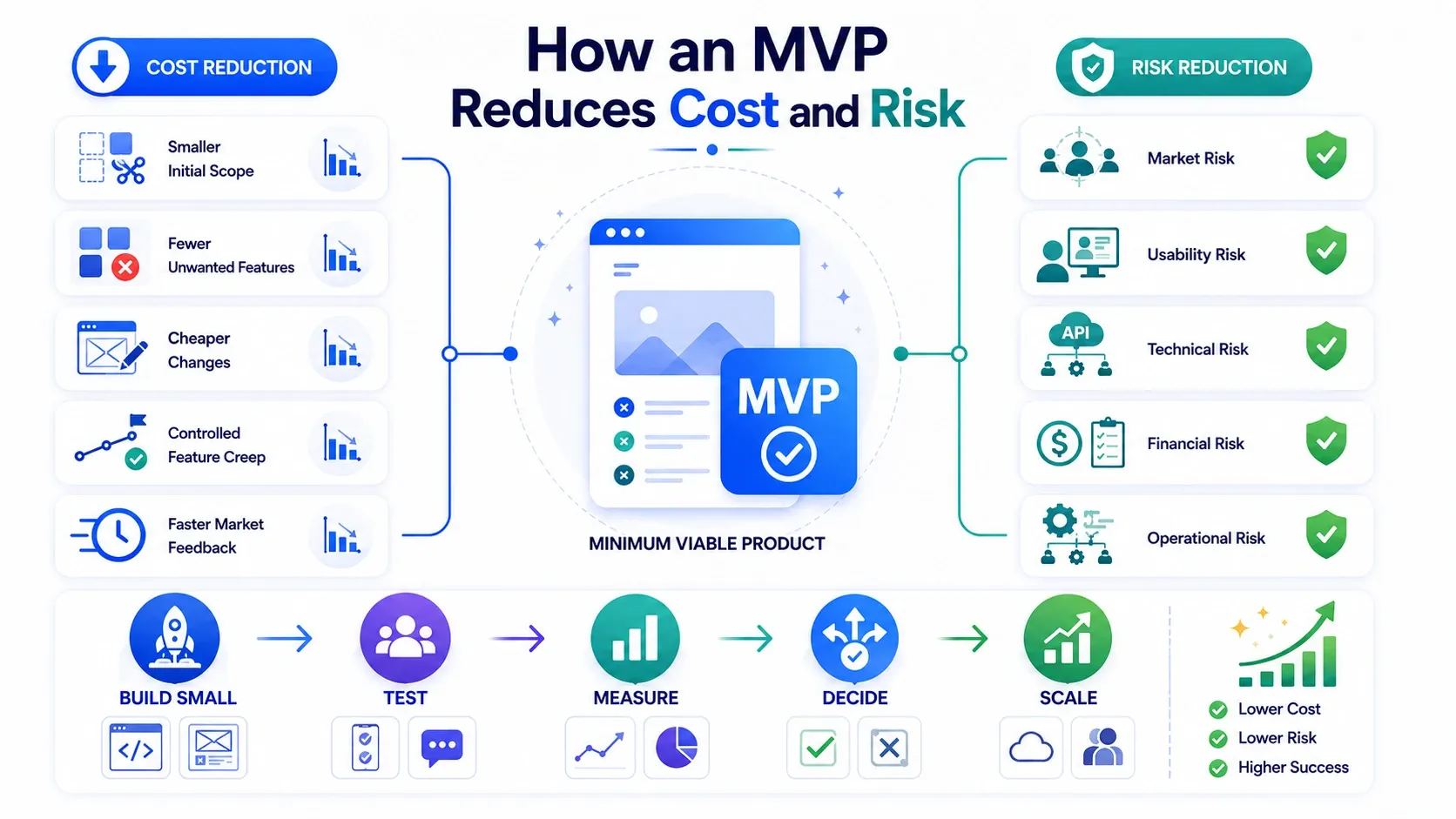
Building a software product can require a significant investment. Beyond programming, a complete solution may involve business analysis, user-experience design, infrastructure, security, testing, integrations, deployment, maintenance, and customer support.
The greatest risk is not simply that development will cost more than expected. It is that a business may spend heavily building the wrong product.
A Minimum Viable Product, or MVP, provides a more controlled approach. It allows a business to launch the smallest reliable version of its solution, test it with real users, and use the evidence to guide further development.
What Is an MVP?
An MVP is the simplest functional version of a product that delivers meaningful value to a selected group of users.
It includes the features required to solve one important problem and complete the product’s core user journey. Optional functionality can be introduced later when customer evidence supports the investment.
For example, imagine a founder wants to create a complete property-management platform. The final vision may include:
- Property listings
- Tenant screening
- Rental payments
- Maintenance management
- Financial reports
- Automated reminders
- Document storage
- Accounting integrations
However, if the main assumption is that small landlords need a simpler way to receive and manage maintenance requests, the MVP might initially focus on property registration, tenant access, request submission, status updates, and notifications.
This focused product can test the central opportunity without funding the entire platform.
How Does an MVP Reduce Software Development Costs?
1. It limits the initial development scope
Software development costs are strongly influenced by the number of features, screens, user roles, integrations, and business rules involved.
An MVP reduces the initial scope to the capabilities necessary to deliver the core value. Fewer features generally require less design, development, testing, documentation, and training.
This does not mean reducing quality. A focused MVP should still be secure, reliable, and easy to use. The saving comes from building fewer things, not from building them poorly.
Atlassian describes an MVP as a way to validate a product idea using minimal resources before investing heavily in full development. Read Atlassian’s MVP guide.
2. It prevents investment in unwanted features
Founders often assume they know which features customers need. After launch, they may discover that users ignore some features while repeatedly requesting something that was not originally prioritized.
Building a large product based entirely on assumptions can create substantial waste. Every unused feature has already consumed time across planning, design, programming, quality assurance, deployment, and maintenance.
An MVP introduces real customer evidence before these larger investments are made. The team can then fund features according to observed demand rather than internal opinions.
3. It reduces the cost of changing direction
Changing a product becomes more expensive as development progresses.
Adjusting a wireframe is relatively inexpensive. Modifying a focused MVP is manageable. Redesigning a large product with many connected features, databases, integrations, and users can be considerably more difficult.
Early feedback may reveal that the startup should target a different customer group, change its pricing model, simplify its workflow, or reposition the product. An MVP allows these changes to happen while the product remains smaller and less costly to revise.
4. It controls feature creep
Feature creep occurs when new requirements are continuously added without proper evaluation. It increases development time, expands the testing effort, complicates the user experience, and makes the budget harder to control.
A well-planned MVP establishes a clear boundary around the first release. Each proposed feature should be evaluated against one question:
Is this required to test the product’s core assumption?
If not, it can be recorded for a later phase. This approach protects the budget while ensuring useful ideas are not forgotten.
5. It shortens the path to market feedback
A full product may take months to reach customers. During that time, the company continues spending without knowing how the market will respond.
Because an MVP contains a smaller, prioritized feature set, it can usually be launched sooner. The business begins collecting usage data, feedback, pilot results, and potentially revenue at an earlier stage.
Faster feedback not only saves development costs. It also prevents the company from spending months following an unvalidated direction.
How Does an MVP Reduce Business and Product Risk?
Market risk
Market risk is the possibility that customers do not need the product or do not consider the problem important enough to pay for a solution.
An MVP tests this through actual behaviour. Registrations, completed transactions, repeat usage, pilot requests, referrals, and payments offer stronger evidence than encouraging survey responses.
Usability risk
A product can solve a real problem and still fail if customers find it confusing.
An MVP allows the team to observe where users become stuck, which steps they abandon, and which parts require explanation. The product experience can then be improved before it expands to a larger audience.
Technical risk
Some products depend on uncertain technologies, integrations, data sources, or performance requirements.
A focused MVP can test the most important technical assumptions early. For example, it can reveal whether an external system integrates reliably, whether an AI feature produces useful results, or whether the selected architecture supports the core workflow.
However, an MVP should not be treated as disposable, low-quality code. Ignoring security, maintainability, and basic architecture may produce technical debt that becomes expensive later.
Financial risk
Instead of committing the entire product budget at once, an MVP divides the investment into stages.
The business can review evidence after the initial launch and decide whether to continue, improve, change direction, or stop. This creates practical decision points before additional capital is committed.
Operational risk
A product may work technically while its business operations fail. Orders may require too much manual effort, customer support costs may be too high, or suppliers may be unable to meet demand.
An MVP exposes these operational realities on a controlled scale. The company can improve its processes before serving a much larger customer base.
An MVP Does Not Mean “Cheap Software”
One common misconception is that an MVP should always be developed using the cheapest possible method.
Cost control remains important, but an unreliable product can produce misleading feedback. Users may reject it because of poor performance or confusing design rather than because the business idea lacks value.
A strong MVP should provide:
- A clear core user journey
- Reliable essential functionality
- Appropriate security and data protection
- A simple, professional user experience
- Basic usage measurement
- A foundation suitable for planned improvement
The objective is to minimize unnecessary scope while preserving the quality needed for a meaningful market test.
How to Plan a Cost-Effective MVP
Start by defining one customer group, one important problem, and one measurable assumption. Map the shortest user journey required to solve that problem.
Classify potential features as must-have, useful later, or unnecessary for validation. Set clear success measures, such as activation, repeat usage, completed transactions, pilot conversion, or willingness to pay.
After launch, review both customer feedback and actual behaviour. Continue investing when the evidence supports the product direction. If it does not, revise the idea before expanding development.
Final Thoughts
An MVP reduces software development cost by limiting the initial scope, preventing unnecessary features, controlling feature creep, and making early changes less expensive.
More importantly, it reduces uncertainty. Founders can test market demand, usability, technical feasibility, operational processes, and commercial potential before committing to full product development.
The goal is not merely to spend less. It is to ensure that each stage of investment is supported by stronger evidence than the stage before it.
MVPHUB helps founders define, design, and develop focused MVPs that test real business assumptions without unnecessary complexity or premature development costs.
💡 Protect your product budget before building at full scale.
Don’t spend months building features your users might not even want.
💡 Have a software idea?
Receive a focused MVP scope, fixed price and achievable delivery timeline.
Book a free consultation with MVPHUBFrequently Asked Questions
Is an MVP always cheaper than a full product?
An MVP normally requires a smaller initial investment because it contains fewer features. Its actual cost will still depend on technical complexity, integrations, security requirements, and design needs.
Does an MVP eliminate software development risk?
No approach can eliminate all risk. An MVP reduces uncertainty by testing important assumptions earlier and on a controlled scale.
How do I decide which features belong in an MVP?
Include only the features required to solve the main customer problem, complete the core journey, and test the most important business assumption.
Should an MVP be scalable?
It should support the expected validation audience and have a sensible path for improvement. Building expensive infrastructure for millions of users before demand is proven is usually unnecessary.
Can AI tools make MVP development less expensive?
AI-assisted tools can accelerate some design, coding, testing, and documentation tasks. However, experienced oversight remains important for product decisions, architecture, security, quality assurance, and maintainability.
