
How to Choose an MVP Development Company
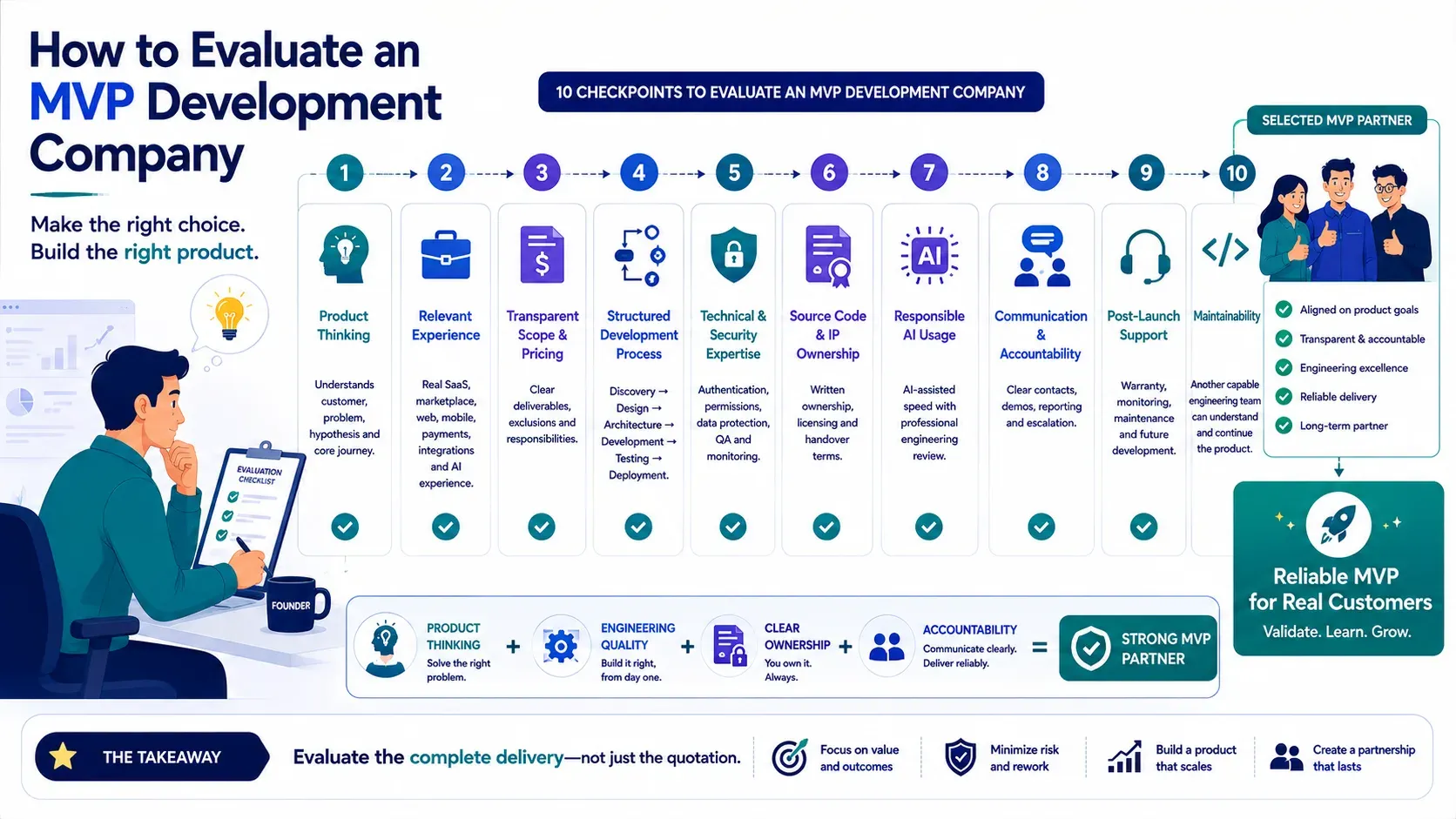
The right MVP development company should do more than write code. It should help you define what to build, reduce unnecessary scope, manage technical risks, and launch a reliable product that can be tested with real customers.
The cheapest or fastest proposal is not always the most cost-effective. An incomplete product may later require expensive rebuilding because of poor architecture, security weaknesses, missing source code, or unreliable functionality.
Here is what to evaluate before selecting an MVP development partner.
1. Look for Product Thinking, Not Just Coding
A capable MVP development company should begin by understanding:
- Your target customer
- The problem being solved
- Your business model
- The main assumption to test
- The core customer journey
- How will success be measured
Be cautious if a provider accepts a long feature list without questioning whether every feature belongs in the first release.
A strong partner helps you build the smallest product capable of producing meaningful market evidence.
2. Review Relevant Experience
Examine the company’s previous work, especially products similar in complexity or business model to yours.
Look for evidence of experience with:
- SaaS platforms
- Marketplaces
- Mobile and web applications
- Payment systems
- User roles and permissions
- Third-party integrations
- AI capabilities
- Data migration
- Security-sensitive workflows
A portfolio should demonstrate working products, not only attractive interface designs.
Ask what the company specifically delivered, which challenges it solved, and whether the products progressed beyond prototypes.
3. Understand What the Price Includes
Two companies may use the term “MVP” for completely different deliverables.
One proposal may cover only design and basic development. Another may include discovery, architecture, testing, security review, production deployment, and source-code handover.
A professional quotation should clarify whether it includes:
- Product discovery and scope definition
- User journeys and wireframes
- UI design
- Front-end and back-end development
- Database setup
- Integrations
- Authentication and permissions
- Quality assurance
- Security verification
- Production deployment
- Documentation
- Source-code handover
- Post-launch support
Compare deliverables and exclusions, not only the final price.
4. Check the Development Process
A structured MVP process may include:
- Product discovery
- Requirement clarification
- Scope and exclusions
- User journeys and wireframes
- Technical architecture
- Development
- Continuous testing
- Client acceptance
- Production deployment
- Launch support
Ask how often you will receive demonstrations, how feedback will be handled, and who is authorized to approve changes.
You should have visibility throughout development rather than seeing the product for the first time at the end.
5. Evaluate Technical and Security Expertise
An MVP contains fewer business features, but it should not ignore essential engineering quality.
Ask how the company manages:
- Authentication
- Role-based permissions
- Data protection
- Secure configuration
- Input validation
- Error handling
- Code review
- Automated and manual testing
- Backups and monitoring
- Third-party dependencies
- Production environments
The required controls depend on the product’s risk. Applications handling payments, identity information, health data, or confidential records need stronger safeguards.
6. Confirm Source Code and IP Ownership
The contract should clearly state:
- Who owns the completed product
- When intellectual property transfers
- Whether source code is included
- Which third-party components are used
- Whether reusable company-owned components remain licensed
- Whether you can appoint another developer later
- Which payments must be completed before handover
Avoid relying on verbal assurances. Ownership and licensing terms should appear in writing.
7. Ask How AI Is Used
AI can accelerate requirements, wireframing, coding, testing, and documentation. However, uncontrolled AI-generated development can introduce security weaknesses, incorrect logic, inconsistent architecture, and difficult-to-maintain code.
A responsible MVP development company should use AI as an accelerator while professional engineers remain accountable for:
- Technical decisions
- Architecture
- Code review
- Security
- Testing
- Deployment
- Maintainability
The strongest approach combines AI-assisted speed with professional engineering oversight.
8. Review Communication and Accountability
Before signing, identify:
- Your main point of contact
- The product or project owner
- The technical decision-maker
- Reporting frequency
- Demonstration schedule
- Issue-escalation process
- Expected response times
- Client responsibilities
Good communication is not an optional extra. Delayed decisions and unclear responsibilities can directly affect the cost and timeline.
9. Understand Post-Launch Support
MVP delivery begins the validation process. Real users may reveal bugs, usability issues, missing edge cases, or operational challenges.
Ask whether the company provides:
- A warranty or defect-resolution period
- Production monitoring
- Technical support
- Security updates
- Hosting assistance
- Analytics review
- Ongoing maintenance
- Future development options
Clarify which issues are included and which changes require additional payment.
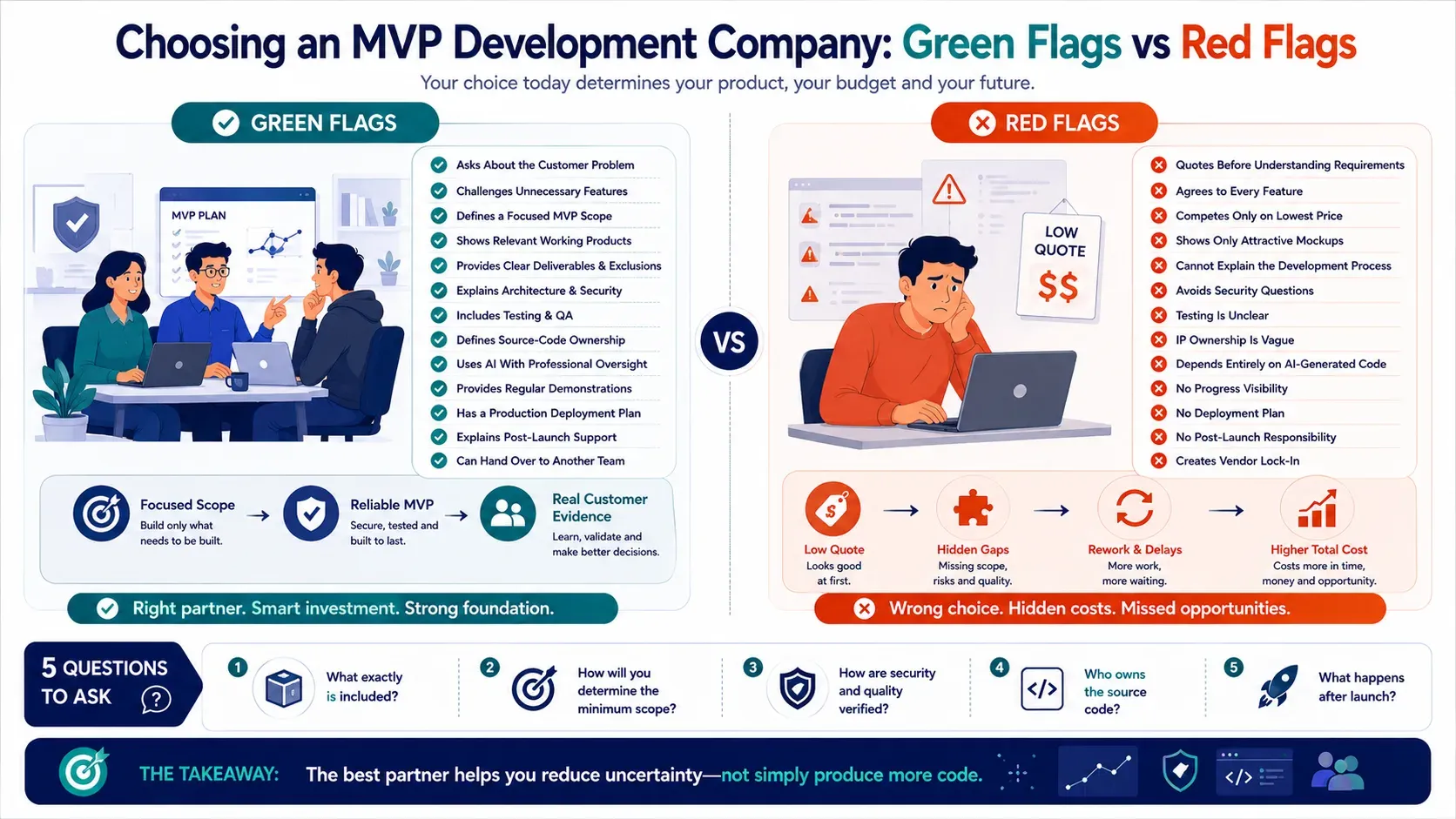
10. Watch for Red Flags
Be cautious when an MVP development company:
- Guarantees a price without understanding the requirements
- Agrees to every requested feature
- Cannot explain its development process
- Shows only visual mockups
- Avoids discussing security or testing
- Provides unclear ownership terms
- Depends entirely on AI-generated code
- Offers no production deployment plan
- Requires complete payment before meaningful progress
- Cannot explain post-launch support
Questions to Ask Before Hiring
Ask shortlisted companies:
- How will you determine the minimum MVP scope?
- What customer assumption will the product test?
- What exactly is included and excluded?
- Who will work on the project?
- How will architecture and security be managed?
- How often will we review progress?
- Who owns the source code and intellectual property?
- What happens if the scope changes?
- What support is provided after launch?
- Can the product be maintained by another team?
Clear, specific answers are a positive sign.
Choose a Partner That Builds for Real Customers
The best MVP development company balances business validation, controlled scope, engineering quality, delivery speed, and budget.
Your goal is not simply to receive software. It is to launch a reliable product that helps you determine whether the market opportunity deserves further investment.
Looking for the Right MVP Development Partner?
MVPHUB provides AI-accelerated, production-ready MVP development from USD 3,000 to USD 20,000. Our approach combines focused product scoping, professional engineering, security, testing, deployment, and source-code handover. Book a free consultation with MVPHUB to define the right MVP scope and receive a clear delivery plan for your product idea.
Book a free consultation with MVPHUBFrequently Asked Questions
What does an MVP development company do?
It helps define, design, develop, test, and launch the smallest reliable product needed to validate an important customer or business assumption.
How much does an MVP development company charge?
Pricing varies according to features, platforms, integrations, security requirements, design complexity, and delivery model. MVPHUB offers selected, focused MVPs from USD 3,000 to USD 20,000.
Should a startup hire a freelancer or an MVP development company?
A freelancer may suit a small, clearly defined task. A development company is often more appropriate when the product requires integrated design, architecture, development, testing, security, deployment, and ongoing accountability.
Who should own the MVP source code?
The contract should clearly define ownership. Typically, the client receives ownership or agreed usage rights after completing the required payments, subject to third-party and pre-existing component licences.
How long does MVP development take?
A focused MVP may take approximately two to four weeks. Products involving complex integrations, several user roles, regulated data, or advanced technology may require longer.
