
How to Reduce MVP Development Costs Without Building a Cheap Product
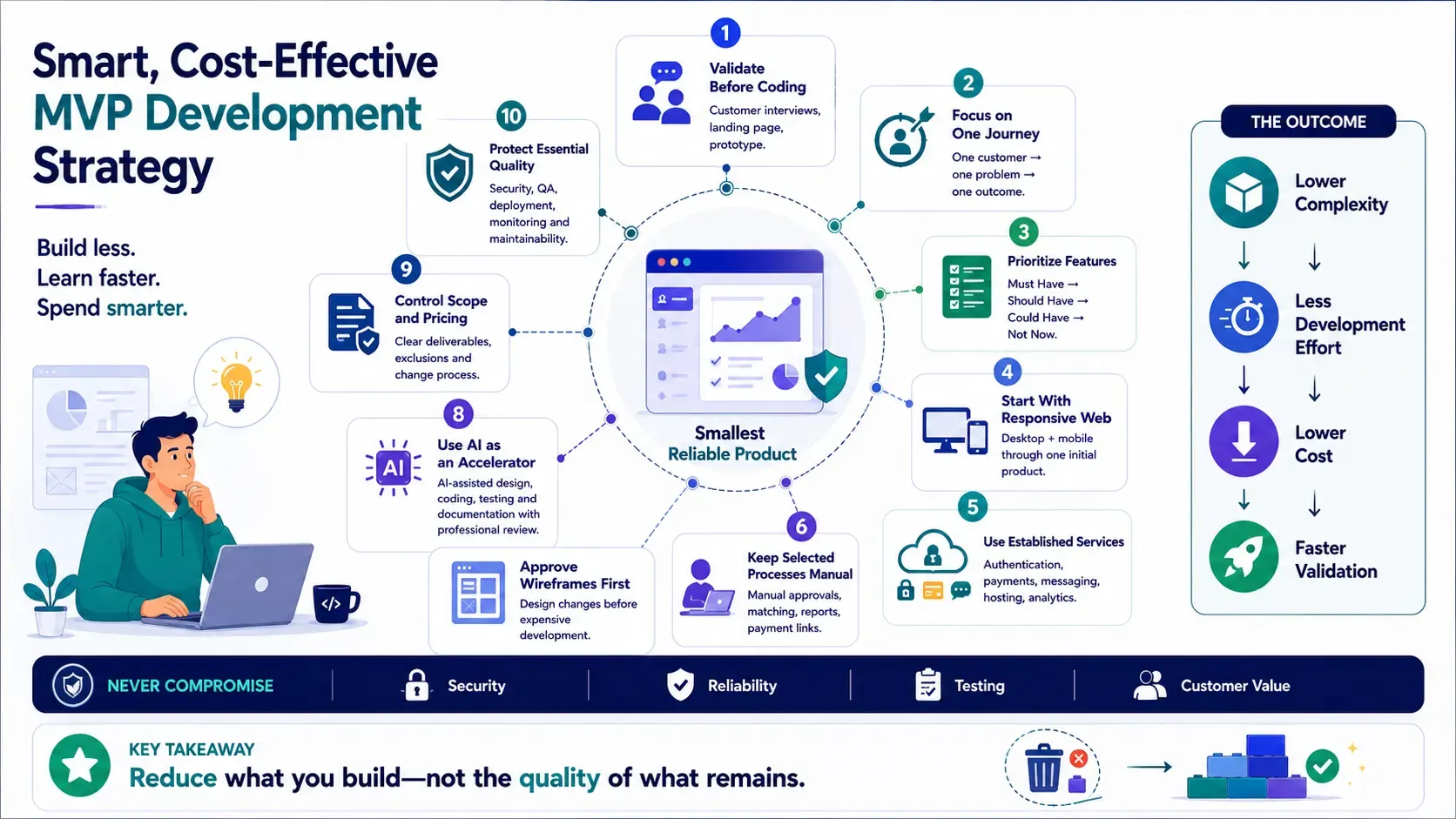
Reducing MVP development costs should not mean launching unreliable software.
A cheap product often cuts essential engineering work: security, testing, error handling, architecture, or deployment readiness. A cost-effective MVP takes a different approach. It reduces scope and complexity while protecting the quality of the features that remain.
The goal is to build the smallest reliable product capable of delivering customer value and generating meaningful market evidence.
1. Validate the Problem Before Writing Code
The most expensive MVP is one nobody needs.
Before development, validate whether:
- The problem genuinely exists
- A specific customer group experiences it
- Current alternatives are insufficient
- Customers are interested in a better solution
- Users are willing to change their behaviour
- Someone is willing to pay
Customer interviews, landing pages, prototypes, waitlists, and manual service experiments can test these assumptions at a fraction of the cost of software development.
2. Build Around One Core Customer Journey
Every additional workflow introduces more design, development, testing, and maintenance.
A focused MVP should serve:
- One initial customer group
- One important problem
- One complete user journey
- One measurable assumption
For example, a booking MVP may allow a customer to select a service, choose a time, confirm the booking, and receive a notification.
Loyalty programmes, advanced reports, multiple payment providers, and native mobile applications can usually wait.
3. Prioritize Features Strictly
Classify every proposed feature as:
- Must have: Required for customer value, validation, safety, or operation
- Should have: Helpful but not essential for the first test
- Could have: Useful if additional capacity remains
- Not now: Move to the post-validation roadmap
Ask one question repeatedly:
Can customers experience the core value and can we test our main assumption without this feature?
If the answer is yes, postponing it can reduce cost without weakening the MVP.
4. Start With a Responsive Web Application
Building separate web, iOS, and Android applications can significantly increase costs.
Unless the product depends on device-specific capabilities, a responsive web application may support desktop and mobile users through one initial codebase.
Native apps can be introduced after customer demand and usage patterns justify the investment.
5. Use Established Services
Authentication, payments, email, SMS, analytics, file storage, and hosting rarely need to be built from the ground up.
Reliable third-party services can reduce delivery time and technical risk. However, the team should evaluate:
- Pricing
- Security
- Data ownership
- Integration limitations
- Vendor dependency
- Future scalability
Using an established service is economical. Selecting one without a professional assessment can create expensive migration work later.
6. Keep Selected Processes Manual
Automation is valuable at scale, but early demand may not justify building it.
During validation, your team may manually:
- Approve new accounts
- Review submitted content
- Match customers with providers
- Send payment links
- Process exceptional requests
- Prepare selected reports
This is sometimes called a concierge approach. It helps founders understand real operations before investing in automation.
7. Approve Wireframes Before Development
Changing a wireframe is faster and cheaper than rebuilding working software.
Before coding begins, confirm:
- User journeys
- Screen structure
- Required information
- Business rules
- User roles
- Acceptance criteria
One authorized decision-maker should consolidate feedback. Conflicting stakeholder instructions and repeated redesigns are common sources of avoidable cost.
8. Use AI as an Accelerator
AI can reduce effort across:
- Requirement organization
- Wireframing
- Interface development
- Standard code generation
- Test-case preparation
- Documentation
- Code-review assistance
However, unmanaged AI-generated software may contain insecure code, incorrect assumptions, unsuitable architecture, or incomplete error handling.
The sustainable model is AI-accelerated professional engineering: AI improves delivery efficiency while experienced engineers remain responsible for architecture, security, testing, and deployment.
9. Choose Fixed-Scope Pricing
A fixed-price engagement can provide stronger budget certainty when the scope is clear.
The agreement should define:
- Included features
- Exclusions
- Deliverables
- Timeline
- Client responsibilities
- Revision limits
- Change-request process
- Source-code ownership
- Deployment and support terms
A low quotation with unclear deliverables can become more expensive through change requests, missing functionality, or redevelopment.
10. Do Not Cut Essential Quality
An MVP can have fewer features, but the included functionality should be dependable.
Protect the budget for:
- Secure authentication and permissions
- Data validation and protection
- Error handling
- Functional testing
- Code review
- Responsive behaviour
- Production deployment
- Monitoring and backups
- Source-code handover
- Appropriate documentation
These elements protect customer trust and make the product easier to improve after validation.
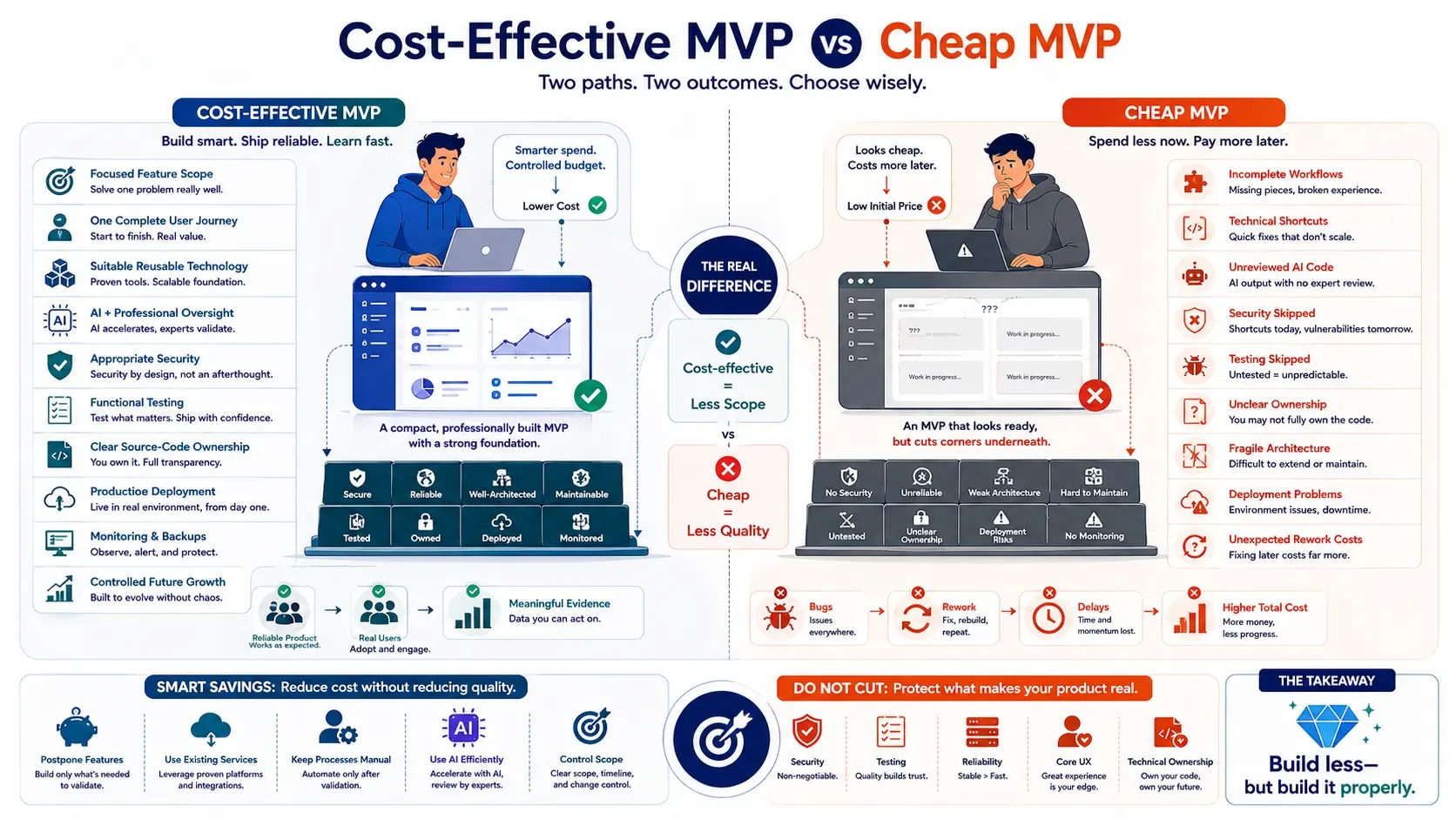
Cost-Effective vs Cheap MVP
| Cost-effective MVP | Cheap MVP |
|---|---|
| Focused feature scope | Incomplete workflows |
| Reusable, suitable technology | Unsuitable technical shortcuts |
| AI with professional oversight | Unreviewed AI-generated code |
| Appropriate security and testing | Security and QA skipped |
| Clear source-code ownership | Unclear ownership |
| Designed for controlled growth | Difficult to maintain or extend |
| Transparent exclusions | Unexpected costs after development |
Build Less—But Build It Properly
The best way to reduce MVP development costs is to control what you build, not weaken how it is built.
Validate the problem, focus on one complete customer journey, postpone unnecessary features, use established services, automate only what matters, and combine AI-assisted speed with professional engineering.
Launch a Reliable MVP Without Overspending
MVPHUB delivers focused, AI-accelerated, production-ready MVPs from USD 3,000 to USD 20,000—combining controlled scope with professional architecture, security, testing, and deployment. Book a free consultation with MVPHUB to define a cost-effective MVP scope built for real customers—not just a low-cost demonstration.
Book a free consultation with MVPHUBFrequently Asked Questions
What is the most effective way to reduce MVP development costs?
Reduce the initial feature scope. Focus on one customer group, one problem, and one complete journey while postponing features that do not contribute to the first market test.
Should I choose the cheapest MVP developer?
Not automatically. Compare deliverables, technical expertise, security, testing, source-code ownership, deployment, and post-launch responsibility—not only the initial price.
Can AI make MVP development more affordable?
Yes. AI can accelerate design, coding, testing, and documentation. Professional review remains necessary to verify reliability, security, and maintainability.
Should an MVP include security and testing?
Yes. “Minimum” refers to feature scope, not essential quality. Security and testing should be appropriate to the product’s data, users, transactions, and operational risks.
Is fixed-price MVP development a good option?
Fixed pricing can provide budget certainty when features, exclusions, responsibilities, and change procedures are clearly defined. It may be less suitable when requirements are highly experimental or frequently changing.
