
How to Validate an App Idea Before Starting Development
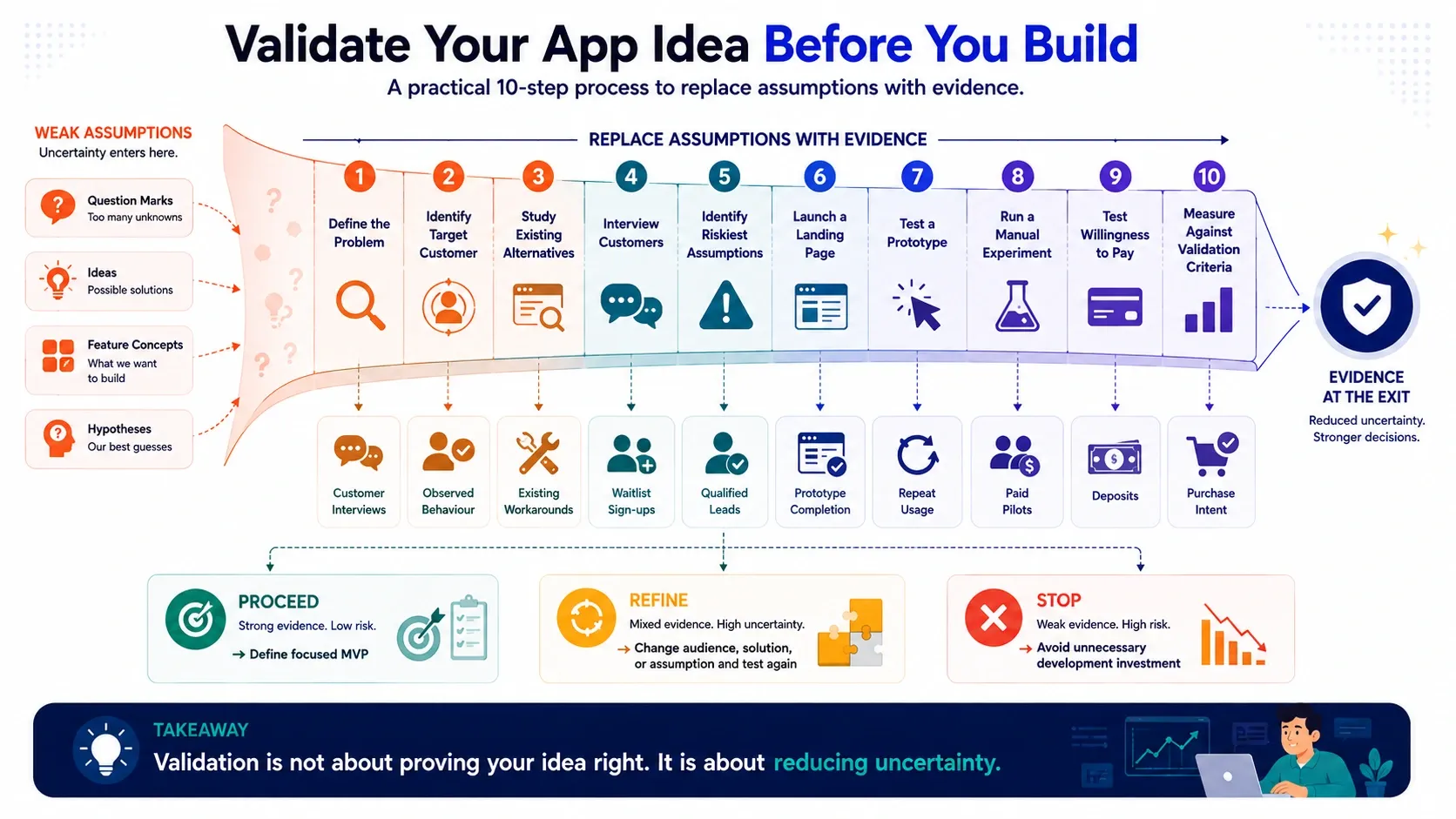
Before investing in app development, you need evidence that the problem is real, the proposed solution is relevant, and a reachable customer group is willing to use or pay for it.
App idea validation does not guarantee success. It reduces uncertainty and helps you avoid building features based entirely on assumptions.
The objective is not to prove that your original idea is correct. It is to discover whether the opportunity is strong enough to justify further investment—and what should actually be built.
1. Define the Problem Clearly
Start with the customer problem rather than the app’s features.
Create a simple statement:
[Target customer] struggles with [specific problem] because [current limitation], resulting in [measurable consequence].
For example:
Independent tutors struggle to manage enrolments, payments, learning materials, and student communication across separate tools, creating repetitive administration and a fragmented student experience.
If you cannot explain the problem without describing your proposed app, further research may be required.
2. Identify a Specific Target Customer
Avoid defining your audience as “everyone,” “all businesses,” or “any smartphone user.”
A focused early segment is easier to understand, contact, and serve. Define characteristics such as:
- Industry or occupation
- Company size
- Location
- Current behaviour
- Problem frequency
- Existing tools
- Purchasing authority
- Ability and willingness to pay
You can expand later. Initial validation should focus on the group experiencing the problem most strongly.
3. Study Existing Alternatives
Search for how customers solve the problem today.
Alternatives may include:
- Direct competitors
- General-purpose software
- Spreadsheets
- Email or messaging apps
- Manual services
- Internal processes
- Doing nothing
Review competitor features, pricing, positioning, customer feedback, and common complaints.
Competition does not automatically invalidate an idea. It may confirm that demand exists. Your task is to identify an underserved customer, an unresolved problem, or a meaningfully better approach.
4. Interview Potential Customers
Speak directly with people in the target segment.
Ask about their past and current behaviour rather than hypothetical opinions.
Useful questions include:
- How do you manage this process today?
- When did this problem last occur?
- How frequently does it happen?
- What does it cost in time, money, or missed opportunities?
- Which tools have you tried?
- What do you dislike about the current solution?
- Who decides whether to purchase a new tool?
- What would prevent your organization from adopting one?
Avoid leading questions such as “Would you use an app that solves this?” People often respond positively to be polite.
Evidence of repeated problems and existing workarounds is more meaningful than compliments about the idea.
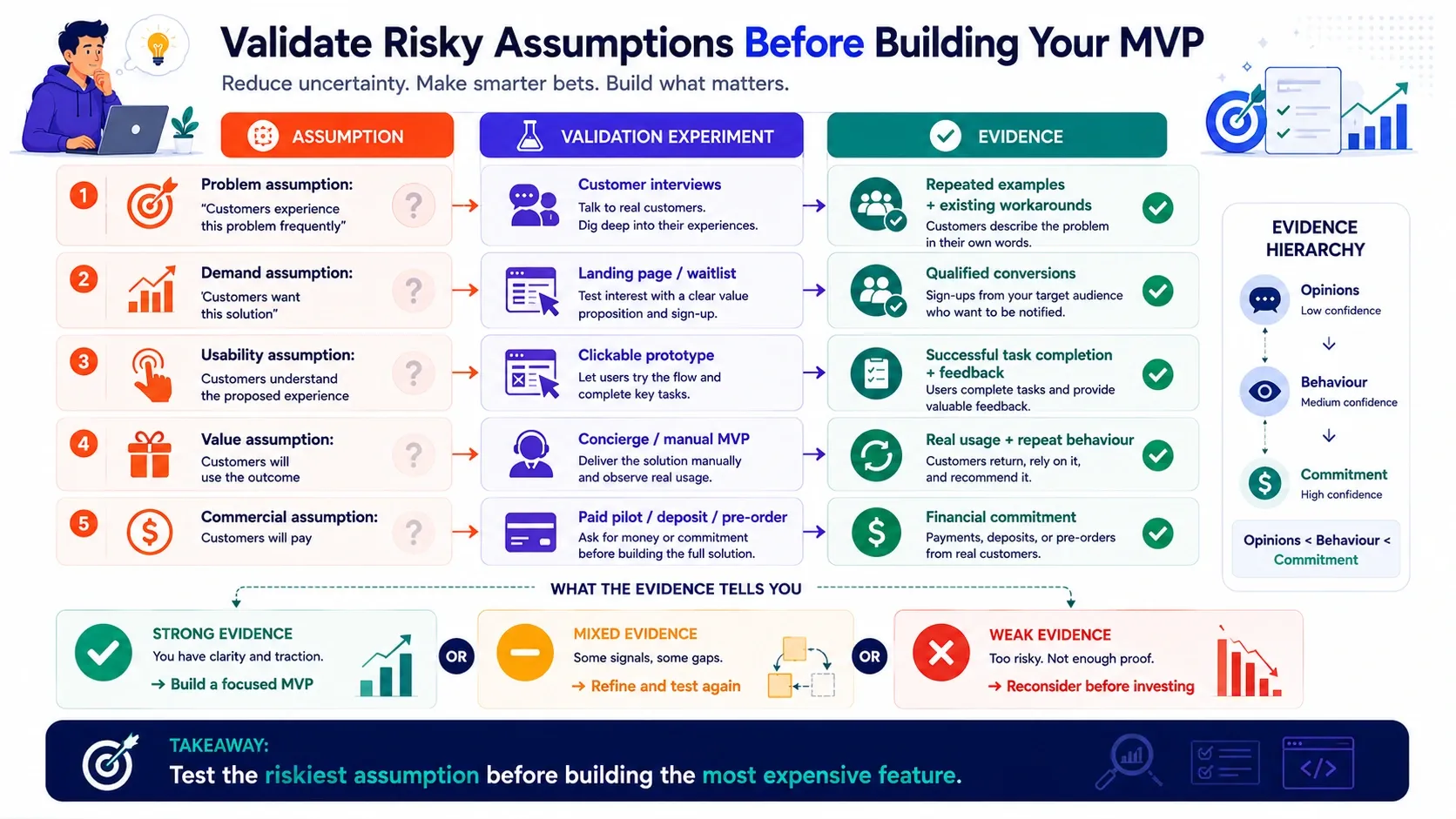
5. Define Your Riskiest Assumptions
List what must be true for the business to succeed.
Typical assumptions include:
- Customers experience the problem frequently.
- The problem is important enough to solve.
- Users will change their current behaviour.
- Customers will trust the product with their data.
- Decision-makers are willing to pay.
- The technology can produce the required result.
- The target audience can be reached affordably.
Rank these assumptions by importance and uncertainty. Test the highest-risk assumptions first.
6. Test Interest With a Landing Page
Create a focused landing page explaining:
- Who the app is for
- What problem does it solve
- The main benefit
- How it works
- The expected call to action
Possible calls to action include:
- Join the waitlist
- Request early access
- Book a demonstration
- Apply for a pilot
- Reserve a place
- Start a paid trial
Track conversion rather than page visits alone. A hundred relevant visitors who produce ten serious enquiries may be more valuable than thousands of untargeted impressions.
7. Create a Prototype
A clickable prototype can demonstrate the app’s core journey without building the complete product.
Use it to test whether users can:
- Understand the product
- Navigate the main workflow
- Complete the intended action
- Recognize the value
- Identify missing information
- Explain where they become confused
A prototype validates the proposed experience. It does not prove technical feasibility or actual customer demand by itself.
8. Test the Service Manually
Some app ideas can be tested through a manual or concierge service.
Before building automation, you might:
- Match customers with providers manually
- Generate reports with human assistance
- Approve submissions manually
- Send payment links directly
- Manage bookings through existing tools
- Deliver recommendations by email
If customers do not use the manually delivered outcome, automating it may not solve the underlying problem.
9. Test Willingness to Pay
Positive feedback is weaker than financial commitment.
Depending on the product stage, stronger evidence may include:
- Pre-orders
- Paid pilots
- Deposits
- Signed letters of intent
- Trial-to-paid conversions
- Customers accepting a proposed price
- Permission to begin procurement
Ask prospects how they currently budget for the problem and who approves spending. This produces more useful information than asking what they “might pay.”
10. Define Clear Validation Criteria
Decide what evidence justifies the next investment before running the test.
Measure outcomes such as:
- Interviewees reporting the same problem
- Landing-page conversion
- Qualified pilot enquiries
- Prototype task-completion rate
- Pre-orders or deposits
- Willingness to pay
- Repeat manual-service usage
- Cost of acquiring a relevant lead
The result may be to proceed, refine the audience, change the solution, test another assumption, or stop. Stopping an unsupported idea before expensive development is a successful validation outcome.
What Comes After Validation?
If the evidence is promising, define an MVP around:
- One target customer
- One important problem
- One complete user journey
- One measurable assumption
- The minimum features needed for value and safety
Avoid turning every interview request into an MVP feature. Build only what is required to produce the next level of reliable market evidence.
Validate Before You Invest Heavily
App validation replaces assumptions with customer evidence. Start by understanding the problem, the customer, alternatives, willingness to change, and willingness to pay. Then use prototypes, landing pages, or manual experiments to test your riskiest assumptions.
Validate Smarter. Build With Confidence.
MVPHUB helps founders validate app ideas, define focused product scopes, and launch production-ready MVPs using AI-accelerated delivery and accountable professional engineering. Book a free consultation with MVPHUB to identify the fastest and most responsible path from your app idea to real market evidence.
Book a free consultation with MVPHUBFrequently Asked Questions
How do I validate an app idea before starting development?
Start by validating the customer problem, target audience, existing alternatives, and willingness to pay. Use customer interviews, landing pages, clickable prototypes, manual experiments, waitlists, or paid pilots before investing heavily in software development.
How do I know if my app idea is worth building?
An app idea is worth exploring further when you find consistent evidence that a specific customer group experiences the problem, actively looks for solutions, and is willing to change its current behaviour or pay for a better alternative.
Do I need to build an MVP to validate my app idea?
Not always. Many assumptions can be tested before building an MVP using interviews, landing pages, prototypes, no-code tools, manual services, pre-orders, or pilot programs. An MVP becomes useful when you need real product usage data to validate the next set of assumptions.
What is the difference between a prototype and an MVP?
A prototype is mainly used to test concepts, workflows, and user experience without building a complete working product. An MVP is a functional product that delivers real value to actual users and helps validate customer behaviour in a real-world environment.
How many customer interviews should I conduct before building an MVP?
There is no universal number. Focus on reaching enough relevant customers to identify repeated patterns rather than targeting an arbitrary interview count. If the same problems, behaviours, and objections repeatedly appear across your target segment, you are developing stronger evidence.
What is the best way to test whether customers will pay for my app?
The strongest signals involve real commitment. Paid pilots, deposits, pre-orders, signed agreements, trial-to-paid conversions, or customers beginning a procurement process provide stronger evidence than simply asking whether someone would pay for the product.
Can I validate an app idea without spending much money?
Yes. Early validation can often be done relatively inexpensively through customer interviews, competitor research, simple landing pages, clickable prototypes, spreadsheets, manual workflows, and existing no-code or productivity tools.
How long should app idea validation take?
The timeline depends on the market, customer accessibility, and complexity of the assumptions being tested. Instead of validating for a fixed number of weeks, define the evidence you need and run the smallest experiments capable of producing that evidence.
What should I do if customers like the idea but are not willing to pay?
Treat that as important validation evidence. The problem may not be painful enough, the target customer may be wrong, the value proposition may need refinement, or the pricing model may not fit how customers currently purchase solutions. Investigate the reason before starting development.
What should I do after validating my app idea?
Translate the strongest evidence into a focused MVP scope. Define one target customer, one important problem, the core user journey, the assumption you need to test next, and only the features required to deliver genuine value and collect meaningful feedback.
