
A Step-by-Step Market Validation Framework for Startups
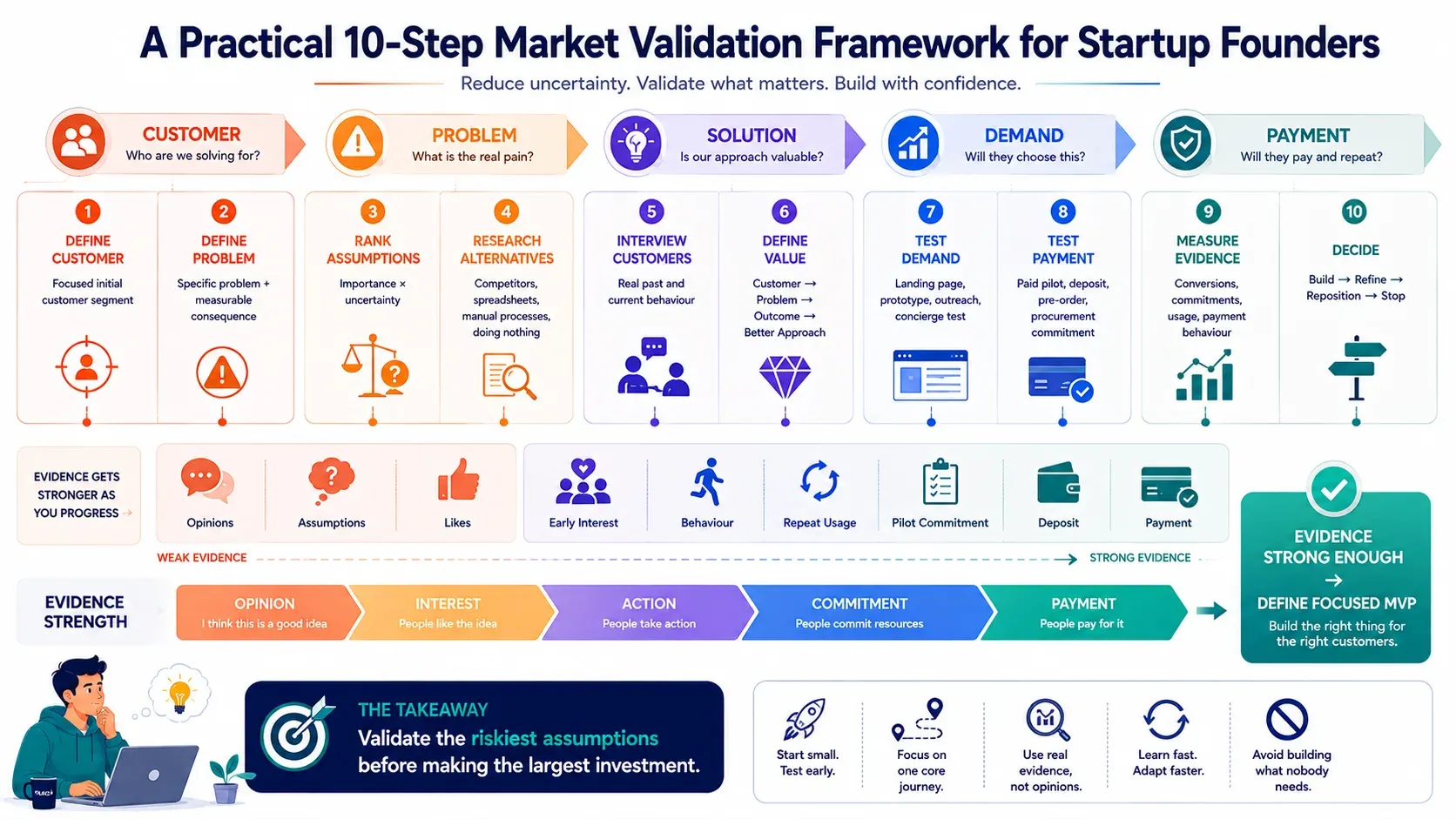
Market validation is the process of collecting evidence that a specific customer group experiences an important problem and is willing to adopt or pay for a proposed solution.
It should happen before significant product development begins.
Validation does not eliminate uncertainty or guarantee success. It helps founders identify weak assumptions, improve the product concept, and avoid investing heavily in something the market does not need.
This practical market validation framework moves from problem discovery to measurable customer commitment.
Step 1: Define the Customer Segment
Avoid starting with a broad audience such as “small businesses” or “smartphone users.”
Define a focused early customer segment using factors such as:
- Industry or profession
- Company size
- Location
- Current behaviour
- Problem frequency
- Existing tools
- Purchasing authority
- Ability to pay
For example, “independent tutors managing more than 50 students through spreadsheets and messaging apps” is more actionable than “education providers.”
A focused segment makes interviews, messaging, product scope, and customer acquisition easier.
Step 2: Write a Clear Problem Statement
Describe the problem without introducing your proposed product.
Use this structure:
[Customer segment] struggles with [specific problem] because [current limitation], resulting in [measurable consequence].
The consequence may involve:
- Lost revenue
- Repetitive work
- Slow service
- High operational costs
- Customer frustration
- Compliance risk
- Missed opportunities
If you cannot explain the problem clearly, development is premature.
Step 3: List Your Riskiest Assumptions
Identify everything that must be true for the business to succeed.
Typical assumptions include:
- The problem occurs frequently.
- Customers consider it important.
- Existing alternatives are inadequate.
- Users will change their current behaviour.
- Decision-makers will approve the solution.
- Customers will trust the product.
- The technology can deliver the promised outcome.
- The target market can be reached affordably.
- Customers will pay enough to support the business.
Rank each assumption by importance and uncertainty. Test the assumptions that are both critical and uncertain first.
Step 4: Research Existing Alternatives
Study how customers currently solve the problem.
Alternatives may include:
- Direct competitors
- General-purpose software
- Spreadsheets
- Email and messaging tools
- Internal processes
- Outsourced services
- Doing nothing
Review competitor positioning, pricing, features, customer reviews, and common complaints.
Competition is not automatically negative. It may confirm demand. The key question is whether a meaningful customer problem remains unresolved.
Step 5: Conduct Customer Interviews
Interview people within the target segment.
Focus on past and current behaviour rather than hypothetical opinions.
Ask questions such as:
- When did you last experience this problem?
- How do you manage it today?
- How often does it happen?
- What does it cost in time or money?
- Which solutions have you tried?
- What frustrates you about them?
- Who approves spending?
- What would prevent adoption?
Avoid asking, “Would you use my app?” Positive opinions are weak evidence unless supported by real behaviour or commitment.
Step 6: Define Your Value Proposition
Based on the research, explain:
- Who does the solution serve
- Which problem does it solve
- What outcome does it create
- Why is it better than the current approach
A simple format is:
For [customer], our solution helps achieve [outcome] by [method], unlike [current alternative].
Use the customer’s language rather than technical terminology. If prospects do not immediately understand the value, the message or solution may need refinement.
Step 7: Run a Low-Cost Demand Test
Test whether people take action—not merely whether they say the idea sounds good.
Possible experiments include:
- A landing page
- A waitlist
- A targeted advertising campaign
- A webinar or demonstration
- Direct outreach
- A clickable prototype
- A manual or concierge service
- A pilot invitation
Track qualified actions such as demo requests, waitlist conversions, completed prototype tasks, or pilot applications.
Step 8: Test Willingness to Pay
Financial commitment is stronger evidence than interest.
Depending on the product stage, test:
- Proposed pricing
- Paid pilots
- Deposits
- Pre-orders
- Letters of intent
- Trial-to-paid conversion
- Procurement discussions
Ask how customers currently budget for the problem and who controls the purchase decision.
A prospect saying “I like it” is encouraging. A customer agreeing to pay is validation.
Step 9: Define Validation Metrics
Choose success criteria before running the experiment.
Relevant metrics may include:
- Interviewees reporting the same problem
- Landing-page conversion rate
- Qualified enquiries
- Prototype completion rate
- Pilot commitments
- Deposits or pre-orders
- Repeat usage
- Willingness to pay
- Estimated customer acquisition cost
Avoid vanity metrics such as impressions or social likes unless they lead to meaningful customer action.
Step 10: Decide What Happens Next
Review the evidence and choose one of four paths:
| Evidence | Recommended action |
|---|---|
| Strong problem and payment evidence | Define and build a focused MVP |
| Strong problem but weak solution response | Redesign the value proposition |
| Interest but weak payment evidence | Revisit pricing, audience, or urgency |
| Weak problem evidence | Stop or explore another opportunity |
Changing direction is not a failed validation process. It is the value of validating before making a larger investment.
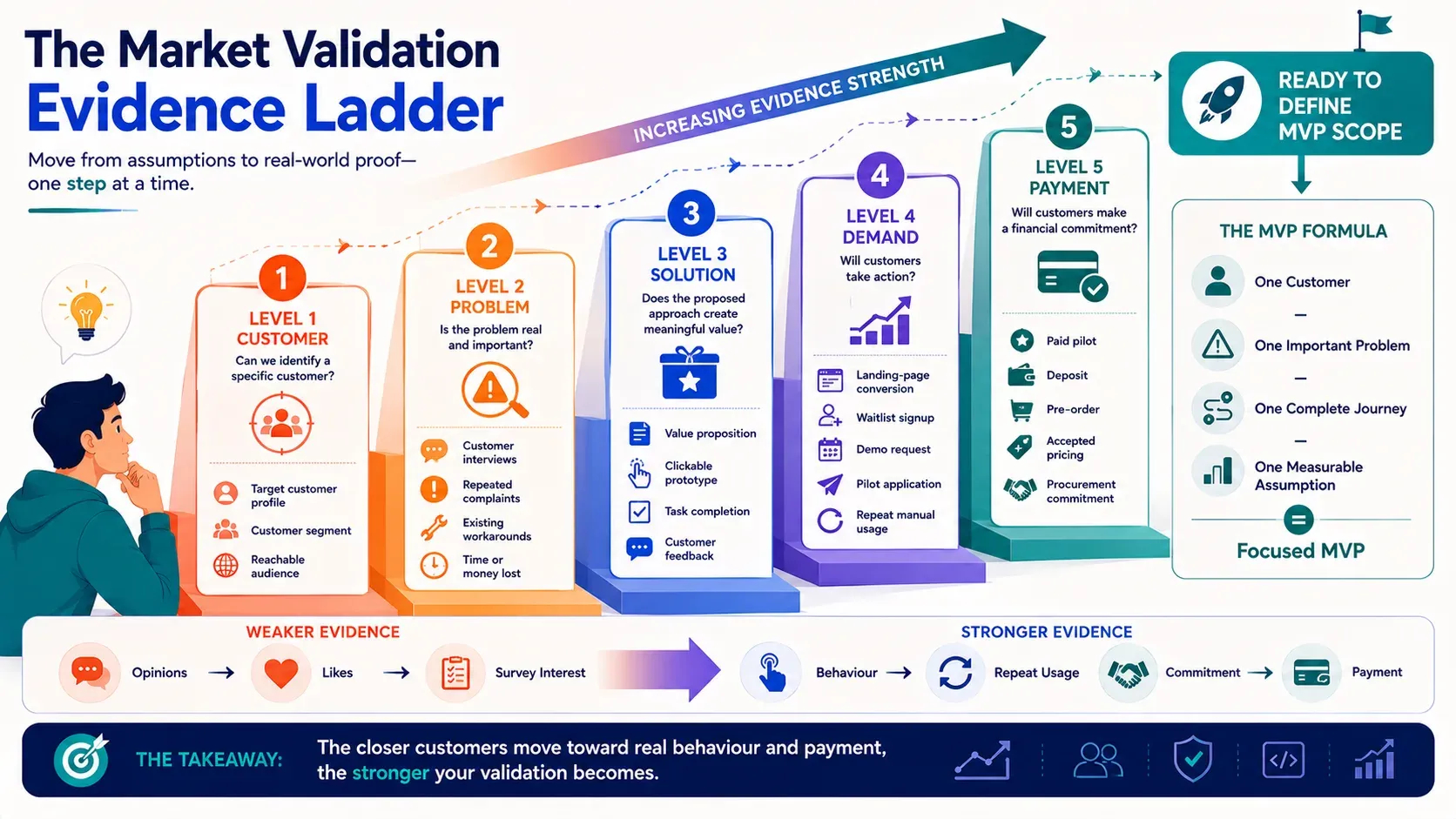
From Validation to MVP Scope
Once the evidence is strong enough, define the MVP around:
- One target customer
- One important problem
- One complete journey
- One measurable assumption
- Essential analytics
- Appropriate security and reliability
Do not turn every interview suggestion into a feature. The MVP should test the strongest opportunity discovered through validation.
Turn Assumptions Into Evidence
A reliable market validation framework moves through five levels:
Customer → Problem → Solution → Demand → Payment
The further customers move from opinions toward behaviour and financial commitment, the stronger the evidence becomes.
Validate First. Build With Confidence.
MVPHUB helps founders validate product ideas, define focused scopes, and launch production-ready MVPs through AI-accelerated delivery and professional engineering. Book a free consultation with MVPHUB to turn your startup assumptions into a practical validation and MVP development plan.
Book a free consultation with MVPHUBFrequently Asked Questions
What is market validation?
Market validation is the process of collecting evidence that a specific customer group experiences an important problem and is willing to adopt or pay for a proposed solution.
How many customer interviews should a startup conduct?
There is no universal number. Interview enough relevant customers to identify repeated patterns. Ten focused interviews with the right segment can be more useful than a large, untargeted survey.
Can I validate a startup idea without building an app?
Yes. Landing pages, prototypes, manual services, direct outreach, waitlists, and paid pilots can test critical assumptions before software development begins.
What is the strongest form of market validation?
Actual payment, deposits, paid pilots, repeat usage, and signed customer commitments usually provide stronger evidence than surveys, compliments, or social engagement.
When is an idea ready for MVP development?
An idea may be ready when the customer and problem are clearly defined, demand evidence exists, the main assumption is measurable, and one focused product journey can test it.
