
What Features Should Be Included in Your First MVP?
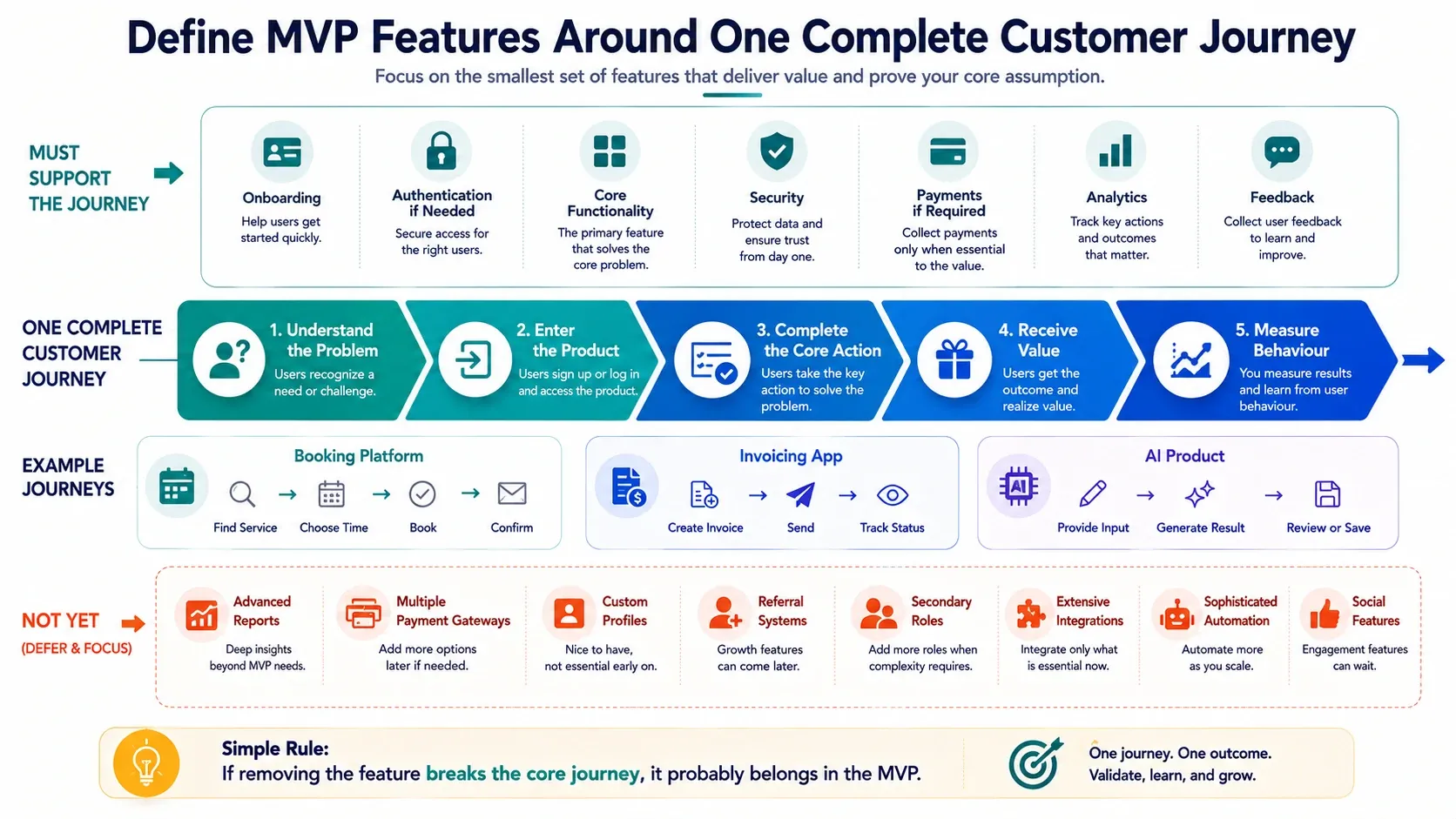
When you have an exciting product idea, deciding what MVP features to build can be surprisingly difficult. Login, payments, dashboards, notifications, AI capabilities, integrations, reporting—the feature list can grow before development even begins.
But a Minimum Viable Product is not supposed to contain everything your future product might offer.
An MVP is the smallest usable version of a product that delivers meaningful value to a defined customer group and allows you to test important business assumptions with real users. “Minimum” means intentionally limited in scope, while “viable” means users can reliably complete the essential journey you want to test.
The right question, therefore, is not “How many features can we fit into our MVP?” It is:
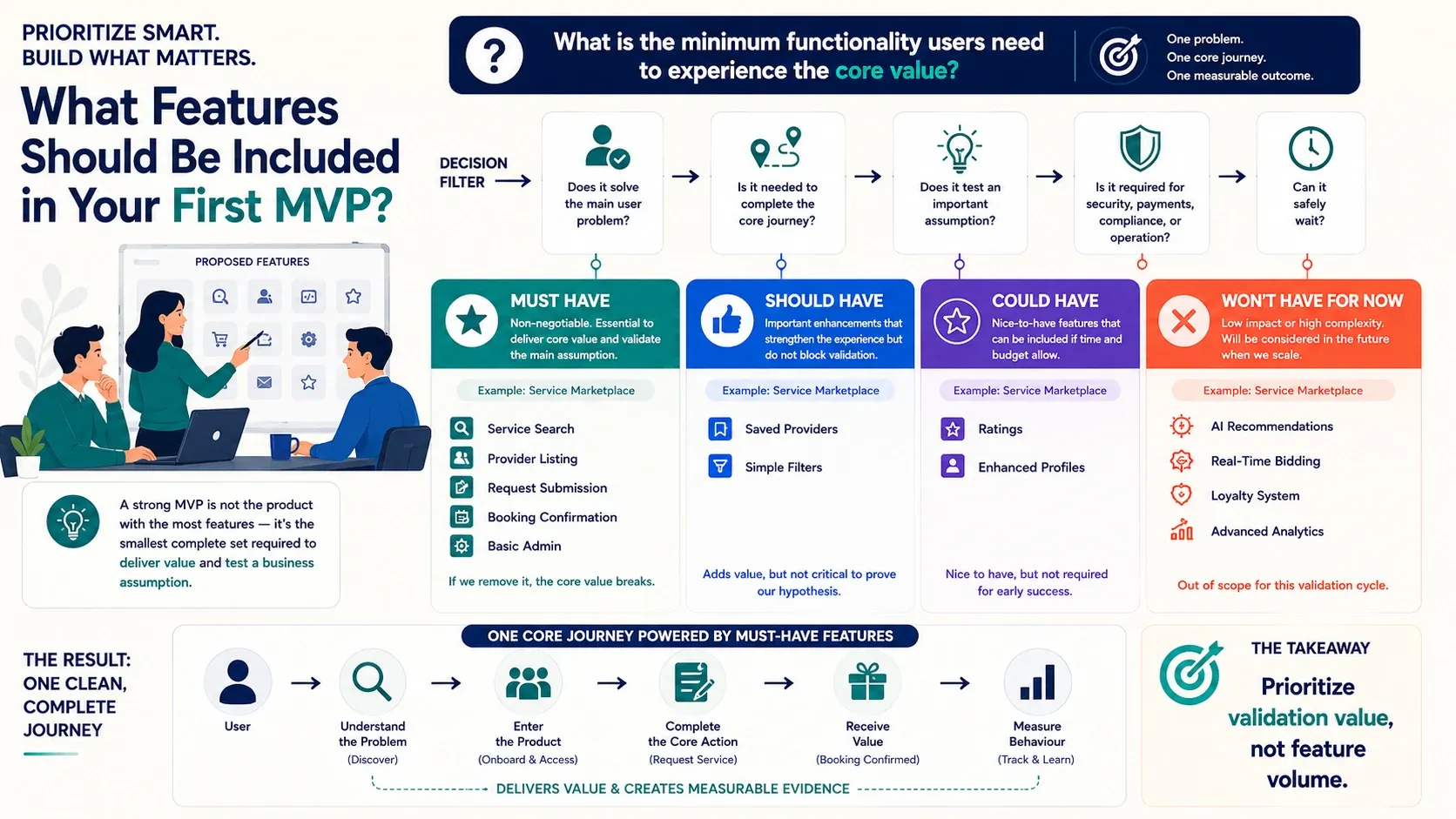
“What is the minimum functionality users need to experience the core value of our product?”
1. Start With One Essential User Journey
Before creating an MVP feature list, identify the single most important journey your customer needs to complete.
For a booking platform, that could be:
Find a service → choose an available time → make a booking → receive confirmation.
For an invoicing application:
Create an invoice → send it to a customer → track its status.
For an AI application:
Provide an input → generate a useful result → review or save the output.
Recent MVP development guidance consistently emphasizes designing the first release around a complete core user journey rather than a long collection of loosely connected features.
If removing a feature prevents users from completing that journey, it is probably a must-have. If users can still receive the product’s core value without it, the feature may be better suited to a later release.
2. Core Problem-Solving Functionality
Every MVP needs functionality that directly solves the problem you are testing.
Imagine you are creating a marketplace connecting customers with local professionals. The core functionality might allow professionals to list a service and customers to find and request that service.
Features such as loyalty programs, advanced recommendations, sophisticated reporting, or extensive profile customization may eventually be valuable. But they do not necessarily prove the initial assumption: Do customers want to use the platform to find and engage these professionals?
Your first MVP should prioritize features that help answer your most important business question.
3. User Accounts and Access When Required
Authentication is common in MVPs, but it should be included because the product needs it, not simply because most applications have a login screen.
If users need to save information, access private data, make purchases, or return to personalized content, basic signup and login functionality may be necessary.
Keep it simple. Multiple social-login options, complex profiles, detailed preference settings, and numerous account types can often wait.
Where different users have different permissions, for example, a customer and an administrator, the MVP should also provide the minimum role and access controls necessary to protect information and operate the service safely.
4. Payments - If Payment Is Part of the Hypothesis
Does your MVP need payments?
Ask what you are trying to validate.
If the central question is whether customers will pay for your service, payment functionality may be an essential MVP feature. If you are initially testing whether users will register for a pilot or complete a particular workflow, full payment functionality may not yet be required.
This distinction matters because an MVP is a learning vehicle, not simply a smaller software project. MVPHUB recommends defining a measurable product hypothesis, target user, and essential journey before extensive development begins.
5. Basic Security and Reliable Error Handling
“Minimum” should never mean careless.
An MVP used by real customers still needs an appropriate level of security and reliability for its intended environment. Depending on the product, that can include authentication, authorization, secure handling of sensitive information, input validation, and protection of secrets.
You should also consider what happens when things go wrong.
What happens when a payment fails? What if a user enters invalid information? What if an integration becomes unavailable or a session expires?
MVPHUB’s readiness framework specifically considers authentication, roles and permissions, data protection, failure paths, infrastructure, logging, backups, and technical ownership when assessing readiness for real users.
A controlled pilot and a public product handling sensitive information will naturally require different levels of engineering and operational readiness.
6. Analytics and Feedback
An MVP should help you learn, so you need a way to determine what users actually do.
At minimum, identify events related to your core hypothesis. Depending on the product, you might measure:
- Registrations
- Completion of the core journey
- Bookings or transactions
- Drop-off points
- Repeat usage
- Subscriptions or purchases
You also need a simple way to collect qualitative feedback. User interviews, feedback forms, support conversations, or pilot sessions can reveal why people behave the way they do.
Without measurement and feedback, you may have launched software—but you have made it harder to achieve the learning objective of an MVP.
How to Prioritize Your MVP Features
One practical approach is the MoSCoW method, which divides requirements into Must-have, Should-have, Could-have, and Won’t-have-for-now categories. This framework is also prominent in current MVP feature-prioritization guidance.
For each proposed feature, ask:
- Does it directly help solve the user’s main problem?
- Is it necessary to complete the core user journey?
- Does it help test an important business assumption?
- Is it required for security, payments, compliance, or basic operation?
- Could we add it later without weakening the initial test?
Features that fail these tests should generally move to the post-MVP roadmap.
What Should You Leave Out of Your First MVP?
The biggest challenge in MVP feature prioritization is often deciding what not to build.
Advanced dashboards, extensive customization, multiple integrations, sophisticated reporting, referral systems, secondary user roles, and elaborate automation can often wait unless they directly support the hypothesis being tested.
This does not mean those ideas are bad. It means there is not enough evidence yet to justify including them in Version 1.
Current MVP guidance repeatedly warns against allowing the first release to become a smaller version of the complete future product rather than a focused validation tool.
Build for Learning, Not for Feature Count
A successful first MVP is not the product with the longest feature list. It is the product that lets the right users complete an important journey and gives you useful evidence about what to do next.
Start with the customer problem. Define one essential journey. Include only the features necessary to deliver that value safely and reliably. Then measure what happens.
The feedback from real users can tell you whether to improve the experience, add functionality, change direction, or invest in scaling.
💡 Have a software idea?
Receive a focused MVP scope, fixed price and achievable delivery timeline.
Book a free consultation with MVPHUBFrequently Asked Questions
What features should an MVP have?
An MVP should contain the minimum features required for a defined customer to complete the core user journey and experience meaningful value. It should also include the security, reliability, measurement, and operational capabilities appropriate to its intended use.
How many features should an MVP include?
There is no universal number. Some current MVP guides suggest roughly three to five core features for focused products, but feature count should not become an arbitrary rule. The correct scope is the smallest set necessary to test your core hypothesis with real users.
Should an MVP include login and registration?
Only when they are necessary. If users need private accounts, saved information, personalized experiences, or protected functionality, authentication is likely required. Otherwise, adding an account system may introduce unnecessary scope.
Should an MVP include payment functionality?
If willingness to pay is a central assumption you need to test, payments may be essential. If the first release is a controlled pilot designed to test another behavior, payments might be deferred.
How do you prioritize MVP features?
Start with the essential user journey and evaluate each feature according to user value, validation impact, necessity, risk, and development effort. Frameworks such as MoSCoW can help separate must-haves from features that should wait.
What should not be included in an MVP?
Avoid features that do not help users complete the core journey, test an important assumption, or satisfy necessary operational, security, or compliance requirements. Advanced customization, unnecessary integrations, complex reporting, and speculative features are common candidates for later releases.
