
MVP vs MMP vs MLP: Key Differences Explained
MVP, MMP, and MLP describe three different approaches to early product development.
- An MVP tests whether customers need the solution.
- An MMP prepares the product for broader commercial adoption.
- An MLP aims to create an experience customers value and actively prefer.
They are not simply three names for a basic product. Each one addresses a different business question.
MVP vs MMP vs MLP: Quick Comparison
| Area | MVP | MMP | MLP |
|---|---|---|---|
| Full term | Minimum Viable Product | Minimum Marketable Product | Minimum Lovable Product |
| Main objective | Validate demand | Support wider commercialization | Build customer preference |
| Central question | Will people use or pay for it? | Can we market and sell it confidently? | Will customers enjoy and recommend it? |
| Primary users | Selected early adopters | Broader target market | Users expecting a distinctive experience |
| Feature scope | One core journey | Core journey plus commercial essentials | Core value plus memorable experience |
| Main evidence | Usage, conversion, feedback | Acquisition, revenue, retention | Engagement, loyalty, referrals |
| Typical stage | Market validation | Commercial expansion | Differentiation and stronger adoption |
What Is a Minimum Viable Product?
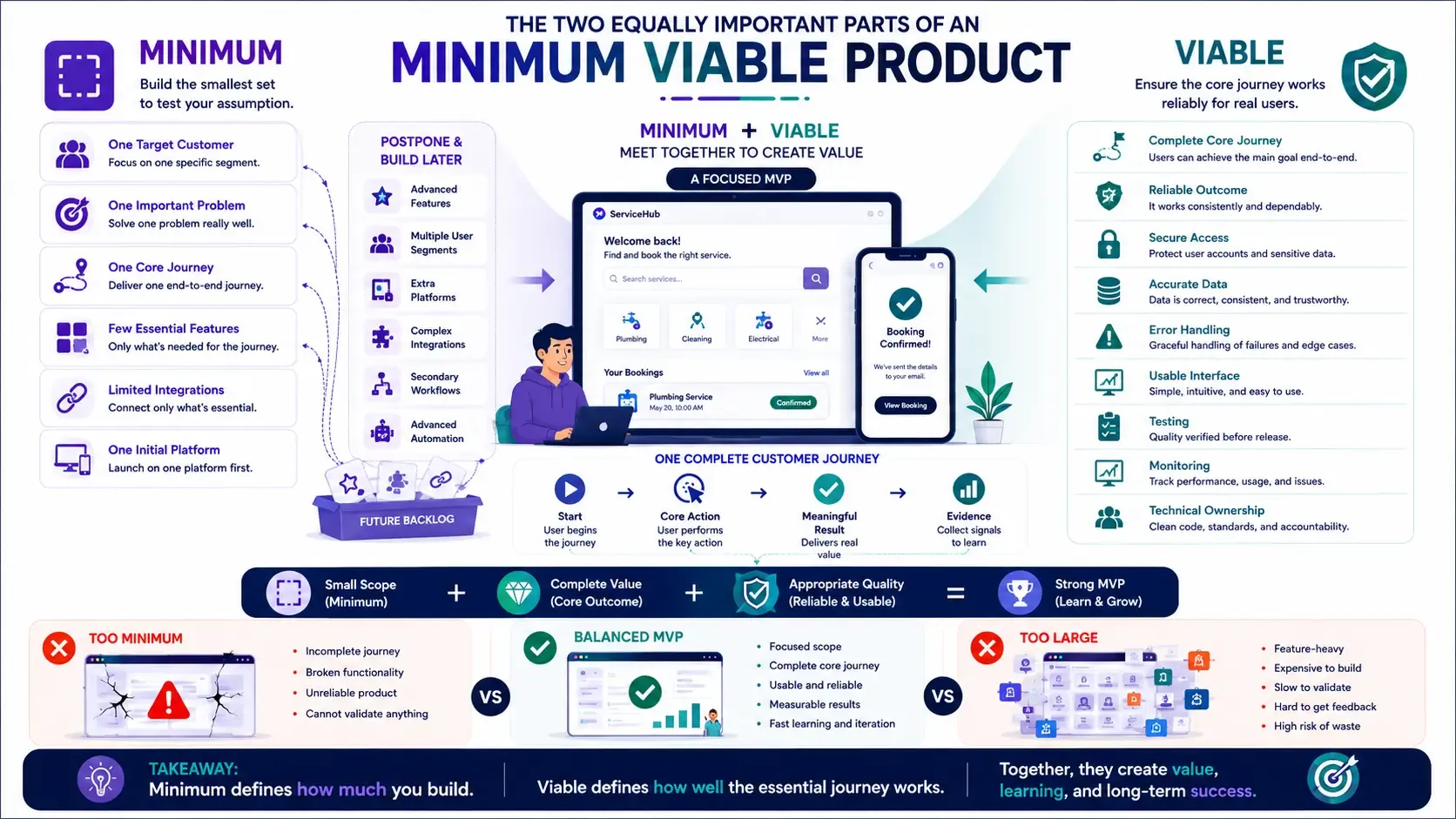
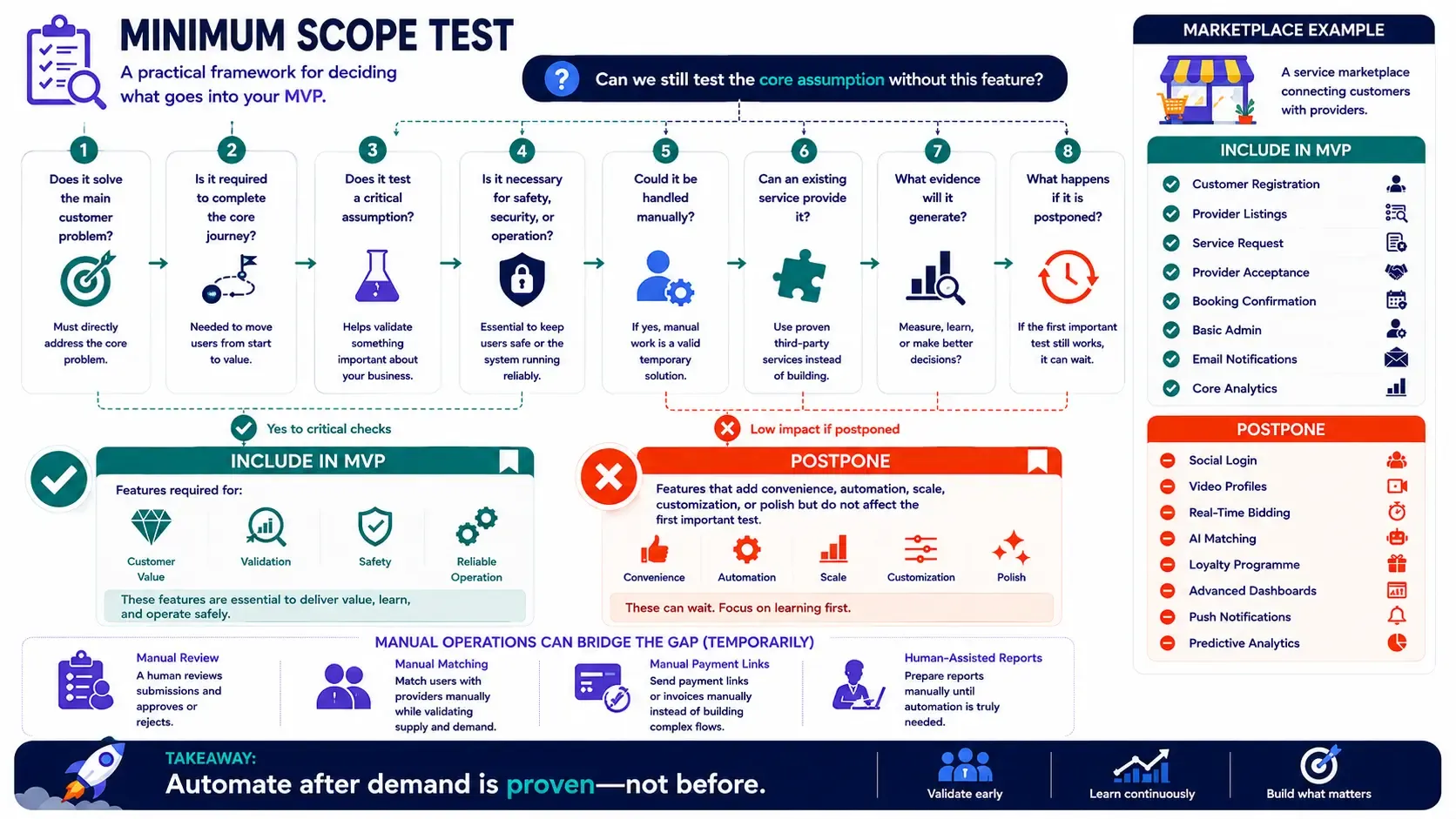
An MVP is the smallest functional product that delivers meaningful value to real early users and tests a critical business assumption.
It usually focuses on:
- One target customer
- One important problem
- One complete user journey
- One measurable assumption
For example, a service-booking MVP might allow customers to select a service, choose a time, confirm the booking, and receive a notification.
Advanced reports, loyalty programmes, multiple payment providers, complex automation, and native mobile applications may wait.
“Minimum” refers to scope—not poor quality. A production-ready MVP still needs appropriate security, validation, testing, error handling, deployment, and technical ownership.
What Is a Minimum Marketable Product?
A Minimum Marketable Product is the smallest product that a business can confidently promote and sell to a broader market.
An MVP may work well for a controlled group of early adopters who tolerate manual processes or limited functionality. An MMP must meet the expectations of customers who are less forgiving.
Compared with an MVP, an MMP may require:
- More polished onboarding
- Stronger self-service capabilities
- Clear pricing and payment options
- Improved administration
- Customer support processes
- Legal and privacy documentation
- Better analytics and monitoring
- Scalable infrastructure
- Sales and marketing readiness
- Reliable operational workflows
An MMP does not need every planned feature. It needs enough commercial and operational maturity to support repeatable acquisition and delivery.
What Is a Minimum Lovable Product?
A Minimum Lovable Product focuses on creating an early experience that customers do not merely tolerate but genuinely appreciate.
It aims to give users a reason to prefer, remember, and recommend the product.
A lovable experience may come from:
- Exceptionally simple onboarding
- Clear and thoughtful design
- Faster completion of a frustrating task
- Personalized results
- Helpful communication
- A distinctive brand personality
- Responsive customer support
- One feature delivered remarkably well
An MLP does not mean adding numerous decorative features. Lovability often comes from removing friction and understanding what matters most to the customer.
A product can be technically functional without being pleasant. An MLP intentionally addresses that gap.
Are MVP, MMP, and MLP Sequential Stages?
They can represent a progression, but the path is not always rigid.
A common journey is:
- MVP: Validate that customers need the solution.
- MMP: Prepare it for repeatable marketing and sales.
- MLP: Strengthen customer preference, loyalty, and advocacy.
However, founders should consider usability and customer experience from the beginning. An MVP does not need to feel careless simply because it is focused.
Similarly, a startup should not invest heavily in making an unvalidated idea “lovable” before confirming that it solves a meaningful problem.
Example: Online Learning Platform
| MVP | MMP | MLP |
|---|---|---|
| Tutor creates a class | Self-service tutor onboarding | Remarkably simple class setup |
| Student enrols | Subscription and payment options | Personalized learning experience |
| Student joins a lesson | Automated receipts and policies | Helpful learning reminders |
| Tutor shares materials | Improved admin and reporting | Thoughtful progress feedback |
| Basic email notifications | Support and monitoring processes | Distinctive, engaging interface |
The MVP proves that tutors and students will use the platform. The MMP supports wider commercial growth. The MLP gives customers a stronger reason to stay and recommend it.
Which Product Stage Should You Build?
Choose an MVP when:
- Customer demand remains uncertain.
- You need to test the core business assumption.
- The first launch will involve selected early adopters.
- You want to control initial cost and scope.
Choose an MMP when:
- The core product has been validated.
- You are preparing for wider marketing and sales.
- Manual processes are limiting growth.
- Customers expect better self-service and support.
Choose an MLP when:
- Functional value has been established.
- The market contains similar alternatives.
- Retention and differentiation are priorities.
- You understand what customers value emotionally and practically.
Where Does AI Fit?
AI can accelerate discovery, wireframing, development, testing, personalization, and documentation across all three stages.
However, AI cannot replace market evidence or product judgment. Professionally engineered oversight is still needed to control scope, verify security, maintain consistent architecture, and determine whether the product is ready for real customers.
Build for the Evidence You Need Next
An MVP validates demand. An MMP supports commercialization. An MLP strengthens customer preference.
The right stage is not the one with the most features. It is the smallest product capable of achieving your next important business objective.
From Viable Idea to Valuable Product
MVPHUB helps founders define and launch focused, production-ready MVPs that create a strong foundation for commercialization, growth, and customer loyalty. Book a free consultation with MVPHUB to identify your current product stage and determine what you should build next.
Book a free consultation with MVPHUBFrequently Asked Questions
What is the main difference between an MVP, MMP, and MLP?
An MVP (Minimum Viable Product) is built to validate whether customers need and will use a solution. An MMP (Minimum Marketable Product) adds the commercial readiness needed to sell to a broader audience. An MLP (Minimum Lovable Product) focuses on creating an experience customers value, prefer, and are more likely to recommend.
Should I build an MVP, MMP, or MLP first?
Most unvalidated product ideas should start with an MVP because the first priority is proving demand. An MMP is more appropriate when the core product has already been validated and you are preparing to scale sales or marketing. An MLP becomes especially valuable when customer experience, retention, and differentiation are important.
Is an MVP always the first stage of product development?
Not necessarily. Some businesses already have strong market evidence, an existing customer base, or validated demand and may be able to move directly toward an MMP. However, startups with significant uncertainty usually benefit from validating the core assumptions through an MVP before investing in broader commercialization.
Can an MVP also be a Minimum Lovable Product?
Yes. An MVP can still provide an enjoyable and thoughtful user experience. “Minimum” refers to the scope required to validate the product, not to poor design or low quality. A focused MVP can be both viable and pleasant without adding unnecessary features.
What features should an MVP include compared with an MMP?
An MVP should contain only the features required to complete the core user journey and test the most important business assumption. An MMP usually adds capabilities such as improved onboarding, payments, administration, analytics, customer support, legal requirements, and operational processes needed to support broader commercial adoption.
When should an MVP become an MMP?
You should consider moving from MVP to MMP when there is credible evidence that customers want the core solution and the main challenge has shifted from validation to commercialization. This may happen when early users are consistently engaging with the product, paying for it, requesting wider functionality, or when manual processes begin limiting growth.
What makes a product “lovable” rather than simply viable?
A lovable product removes important friction and delivers part of the customer experience exceptionally well. This could come from easier onboarding, faster workflows, thoughtful personalization, clearer communication, excellent support, or a distinctive user experience. It does not necessarily require more features.
Is an MMP the same as a full product?
No. An MMP is still deliberately limited in scope. It contains enough functionality, reliability, operational support, and commercial readiness to market and sell the product effectively, but it does not need to include every feature on the long-term product roadmap.
How do I know when my MVP has been successfully validated?
Validation should be based on real customer behavior rather than positive feedback alone. Useful evidence can include users completing the core journey, returning to the product, paying for it, converting from trials, recommending it, or demonstrating that the product solves the intended problem better than their existing alternative.
Can AI help build an MVP, MMP, or MLP faster?
Yes. AI can accelerate activities such as research, prototyping, UI development, coding, testing, documentation, and personalization. However, AI does not replace product validation or engineering judgment. Human oversight is still important for architecture, security, scope decisions, quality assurance, and determining whether the product is ready for real users.
