
Proof of Concept vs Prototype vs MVP: Key Differences Explained
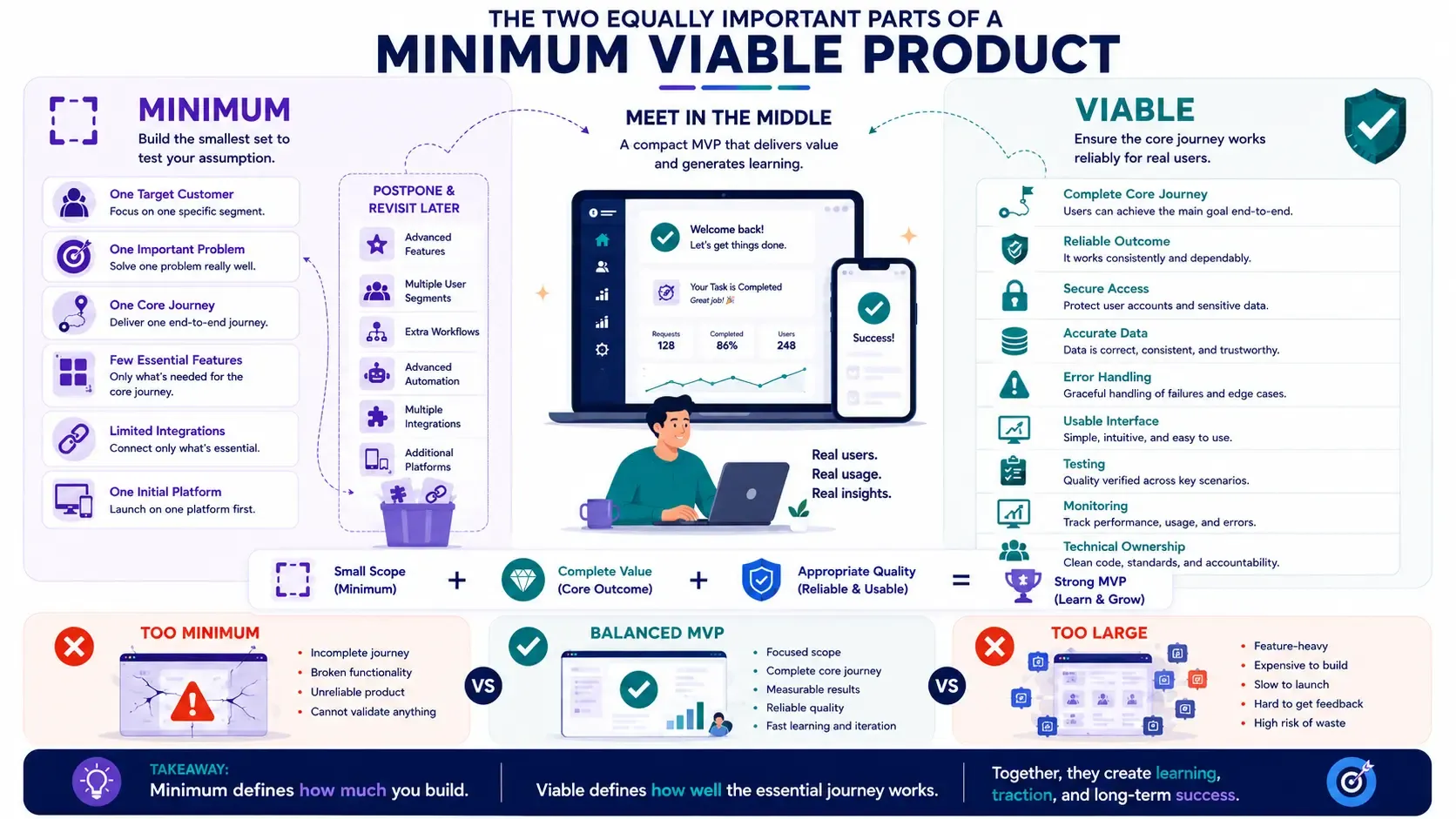
A Proof of Concept (POC), prototype, and Minimum Viable Product (MVP) help reduce uncertainty at different stages of digital product development.
A POC tests whether an idea is technically possible. A prototype explores how the product could look and work. An MVP allows real users to experience its core value and helps the business validate market demand.
Understanding these differences helps founders avoid investing in the wrong deliverable—or launching something that is not ready for customers.
Quick Comparison
| Area | Proof of Concept | Prototype | MVP |
|---|---|---|---|
| Primary purpose | Test technical feasibility | Test design and usability | Test customer demand |
| Main question | Can we build it? | How should it work? | Will customers use or pay for it? |
| Typical users | Internal technical team | Stakeholders and test users | Real early customers |
| Functionality | Limited technical experiment | Usually simulated or incomplete | Working core journey |
| Production-ready | No | Usually no | Yes, for controlled use |
| Main evidence | Technical result | Usability feedback | Real customer behaviour |
| Typical output | Experiment or technical demo | Wireframe or clickable interface | Deployed usable product |
What Is a Proof of Concept?
A Proof of Concept is a limited experiment created to determine whether a technical idea is achievable.
It is useful when the greatest uncertainty is technical rather than commercial.
A POC might test whether:
- An AI model can classify specific images
- A legacy system can connect to a modern platform
- A device can transmit data reliably
- An external API supports a required workflow
- A large dataset can be processed within an acceptable time
- A proposed algorithm produces sufficiently accurate results
A POC is normally used internally. It may contain temporary code, limited security, test data, and no polished interface.
Its purpose is to produce a technical answer, not to serve customers.
What Is a Prototype?
A prototype is a visual or interactive representation of the proposed product.
It helps stakeholders understand the experience before full development begins.
Prototypes can range from simple sketches to high-fidelity clickable screens. They are commonly used to test:
- User journeys
- Screen layouts
- Navigation
- Content hierarchy
- Feature placement
- Usability
- Stakeholder expectations
A prototype may look realistic without having a functional backend, database, security controls, integrations, or reliable business logic.
It can show what happens after a customer presses “Pay,” but it may not process an actual payment.
What Is an MVP?
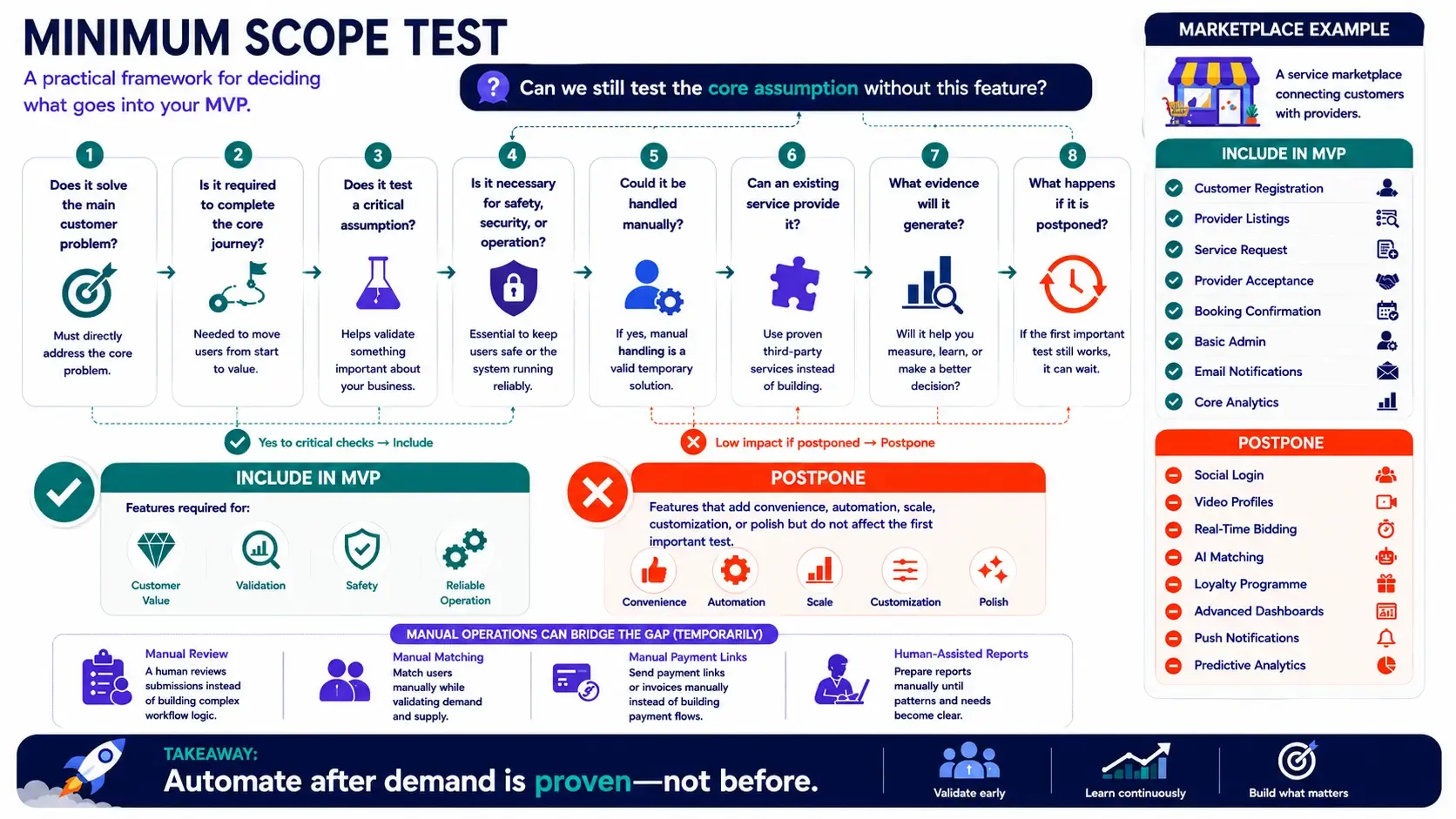
An MVP is the smallest functional product that delivers meaningful value to real early users while testing an important business assumption.
It should provide one complete core journey.
For example, a booking MVP could allow customers to:
- View available services.
- Select a date and time.
- Submit their details.
- Confirm the booking.
- Receive confirmation.
The first version may exclude loyalty programmes, advanced reporting, multiple payment gateways, complex automation, and native mobile applications.
An MVP reduces feature scope, but it should still include appropriate security, validation, error handling, testing, deployment, and technical ownership.
Which One Should You Build?
Choose a POC when technical feasibility is uncertain
A POC is appropriate when the project depends on unproven technology, complex integrations, AI accuracy, device communication, or performance targets.
The goal is to resolve the technical risk before investing in the complete experience.
Choose a prototype when the experience is uncertain
A prototype is appropriate when you need to visualize the product, align stakeholders, test navigation, collect usability feedback, or demonstrate the concept.
It is particularly valuable before development because design changes are usually less expensive at this stage.
Choose an MVP when market demand is uncertain
An MVP is appropriate when the idea is technically achievable, but you need evidence that customers will use, value, or pay for the solution.
It provides stronger evidence because real users interact with a working product rather than describing what they might do.
Do You Need All Three?
Not always.
A straightforward booking platform may use an existing technical approach, so a separate POC may be unnecessary. The team could move from wireframes to a prototype and then an MVP.
A technically complex AI product may require:
- A POC to test model accuracy.
- A prototype to validate the user experience.
- An MVP to test demand with real customers.
The correct sequence depends on the biggest unanswered question.
Common Mistakes to Avoid
Treating a prototype as a finished MVP
A polished, clickable design may impress stakeholders, but it is not customer-ready without functional systems behind it.
Turning a POC directly into production
POC code is often written for experimentation. It may need to be restructured, secured, tested, and documented before becoming part of a customer-facing product.
Building an MVP before resolving technical uncertainty
If the product depends on an untested technology, a focused POC may prevent expensive development based on an incorrect assumption.
Building too much before customer validation
A feature-heavy product may delay learning and increase financial exposure. An MVP should focus on one important customer outcome.
Can AI Accelerate All Three?
AI can support:
- Technical experiments and code generation for POCs
- Wireframes and interface concepts for prototypes
- Development, testing, and documentation for MVPs
However, AI-generated output still requires professional evaluation. A realistic-looking interface may not be functional, while generated code may contain security weaknesses, incorrect logic, or unsuitable architecture.
The strongest approach combines AI-assisted speed with professional product and engineering oversight.
Test the Right Question at the Right Stage
The simplest way to choose is to identify your biggest uncertainty:
- Can it be built? Start with a POC.
- How should it work? Build a prototype.
- Will customers use or pay for it? Launch an MVP.
Each approach has a different purpose. Choosing correctly helps you reduce risk, control costs, and move toward a launchable product with stronger evidence.
Move From Idea to Evidence
MVPHUB helps founders validate technical assumptions, design practical product experiences, and build production-ready MVPs through AI-accelerated professional engineering.
Book a free consultation with MVPHUBFrequently Asked Questions
What is the main difference between a POC, prototype, and MVP?
A Proof of Concept (POC) tests whether an idea is technically possible, a prototype tests how the product should look and work, and an MVP tests whether real users will use or pay for the product. Each one reduces a different type of uncertainty.
Should I build a POC, prototype, or MVP first?
Start with the option that addresses your biggest unanswered question. If technical feasibility is uncertain, begin with a POC. If the user experience is unclear, build a prototype. If the technology and experience are sufficiently understood but market demand is uncertain, an MVP is usually the next step.
Is a prototype the same as an MVP?
No. A prototype can look and behave like a real product without having a working backend, database, payment system, security controls, or complete business logic. An MVP is a functional product that real early users can use to complete a meaningful core journey.
Is a POC production-ready software?
Usually not. A POC is designed to test a technical assumption as quickly as possible. It may use temporary code, test data, limited security, and simplified architecture. If the POC succeeds, parts of it may need to be redesigned or rebuilt before being used in a production product.
Can I skip the POC and go directly to an MVP?
Yes, if the technical approach is already well understood. For example, a relatively standard booking, marketplace, or business management platform may not require a separate POC. A POC becomes more valuable when the product depends on uncertain AI performance, unusual integrations, hardware, complex algorithms, or demanding performance requirements.
Can I skip the prototype and start developing the MVP?
It is possible, but not always advisable. Even a lightweight wireframe or clickable prototype can help clarify user journeys, expose usability problems, and reduce misunderstandings before development begins. For very simple products, however, a full high-fidelity prototype may not be necessary.
Does an MVP need to be production-ready?
An MVP should be ready for the level of real-world usage it is intended to support. It does not need every feature or enterprise-level scalability from day one, but it should include appropriate security, testing, error handling, data protection, monitoring, deployment, and operational reliability.
How much functionality should an MVP include?
An MVP should contain the smallest set of functionality needed to deliver one meaningful customer outcome and test an important business assumption. The goal is not to reach a specific number of features, but to provide a complete core journey that produces useful evidence from real users.
What is the difference between an MVP and a poorly built product?
A true MVP is intentionally limited in scope, not in basic quality. Removing advanced reports, automation, secondary integrations, or additional user roles can be sensible. Ignoring security, testing, backups, error handling, or maintainability simply creates unnecessary technical risk.
Can a POC become part of the final MVP?
Sometimes. If the POC was developed using suitable engineering standards, parts of its code or technical approach may be reusable. However, experimental POC code should not automatically be moved into production without reviewing its architecture, security, performance, maintainability, and testing.
