
Prototype vs MVP vs Full Product: What Should You Build First?
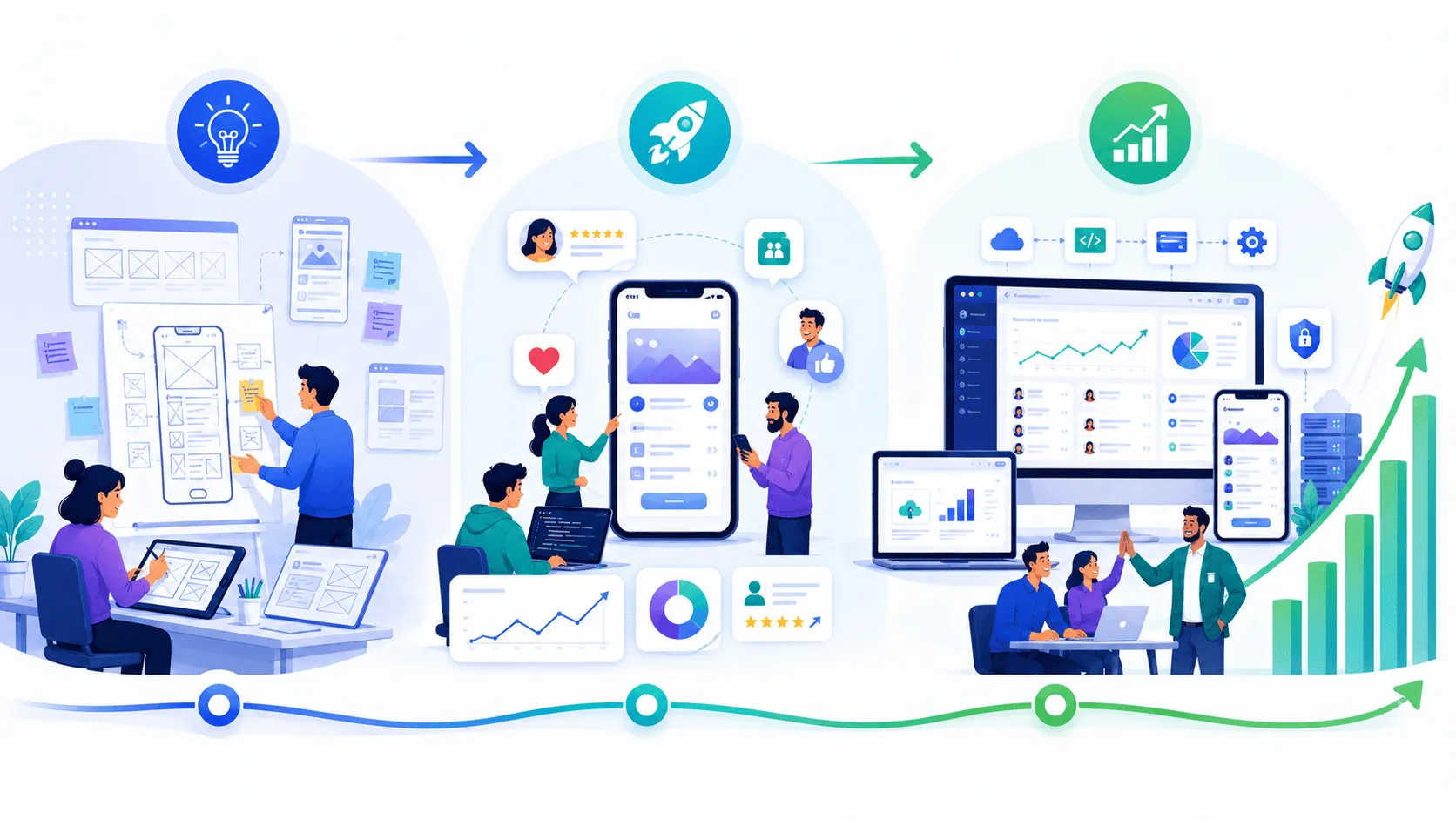
When you have an exciting product idea, it can be tempting to start developing the complete application immediately. You may already have a list of features, integrations, design ideas, and future expansion plans.
However, building everything at once is rarely the safest starting point for a new startup.
Before choosing what to build, you need to understand three commonly confused stages of product development: the prototype, the Minimum Viable Product, and the full product.
Each serves a different purpose. A prototype tests how the idea could work. An MVP tests whether people will actually use it. A full product supports a validated business at a larger scale.
Prototype vs MVP vs Full Product at a Glance
| Area | Prototype | MVP | Full product |
|---|---|---|---|
| Main purpose | Test the concept and experience | Validate demand with real users | Serve the wider market |
| Typical users | Founders, stakeholders and test participants | Early adopters and pilot customers | Paying customers at scale |
| Functionality | Simulated or partly functional | Functional core journey | Broader, mature functionality |
| Market-ready | Usually no | Yes, for a selected audience | Yes |
| Customer data | Opinions and usability feedback | Real usage and commercial evidence | Growth and operational data |
| Investment | Low | Moderate | High |
What Is a Prototype?
A prototype is an early representation of how a product may look, feel, or operate. It may take the form of paper sketches, wireframes, clickable screens, or a limited technical demonstration.
The Interaction Design Foundation defines prototypes as early product models that simulate design and functionality. Their purpose is to help teams explore and test ideas before committing to full implementation. Interaction Design Foundation
For example, a prototype of a food-delivery application may allow someone to click through restaurant selection, meal ordering, and checkout screens. However, it may not connect to real restaurants, process payments, or place actual orders.
A prototype helps answer questions such as:
- Can users understand the proposed journey?
- Is the navigation clear?
- Does the solution communicate its value?
- Which design option works best?
- Is the idea technically possible?
Because it does not require every feature to function, a prototype can be created relatively quickly and revised before expensive development begins.
What Is an MVP?
An MVP, or Minimum Viable Product, is the smallest functional version of a product that delivers meaningful value to real users.
Unlike a prototype, an MVP operates in a real environment. Customers can complete its central journey, and the business can observe actual behaviour.
ProductPlan defines an MVP as a product with enough functionality to attract early adopters and validate the idea during the early product-development cycle. ProductPlan’s MVP guide
An MVP for the food-delivery example might include:
- Customer registration
- A limited selection of restaurants
- Menu browsing
- Order placement
- Payment processing
- Basic delivery updates
Features such as loyalty points, advanced recommendations, scheduled orders, and multiple payment options could be introduced later.
The objective is not to build a low-quality application. “Minimum” refers to the number of features, not the standard of design, security, or reliability.
An MVP helps answer more commercially important questions:
- Will customers use the product?
- Will they return after the first experience?
- Are they willing to pay?
- Which features produce the most value?
- Does the business model work in practice?
What Is a Full Product?
A full product is a mature solution designed to serve a broader customer base and support established business operations.
It normally includes a more comprehensive user experience, greater automation, stronger infrastructure, advanced security controls, customer support tools, analytics, integrations, and features required by different user groups.
A full product is never truly “finished.” Customer expectations, technologies, regulations, and competitor offerings continue to change. Even established applications require regular improvement.
The important difference is that investment in the full product should ideally be supported by evidence. By this stage, the business should have a clearer understanding of its customers, core value proposition, revenue model, and most valuable features.
What Should You Build First?
For most new digital-product ideas, the safest sequence is:
Prototype → MVP → Full product
Start with a prototype when the experience, workflow, or technical approach remains unclear. It allows you to test the product direction with limited investment.
Move to an MVP once the core problem, target audience, and proposed journey are sufficiently understood. The MVP lets you replace opinions with evidence from real usage.
Develop toward a full product after the MVP demonstrates meaningful signals such as repeat usage, pilot adoption, customer referrals, paid subscriptions, or measurable operational value.
ProductPlan’s current product-development guidance follows a similar progression: research, create a prototype, release a genuinely usable MVP, and learn from the market before expanding. Product development cycle
When Can You Skip the Prototype?
A prototype may not always be necessary. You might proceed directly to an MVP when:
- The product journey is simple and already understood.
- The solution uses a familiar interaction pattern.
- Early customers have clearly confirmed their requirements.
- A basic functional version would cost little more than a prototype.
However, skipping prototyping becomes risky when the application has complicated workflows, several user roles, an unfamiliar interface, or expensive technical integrations.
When Is Full Product Development Appropriate?
Starting with a full product can make sense when the market and requirements are already well established. Examples include internal enterprise systems, replacements for existing software, contractually defined client solutions, or regulated products that must meet a minimum compliance standard before release.
Even in these cases, phased development remains valuable. Atlassian describes agile product development as an iterative process built around manageable releases, adaptability, and customer feedback. Atlassian’s agile project-management guide
Common Mistakes to Avoid
One common mistake is treating a polished prototype as evidence of market demand. Users may enjoy clicking through an attractive design without being willing to adopt or purchase the actual product.
Another is calling an incomplete or unreliable application an MVP. An MVP must successfully deliver its promised core value.
Founders can also remain in the MVP stage for too long. Once demand has been validated, the product must evolve to improve retention, reliability, scalability, security, and competitiveness.
Finally, avoid filling the first release with optional features. Every additional feature increases cost and delays the customer feedback that should guide future investment.
Final Thoughts
A prototype, MVP, and full product are not competing options. They are different tools for reducing uncertainty at different stages.
Use a prototype to test the experience. Use an MVP to test customer demand. Invest in a full product when the evidence supports expansion.
For most startups, building in this sequence offers the best balance between speed, cost, learning, and risk. It allows the product to grow around genuine customer behaviour rather than untested assumptions.
MVPHUB helps founders move from idea validation and prototyping to a focused, production-ready MVP- without investing prematurely in unnecessary functionality.
💡 Not sure whether you need a prototype or an MVP?
Talk to MVPHUB and identify the right first step for your product idea. Contact us →
Frequently Asked Questions
Is a prototype the same as an MVP?
No. A prototype demonstrates a product concept or experience. An MVP is functional and used by real customers to test demand.
Should every startup build a prototype first?
Not always. A straightforward, well-understood idea may proceed directly to an MVP. Complex or unfamiliar experiences generally benefit from prototyping.
Can an MVP become the full product?
Yes. A well-engineered MVP can be expanded progressively as customer feedback validates new features and business requirements.
Is an MVP suitable for paying customers?
Yes. Charging customers can provide stronger validation than collecting opinions alone, provided the MVP delivers reliable value.
💡 Have a software idea?
Receive a focused MVP scope, fixed price and achievable delivery timeline.
Book a free consultation with MVPHUB