
How to Identify the Riskiest Assumption Behind Your Product Idea
Every product idea depends on assumptions.
You may assume that customers experience a particular problem, care enough to solve it, understand your solution, trust your platform, or agree to pay your proposed price.
If one critical assumption is wrong, the entire business model may fail even when the application is technically excellent.
Startup assumption testing helps founders identify and test these uncertainties before investing heavily in product development.
What Is the Riskiest Assumption?
The riskiest assumption is the belief that:
- Essential to the product’s success
- Supported by limited reliable evidence
- Capable of invalidating the idea if proven wrong
For example, imagine a platform that uses AI to prepare legal documents.
Possible assumptions include:
- Small businesses struggle to prepare these documents.
- The problem occurs frequently enough to justify a product.
- Customers trust AI-assisted document generation.
- The technology can generate sufficiently accurate results.
- Customers will pay for each document.
- The business can reach customers at a sustainable cost.
The riskiest assumption may not be technical. If customers do not trust the output, better AI accuracy alone will not create a viable business.
Step 1: Describe the Product Without Features
Complete this sentence:
We believe [customer] experiences [problem] and will use [solution approach] to achieve [outcome].
Example:
We believe independent tutors struggle to manage enrolments and payments and will use a centralized platform to reduce administrative work.
This keeps the discussion focused on the customer and outcome rather than an unvalidated feature list.
Step 2: List Every Important Assumption
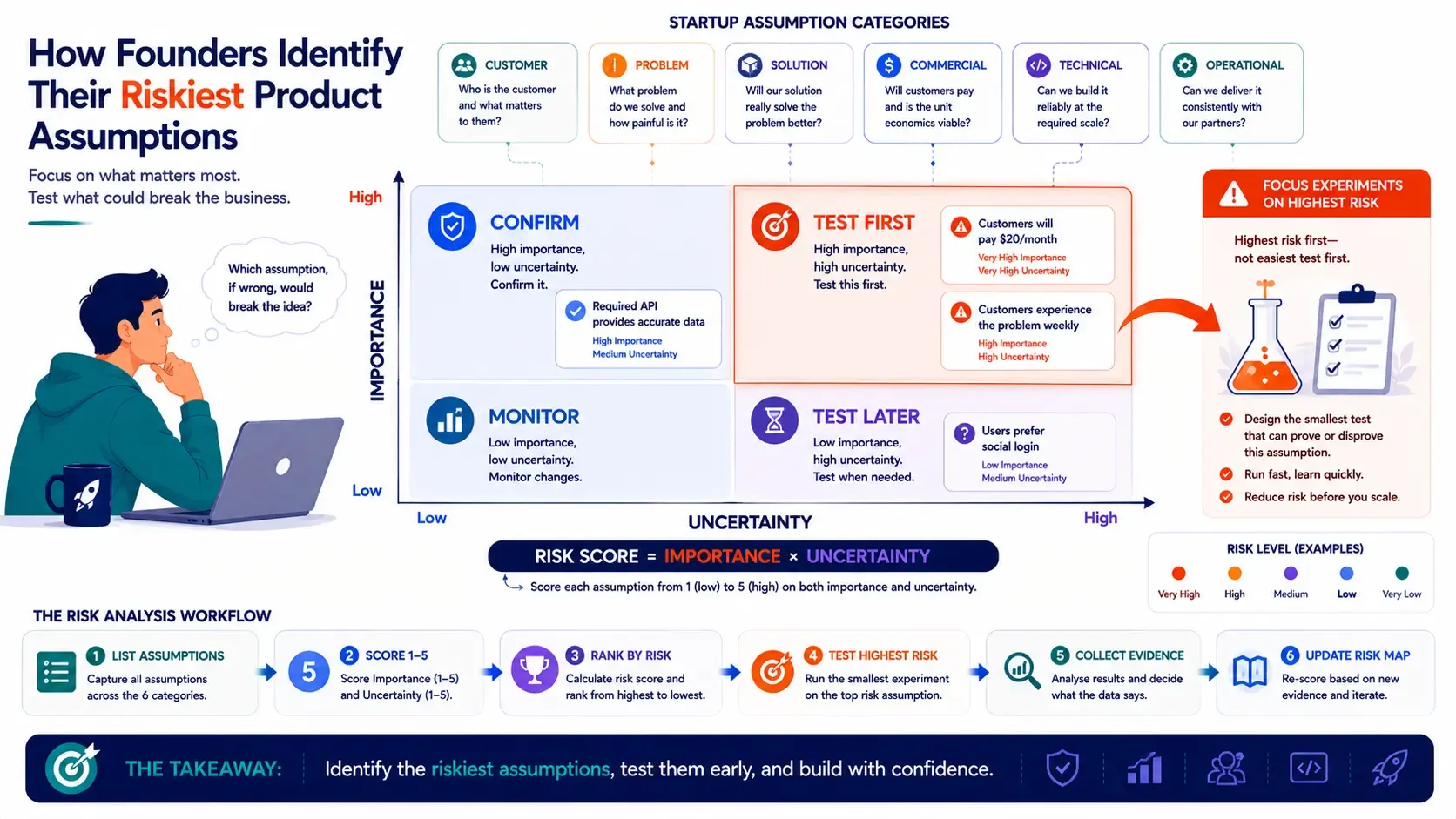
Organize assumptions into six categories.
Customer assumptions
- The target customer is clearly identifiable.
- The customer can be reached.
- The user and buyer are correctly understood.
Problem assumptions
- The problem genuinely exists.
- It occurs frequently.
- Its consequences are important.
Solution assumptions
- Customers understand the proposed approach.
- The solution fits their workflow.
- It creates a meaningful improvement.
Commercial assumptions
- Customers are willing to pay.
- The proposed price is acceptable.
- Customer acquisition can be sustainable.
Technical assumptions
- The required technology is feasible.
- Integrations will support the workflow.
- Performance and accuracy will be sufficient.
Operational assumptions
- The service can be delivered reliably.
- Required suppliers or partners will participate.
- Legal, security, and compliance requirements are manageable.
Write assumptions as statements that can be proven or disproven, not vague concerns.
Step 3: Score Importance and Uncertainty
Score every assumption from 1 to 5.
- Importance: How damaging would it be if this assumption were false?
- Uncertainty: How little reliable evidence do you currently have?
Multiply the scores:
Risk score = Importance × Uncertainty
| Assumption | Importance | Uncertainty | Risk score |
|---|---|---|---|
| Customers experience the problem weekly | 5 | 4 | 20 |
| Customers will pay $20 monthly | 5 | 5 | 25 |
| Social login is preferred | 2 | 3 | 6 |
| Required API provides accurate data | 5 | 3 | 15 |
Start with assumptions carrying the highest scores.
Do not test low-impact interface preferences while the central demand or payment assumption remains unsupported.
Step 4: Evaluate Your Existing Evidence
Separate evidence into three levels:
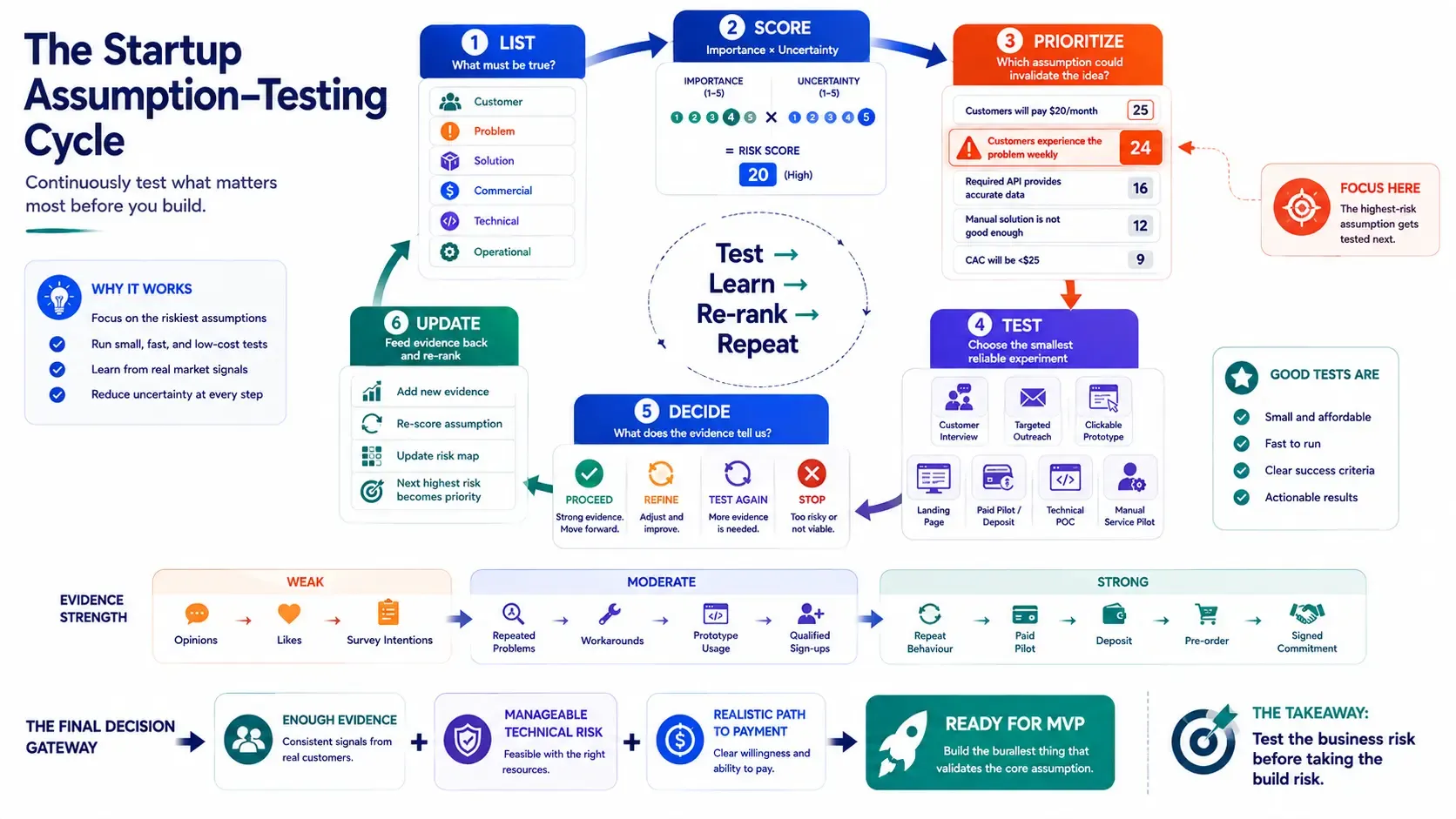
- Weak: Opinions, internal discussions, online likes, and survey intentions
- Moderate: Repeated customer problems, existing workarounds, waitlist sign-ups, and prototype usage
- Strong: Paid pilots, deposits, pre-orders, repeat usage, and signed commitments
Founders commonly mistake enthusiasm for validation. A customer saying “That sounds useful” is weaker than someone changing behaviour or making a financial commitment.
Step 5: Choose the Smallest Reliable Test
Match each assumption to an appropriate experiment.
| Risk | Recommended test | Evidence to collect |
|---|---|---|
| Problem may not matter | Customer interviews | Recent examples and existing workarounds |
| Target segment may be wrong | Segment-specific outreach | Response and meeting rates |
| Solution may be confusing | Clickable prototype | Task completion and observed friction |
| Demand may be weak | Landing page | Qualified conversions |
| Customers may not pay | Paid pilot or deposit | Financial commitment |
| Technology may not work | Technical proof of concept | Accuracy, performance, or integration result |
| Operations may be difficult | Manual service pilot | Delivery time, cost, and failure points |
The experiment should test one major assumption with minimal cost and effort.
Step 6: Define the Decision Before Testing
Establish success criteria in advance to avoid interpreting weak results too positively.
For example:
If at least 6 of 10 qualified interviewees describe the same recent problem and three agree to test a paid pilot, we will define the MVP.
Possible decisions include:
- Proceed: Evidence supports the assumption.
- Refine: The problem exists, but the segment or solution needs adjustment.
- Test again: Evidence is mixed, or the experiment was weak.
- Stop: A critical assumption is unsupported.
Stopping or changing direction is not a failed test. It prevents larger losses.
Step 7: Update the Risk Map
Testing one assumption often exposes another.
For example:
- Customers confirm the problem, but reject the price.
- Buyers accept the price but need security approval.
- Users understand the prototype, but cannot change their current process.
- The technology works, but its operating cost is too high.
Record what was learned, update the scores, and test the next highest-risk assumption.
Startup assumption testing is a cycle, not a one-time workshop.
When Should You Build the MVP?
Begin MVP development when:
- The target customer is specific.
- The problem is supported by repeated evidence.
- The core solution is understandable.
- Major technical risks are manageable.
- A realistic path to payment exists.
- One complete journey can test the next critical assumption.
- Success metrics are defined.
You do not need to eliminate every uncertainty. The MVP itself should test assumptions that require a working product and real user behaviour.
Test the Business Risk Before the Build Risk
The most polished product cannot rescue an idea built on a false critical assumption.
List what must be true, score each belief by importance and uncertainty, select the highest-risk assumption, and design the smallest experiment capable of producing reliable evidence.
Turn Your Strongest Evidence Into a Focused MVP
MVPHUB helps founders test product assumptions, define evidence-based scopes, and launch production-ready MVPs using AI-accelerated delivery and professional engineering. Book a free consultation with MVPHUB to identify your riskiest product assumption and determine the right validation or development action.
Book a free consultation with MVPHUBFrequently Asked Questions
What is startup assumption testing?
It is the process of identifying beliefs behind a business idea and using focused experiments to determine whether reliable evidence supports them.
Which assumption should a startup test first?
Test the assumption that is both essential to success and supported by the least reliable evidence.
Can customer interviews validate every assumption?
No. Interviews help validate problems and buying processes. Prototypes, technical POCs, behavioural experiments, and paid pilots are better for other assumptions.
Should assumption testing happen before an MVP?
Yes, particularly for assumptions that can be tested without software. An MVP should address uncertainties that require a working product and real user behaviour.
What happens if a critical assumption fails?
Refine the customer segment, problem, solution, price, or business model and test again. If the evidence remains weak, stop further investment.
