
Why Validate Your App Idea Before Full Development?
A promising app idea can be exciting. You may already imagine its features, design, launch campaign, and future users. However, enthusiasm alone does not prove that the market needs your application.
One of the costliest mistakes a founder can make is investing in full app development before confirming that the product solves a meaningful problem for a clearly defined audience.
App idea validation helps you replace assumptions with evidence. It allows you to test the problem, target audience, proposed solution, and market demand before committing a large budget to development.
What Is App Idea Validation?
App idea validation is the process of determining whether your proposed application solves a real problem and whether enough people are interested in using or paying for the solution.
According to Antler, market validation aims to establish reasonable confidence that customers will purchase a product or service. Testing feasibility early can prevent founders from investing significant effort in an idea that does not work. Antler’s market-validation guide
Validation does not guarantee that an application will succeed. Instead, it reduces uncertainty and helps you make better decisions before taking on greater financial and technical commitments.
A proper validation process should help answer four questions:
- Does the identified problem genuinely exist?
- Who experiences this problem most frequently?
- Are current solutions inadequate?
- Will users take meaningful action to obtain a better solution?
Why Validate an App Idea Before Full Development?
1. Confirm that you are solving a real problem
Founders sometimes begin with a feature they find interesting rather than a customer problem that needs solving.
For example, “AI Powered Scheduling Application” describes a solution. However, “small healthcare clinics lose appointments because their scheduling process is fragmented” describes a problem.
Validation helps you investigate how frequently the problem occurs, how serious it is, and how people currently manage it. If potential users do not consider the problem important, adding more features will not make the application valuable.
2. Reduce financial risk
Full application development can involve business analysis, UI/UX design, software engineering, integrations, security, testing, deployment, and ongoing maintenance. Developing an extensive feature set without validating demand can result in a polished product that few people want.
Validating the concept with interviews, prototypes, landing pages, or a focused MVP requires a smaller initial investment. If the evidence reveals a weak market response, you can improve or change the idea before consuming the full development budget.
3. Avoid building unnecessary features
Founders usually have many ideas for their first release. Yet users may only care about a small number of them.
App idea validation reveals which features contribute directly to the core solution. This allows the development team to prioritize essential functionality and postpone secondary capabilities until genuine demand is demonstrated.
A smaller, focused initial scope can also reduce technical complexity and make the product easier for early customers to understand.
4. Understand your target users
It is difficult to build an effective application for “everyone.” Validation helps identify the group most affected by the problem.
Customer interviews can reveal users’ existing behaviour, frustrations, purchasing authority, preferred devices, and willingness to change. This information influences product features, pricing, marketing messages, and even the platforms on which the application should be launched.
The goal is not to ask people whether they like your idea. People often provide encouraging answers. More useful questions explore what they currently do, what the problem costs them, and whether they have already searched or paid for an alternative.
5. Evaluate competitors and market gaps
Finding competitors does not necessarily mean your idea should be abandoned. Existing products may demonstrate that customers already spend money to solve the problem.
Study competitor features, pricing, customer reviews, app store ratings, and complaints. Negative reviews can expose unmet needs, complicated user experiences, missing integrations, or poor customer service.
Your application does not always need to be completely original. It may succeed by serving a particular segment more effectively or delivering a simpler, faster, or more affordable experience.
6. Reach the market sooner
Building a complete application can take months, while customer needs and competitive conditions continue to change.
A prototype or Minimum Viable Product allows you to test the concept earlier. A Minimum Viable Product contains just enough functionality to deliver the product’s main value and collect feedback from early customers.
This does not mean releasing an unreliable product. The MVP should be focused but usable, secure, and capable of completing its core user journey.
7. Build stronger evidence for investors
Investors rarely evaluate an idea based only on its originality. They also look for evidence that the team understands its customers and that the market is responding positively.
A validated prototype, waiting list, pilot agreement, active-user data, repeat usage, or early revenue can make an investment proposal more credible. Validation shows that business decisions are being guided by customer evidence rather than assumptions.
How Can You Validate an App Idea?
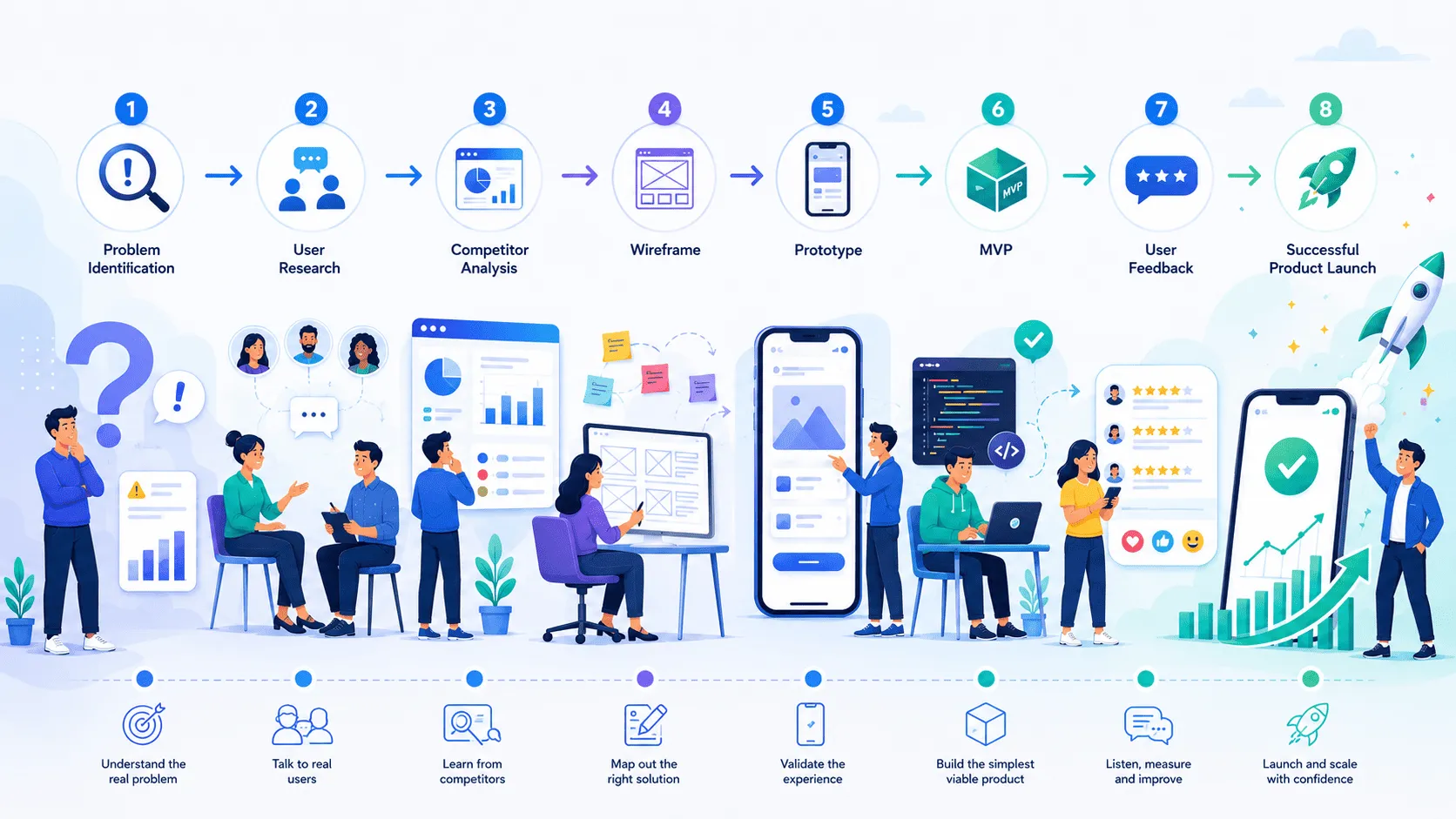
You do not need to develop the entire application to begin validation. A practical process can include:
- Define the problem: Describe the specific problem without mentioning your planned features.
- Identify the target audience: Select the people or organizations that experience it most strongly.
- Research the market: Review competitors, search trends, customer discussions, and app-store feedback.
- Interview potential users: Learn how they currently solve the problem and what limitations they encounter.
- Create a value proposition: Explain why your solution would be meaningfully better.
- Build a prototype: Present the proposed experience through wireframes or a clickable design.
- Test market interest: Use a landing page, waiting list, demo request, or pilot offer.
- Develop a focused MVP: Build only the capabilities required to test the central business assumption.
- Measure behaviour: Monitor registrations, activation, engagement, retention, referrals, and willingness to pay.
HubSpot similarly presents startup validation as a structured process for testing assumptions, collecting customer feedback, and confirming potential market fit before launch. HubSpot for Startups
What Counts as Strong Validation?
Not every positive response is genuine market validation.
Comments such as “That sounds interesting” provide limited evidence because they require no commitment. Stronger signals involve customer action.
Examples include:
- Joining a waiting list
- Requesting a product demonstration
- Participating in a pilot programme
- Using the MVP repeatedly
- Referring another user
- Paying a deposit or subscription
- Agreeing to replace an existing solution
The closer the action is to actual adoption or payment, the stronger the validation.
Common App Validation Mistakes
Avoid relying only on friends and family, as they may hesitate to criticize your idea. Do not ask leading questions designed to confirm what you already believe.
You should also avoid treating a large number of landing-page visits as proof of demand. Traffic may show curiosity, but activation, repeat usage, and payment intent provide more meaningful evidence.
Finally, validation should not be used to justify a predetermined answer. Be prepared to adjust the audience, features, pricing, or even the original concept when evidence points in another direction.
Final Thoughts
Validating your app idea does not delay development. It helps ensure that your development effort is directed toward the right product.
By testing the problem, audience, demand, and core solution first, you can reduce risk, avoid unnecessary features, control costs, and increase your chances of achieving product-market fit.
MVPHUB helps entrepreneurs transform early concepts into focused, production-ready MVPs designed for real-world validation. Instead of investing immediately in a large application, you can test the core opportunity, collect meaningful user evidence, and make your next investment decision with greater confidence.
💡 Have an app idea worth exploring?
Validate it with a focused MVP before committing to full development. Contact us →
Frequently Asked Questions
Can I validate an app idea without coding?
Yes. Interviews, competitor research, landing pages, waiting lists, wireframes, and clickable prototypes can test important assumptions before coding begins.
How long does app idea validation take?
The timeframe depends on the market and product complexity, but early research and prototype testing can often be completed within a few weeks.
Is a prototype the same as an MVP?
No. A prototype demonstrates how a product may look or work. An MVP is a functional product that lets real users complete the core journey.
How do I know whether my app idea is validated?
Look for measurable customer action, including pilot participation, repeat usage, referrals, preorders, deposits, or paid subscriptions, not positive opinions alone.
💡 Have a software idea?
Receive a focused MVP scope, fixed price and achievable delivery timeline.
Book a free consultation with MVPHUB