
What Does “Minimum” Really Mean in a Minimum Viable Product?
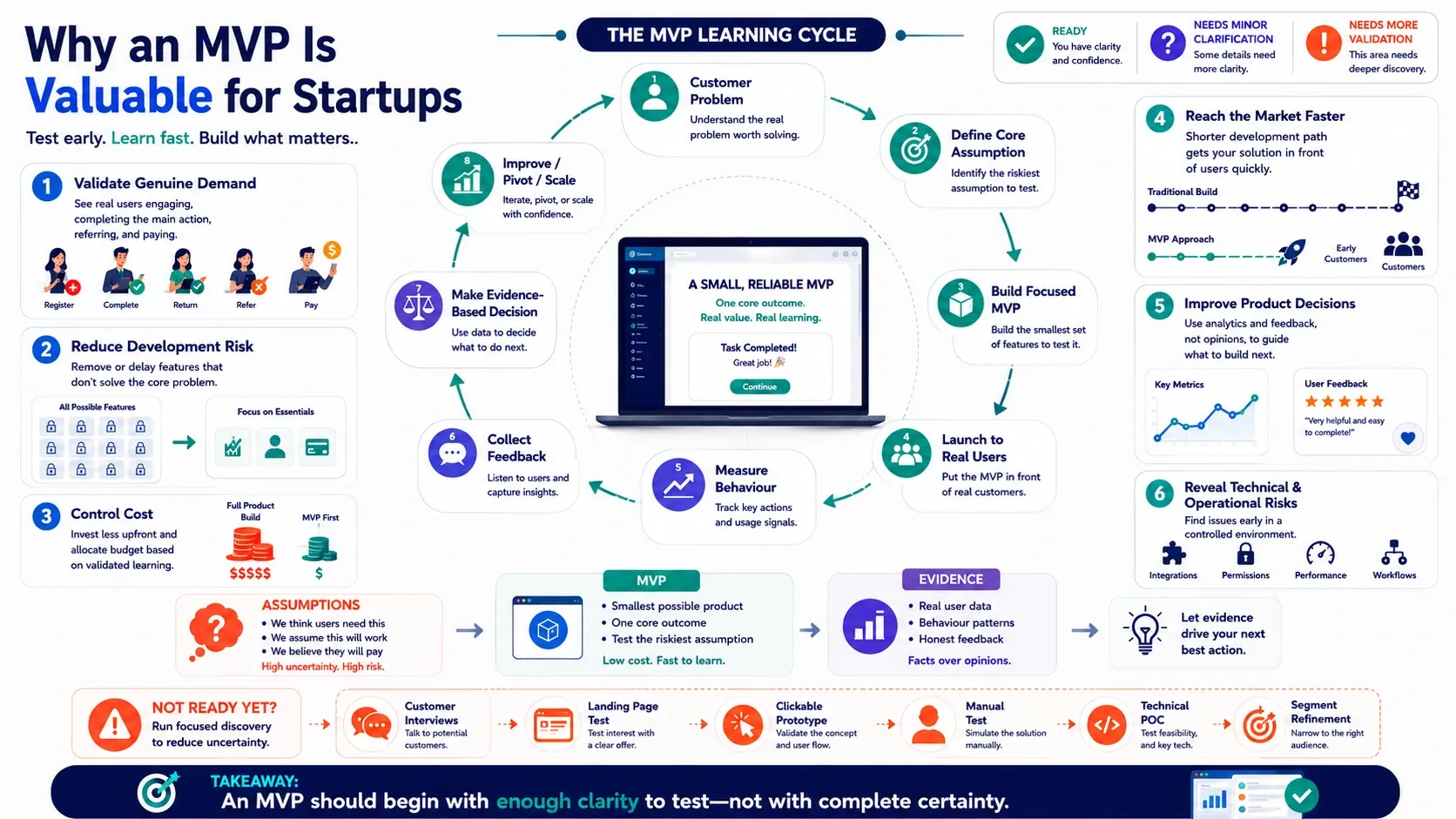
In a Minimum Viable Product, “minimum” means the smallest scope needed to deliver genuine customer value and test an important business assumption.
It does not mean releasing an incomplete, unreliable, or poorly designed application.
A strong MVP includes everything required for a specific user to complete one meaningful journey—and postpones functionality that does not contribute to the first market test.
The purpose is to learn sooner, reduce unnecessary investment, and build future releases around evidence rather than assumptions.
“Minimum” Refers to Scope, Not Quality
Founders sometimes interpret an MVP as the cheapest or fastest application they can release. This can lead to missing security controls, confusing workflows, unreliable payments, or unfinished features.
That is not a viable product.
The word “minimum” should reduce:
- The number of features
- The number of user groups
- The number of platforms
- The number of integrations
- The number of workflows
- The range of initial use cases
It should not automatically reduce:
- Security
- Reliability
- Data accuracy
- Essential testing
- Error handling
- Usability
- Technical accountability
An MVP may be small, but the journey it includes should work properly from beginning to end.
Minimum Must Still Be Viable
The word “viable” is just as important as “minimum.”
A product is viable when its intended early users can use it to achieve the promised outcome.
For example, a service-booking MVP might allow a customer to:
- Select a service.
- Choose an available time.
- Submit personal details.
- Confirm the booking.
- Receive confirmation.
That is one complete journey.
If users can view services but cannot submit a booking, the product may be a prototype or incomplete release rather than a viable MVP.
Start With the Assumption
The right MVP scope begins with what the business needs to learn.
Examples include:
- Will customers book this service online?
- Will tutors pay to manage classes through one platform?
- Will businesses use a simpler quotation tool?
- Will homeowners request services from local providers?
- Will customers pay for an AI-generated report?
Once the assumption is clear, the team can identify the minimum features needed to test it.
A useful filter for each proposed feature is:
“Can we still test the central assumption without this?”
If the answer is yes, the feature may belong in a later release.
What Should the Minimum MVP Include?
Although every product is different, a first MVP may require:
- A clear value proposition
- Simple onboarding
- Secure access when accounts are necessary
- One complete core workflow
- A meaningful result
- Basic administration
- Essential notifications
- Analytics for the main journey
- A feedback or support channel
- Appropriate security and error handling
Payments should be included when willingness to pay is part of the assumption. If not, manual invoices or payment links may be sufficient during initial validation.
What Can Usually Wait?
Features frequently postponed include:
- Advanced dashboards
- Multiple languages and currencies
- Native iOS and Android applications
- Several payment gateways
- Complex automation
- Loyalty and referral programmes
- Extensive customization
- Multiple customer segments
- Advanced role hierarchies
- Social feeds
- Numerous integrations
- AI features unrelated to the core outcome
- Infrastructure for unproven large-scale demand
These features may eventually become valuable. They are simply not always necessary for the first test.
Example: Minimum Scope for a Marketplace
Imagine a marketplace connecting homeowners with cleaning providers.
| Include in the MVP | Add after validation |
|---|---|
| Customer registration | Social login |
| Basic provider listings | Video profiles |
| Service-request form | Real-time bidding |
| Provider acceptance | AI matching |
| Booking confirmation | Loyalty programme |
| Basic admin controls | Advanced dashboards |
| Email notifications | Push and WhatsApp alerts |
| Core usage analytics | Predictive analytics |
This scope can test whether customers submit requests and providers accept them without building the complete future marketplace.
Minimum Does Not Always Mean Automated
Early-stage startups can perform selected processes manually behind the scenes.
For example, the team might:
- Review provider applications manually
- Match customers with suppliers manually
- Approve submitted content manually
- Send payment links manually
- Prepare reports with human assistance
- Resolve exceptions through direct support
Manual operations are reasonable when usage is low, and automation is not central to the customer promise.
Once demand is proven and repeated patterns become clear, the most valuable processes can be automated.
How AI Changes the Meaning of Minimum
AI can accelerate wireframing, interface development, coding, testing, documentation, and standard integrations. This makes it possible to build more functionality within a limited timeline.
However, faster development does not mean every possible feature should enter the MVP.
AI can also generate unnecessary functionality, incorrect business logic, insecure patterns, or unsuitable architecture. Professional engineers must still decide what belongs in the first release and verify that it is reliable enough for real users.
The strongest model is AI-accelerated professional engineering applied to a carefully controlled scope.
A Simple Minimum-Scope Test
Before including a feature, ask:
- Does it solve the main customer problem?
- Is it required to complete the core journey?
- Does it test a critical assumption?
- Is it necessary for safety, security, or operation?
- Could the process be handled manually?
- Can an existing service provide it?
- What evidence will it generate?
- What happens if it is postponed?
Features required for value, validation, safety, or operation belong in the MVP. Everything else should be questioned.
Build Only What You Need to Learn
“Minimum” means building the smallest reliable product that can replace uncertainty with evidence.
It is not about cutting corners. It is about controlling scope, reaching customers sooner, and avoiding investment in features the market has not yet justified.
💡 Smaller Scope. Faster Learning. Stronger Product.
MVPHUB helps founders turn broad digital-product ideas into focused, production-ready MVPs using strategic scope definition, AI-accelerated delivery, and accountable professional engineering.
Book a free consultation with MVPHUBFrequently Asked Questions
What does “minimum” mean in a Minimum Viable Product?
“Minimum” means including only the features required to solve one important customer problem, complete the core user journey, and test a specific business assumption. It refers to limiting the product’s scope, not reducing essential quality, security, reliability, or usability.
How minimal should an MVP be?
An MVP should be as small as possible while still delivering meaningful value to its intended early users. If removing a feature prevents users from achieving the promised outcome or prevents the business from testing its central assumption, that feature probably belongs in the MVP.
What features should an MVP include?
An MVP should typically include simple onboarding, secure access when required, one complete core workflow, a meaningful user outcome, basic administration, essential notifications, analytics, feedback collection, and appropriate error handling. The final feature set should depend on the customer problem and assumption being tested.
Is an MVP a finished product?
An MVP is not the final version of a product, but it should be complete enough for selected customers to use successfully. It is an early, functional release designed to generate feedback and behavioural evidence that can guide future improvements.
How do you define the scope of an MVP?
Start by identifying the target user, main problem, core journey, and most important assumption to validate. List the features required to deliver that journey, then remove or postpone anything that does not contribute to customer value, validation, security, or essential operation. Features can be prioritized by comparing their business value with their cost and complexity.
