
When Should You Skip an MVP and Build a Full Product?
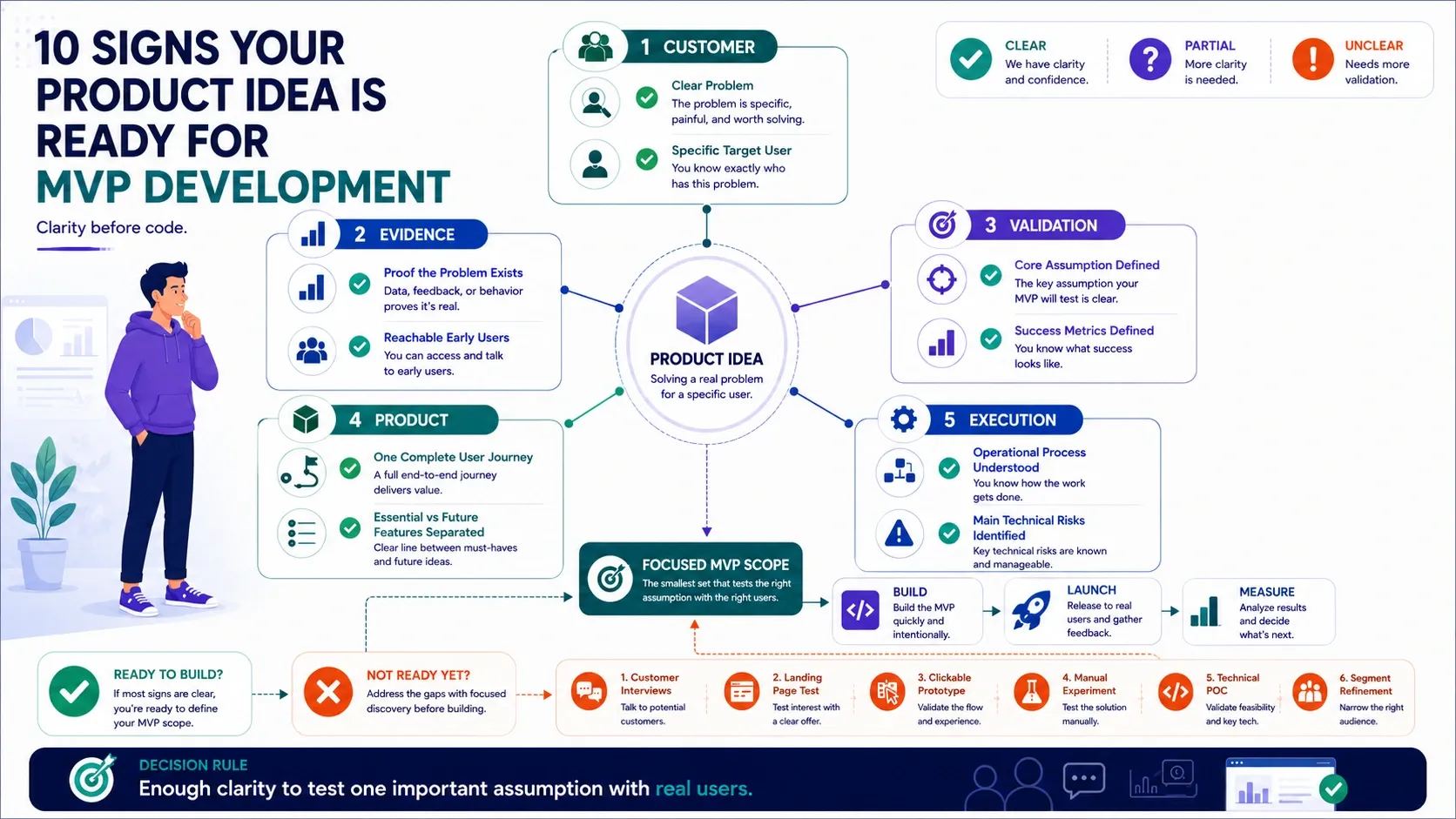
An MVP is valuable when you need to validate customer demand before making a larger investment. However, it is not automatically the right approach for every digital product.
You may need a more complete product when market demand is already proven, customers expect comprehensive functionality, regulations establish strict requirements, or an incomplete workflow could create serious operational risk.
Even then, “full product” should not mean building every imagined feature. It means delivering the complete level of functionality, reliability, security, and operational readiness required for the intended launch.
1. The Product Is Replacing an Existing System
A replacement platform may need to support all essential workflows from the first day.
For example, replacing a university management, accounting, healthcare, or property-management system might require:
- Existing user roles and permissions
- Complete operational workflows
- Historical data migration
- Integrations with connected systems
- Required reports
- User training
- Business-continuity planning
- Rollback arrangements
Launching with only one limited journey could disrupt daily operations. A phased migration may still be appropriate, but every phase must be operationally complete.
2. Regulations Define the Minimum Requirements
Products handling healthcare, finance, identity, children’s data, or regulated transactions may need extensive controls before real users can access them.
Requirements may include:
- Strong authentication
- Detailed access controls
- Audit logs
- Data encryption
- Consent management
- Retention policies
- Compliance documentation
- Security testing
- Incident-response procedures
- Data-residency controls
These are not optional improvements to add after validation. If the product cannot operate legally or safely with reduced functionality, the first release must include the full required foundation.
3. Failure Could Cause Serious Harm
A lightweight MVP is unsuitable when failures could affect health, safety, finances, legal rights, or critical infrastructure.
Examples may include:
- Medical decision-support software
- Payment-processing systems
- Industrial control platforms
- Emergency-response tools
- High-risk financial applications
- Systems controlling physical devices
Such products may still use prototypes and controlled pilots, but public deployment requires rigorous engineering, verification, and risk management.
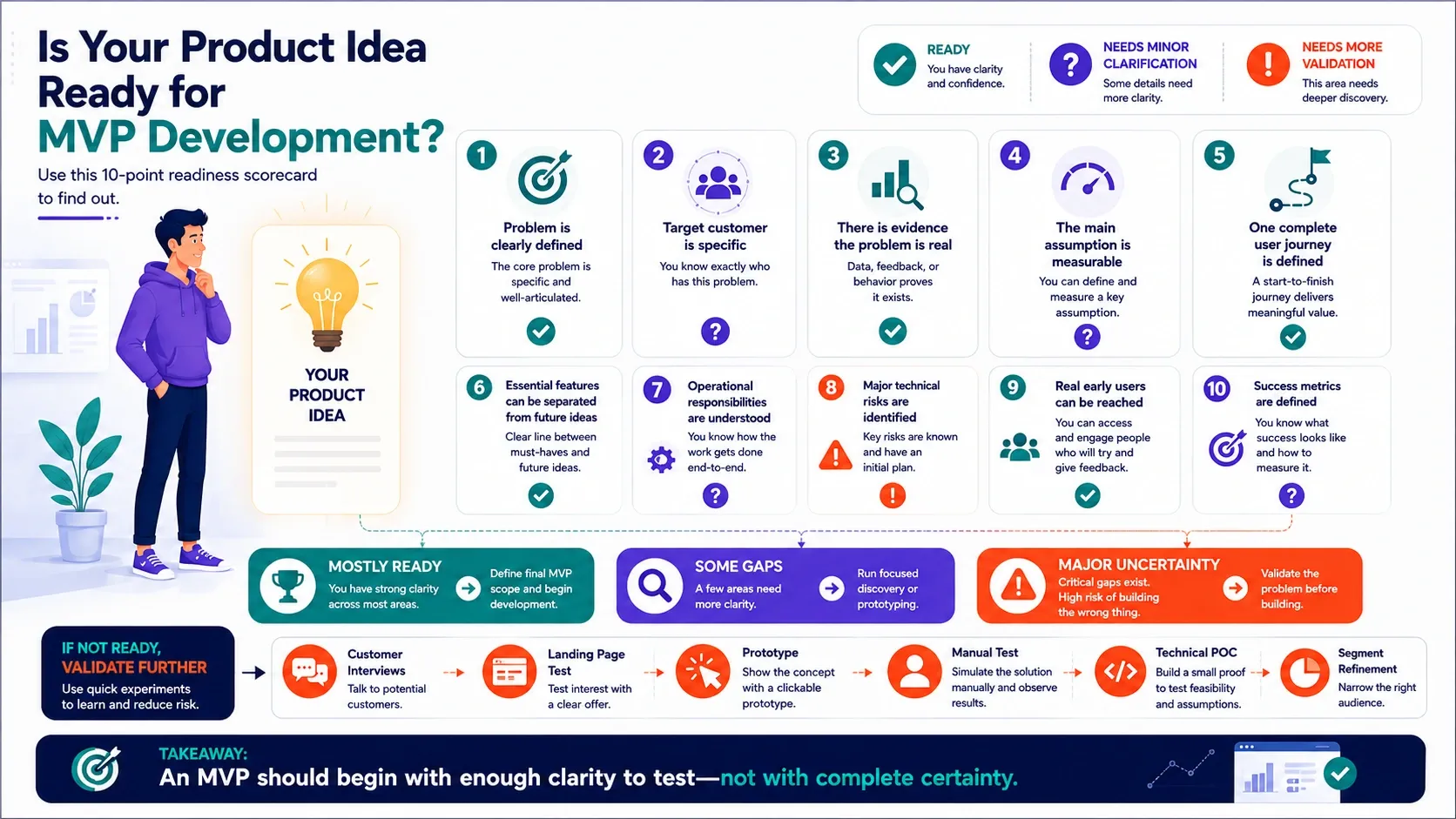
4. Customers Require a Complete Feature Set
Some B2B and enterprise customers will not adopt a product unless it supports their essential processes.
A product may need:
- Single sign-on
- Role-based permissions
- Audit records
- Data import and export
- Administration controls
- Required integrations
- Service-level monitoring
- Reporting
- Security documentation
- Support arrangements
If these capabilities are purchasing requirements rather than optional preferences, a narrow MVP may not generate a meaningful market test.
The better approach may be a paid pilot containing the full requirements of one committed customer segment.
5. Demand Has Already Been Validated
You may not need another MVP when strong evidence already exists.
Evidence could include:
- Signed customer contracts
- Paid pilot commitments
- Successful manual delivery
- Proven demand in an existing business
- Customers requesting a digital version of a current service
- A validated product being introduced to a similar market
- A legacy product with an established user base
The remaining challenge may be execution rather than demand validation. In that case, the team should build the product required to serve those customers effectively.
6. The Product Depends on a Complete Network
Some products provide little value until several connected capabilities exist.
A marketplace may require customers, providers, transactions, dispute handling, and operational support. A communication platform may require invitations, messaging, notifications, privacy controls, and moderation.
If removing one part makes the entire customer outcome impossible, the first release must cover the complete operating loop.
The scope can still be controlled by limiting the initial location, industry, customer group, or transaction type.
7. Brand Trust Is Difficult to Recover
A weak first release may create disproportionate damage when launched under an established brand.
Customers may expect the new product to match existing standards for:
- Reliability
- Accessibility
- Security
- Visual quality
- Customer service
- Data accuracy
- Cross-device performance
An established company can still test concepts privately through prototypes, usability studies, beta programmes, or limited regional launches. However, its public release may need to meet a higher standard than a typical early-stage startup MVP.
8. The Product Has Fixed Contractual Requirements
Government, enterprise, or partnership projects may be governed by an agreed specification.
The release may require:
- Defined functional modules
- Security controls
- Performance targets
- Integration requirements
- Documentation
- Training
- Acceptance testing
- Support commitments
A reduced MVP cannot replace these contractual obligations unless the parties formally agree to a phased delivery.
MVP vs Full Product
| Choose an MVP when | Build a fuller product when |
|---|---|
| Customer demand is uncertain | Demand is already demonstrated |
| One journey can test the idea | Multiple workflows are operationally essential |
| Early users accept limitations | Customers require procurement-ready functionality |
| Manual processes are practical | Manual handling creates serious risk |
| Failure has limited consequences | Failure could cause harm or major disruption |
| Compliance requirements are manageable | Mandatory controls define the release scope |
| The launch is controlled | The product must support broad public use |
You Can Still Reduce Risk Without an MVP
Skipping a public MVP does not mean building blindly.
You can still use:
- Customer interviews
- Proofs of concept
- Clickable prototypes
- Technical spikes
- Usability testing
- Security reviews
- Controlled pilots
- Feature flags
- Staged migrations
- Limited geographic launches
- Parallel operation with the existing system
These methods provide learning while preserving the quality required for the eventual release.
Full Product Does Not Mean Every Feature
The most dangerous alternative to an undersized MVP is an uncontrolled “full product” containing every stakeholder request.
Even a comprehensive first release should prioritize:
- Required customer outcomes
- Operational continuity
- Legal and security obligations
- Contractual commitments
- Commercial readiness
- Reliable support
Optional customization, speculative automation, and unrelated future ideas can still wait.
Choose the Smallest Responsible Release
You should skip a narrow MVP when it cannot provide valid evidence, meet mandatory requirements, or operate without unacceptable risk.
The correct first release may be an MVP, a complete paid pilot, a phased replacement, or a fully production-ready platform. The decision should reflect the uncertainty you need to resolve and the consequences of releasing too little.
Not Sure How Much You Need to Build?
MVPHUB helps businesses evaluate product risk, define the right release scope, and deliver secure, production-ready digital products through AI-accelerated professional engineering. Book a free consultation with MVPHUB to determine whether your idea needs a focused MVP, a complete pilot, or a fuller product from day one.
Book a free consultation with MVPHUBFrequently Asked Questions
When should you skip an MVP and build a full product?
You should consider skipping a narrow MVP when customer demand is already proven, regulations define mandatory functionality, customers require a complete workflow, or product failure could create serious financial, operational, legal, or safety risks.
Is an MVP always necessary for a startup?
No. An MVP is most useful when there are important assumptions about customer demand, usability, or business viability that still need to be tested. If demand is already validated and the main challenge is execution, a more complete first release may be appropriate.
What is the difference between an MVP and a full product?
An MVP contains the smallest complete set of capabilities needed to deliver value and validate important assumptions. A full product provides the broader functionality, reliability, integrations, security, and operational readiness required for its intended market and launch environment.
Can an MVP be production-ready?
Yes. An MVP can be production-ready while still having a limited scope. “Minimum” should refer to the number of features and workflows being tested, not poor security, unreliable code, or an unfinished customer experience.
Should regulated software start with an MVP?
It depends on how the MVP is used. Regulated products can still use prototypes, proofs of concept, sandboxes, and controlled pilots for learning. However, any release involving real users or sensitive data must meet the applicable legal, security, privacy, and compliance requirements.
What should you do instead of an MVP for a high-risk product?
High-risk products can reduce uncertainty through clickable prototypes, technical proofs of concept, usability testing, simulations, controlled pilots, security reviews, staged deployments, and limited user trials before wider production release.
Is a paid pilot better than an MVP for B2B software?
Sometimes. If an enterprise customer already has clearly defined requirements, a paid pilot containing the complete workflows needed by that customer can provide more meaningful validation than a very limited MVP.
Should you build a full product when replacing an existing system?
Often, the replacement must support all business-critical workflows required for the part of the system being migrated. However, this does not necessarily mean replacing everything at once. A phased migration can reduce risk as long as each phase is operationally complete.
Does building a full product mean including every planned feature?
No. A full or production-ready release should include everything necessary for customer outcomes, compliance, operations, security, and commercial readiness. Features that are speculative, optional, or intended for future expansion can still be postponed.
How do you decide between an MVP, pilot, and full product?
Start by asking what uncertainty you need to resolve. If the main uncertainty is customer demand, an MVP may be appropriate. If demand is proven but implementation needs validation, use a pilot. If regulatory, contractual, operational, or safety requirements define a complete minimum release, a fuller production-ready product may be necessary.
