
Why Most Startup Ideas Fail Before Product-Market Fit

Most startup ideas do not fail because the founders lacked ambition, the software was poorly designed, or the team did not work hard enough.
Many fail because they build and scale a solution before proving that enough customers genuinely need it.
A startup may have an impressive website, advanced features, a talented development team, and even early registrations. However, none of these automatically demonstrates product-market fit. If customers do not receive enough value to keep using, recommending, or paying for the product, the business remains vulnerable.
Understanding why startups fail before product-market fit can help founders validate their assumptions earlier and invest more carefully.
What Is Product-Market Fit?
Product-market fit occurs when a product satisfies a meaningful need within a clearly defined market.
It means more than attracting a few customers or receiving positive feedback. Customers must consistently experience enough value to use the product, continue using it, recommend it, or pay for it.
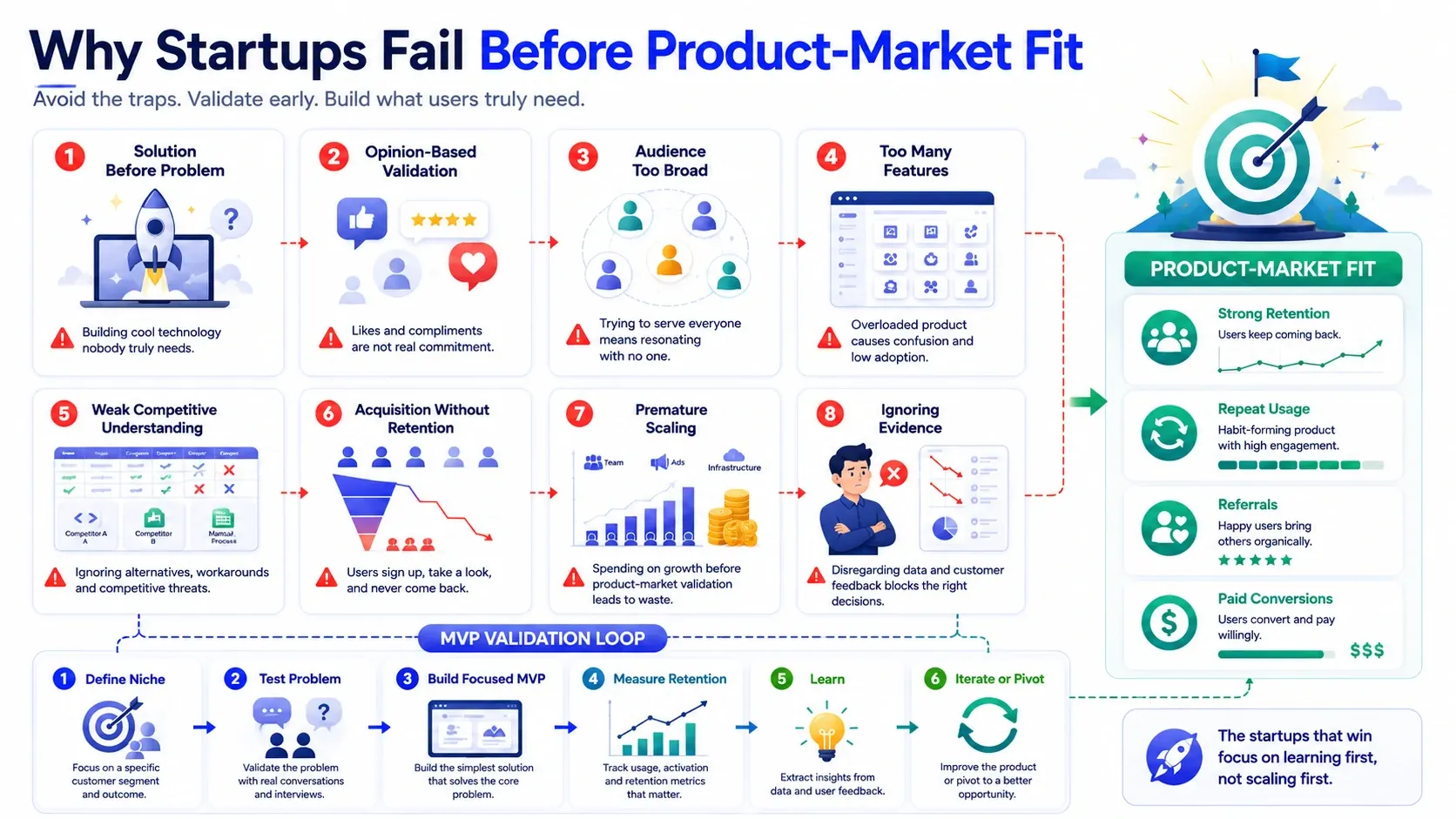
Signs of product-market fit may include:
- Strong customer retention
- Increasing repeat usage
- Organic recommendations
- Consistent paid conversions
- Customers expressing disappointment if the product disappeared
- Demand growing faster than the team can comfortably support it
Y Combinator cautions founders against declaring product-market fit too early. A startup can have customers and some growth while still lacking the repeatable demand required for a sustainable business. Read Y Combinator’s product-market fit guidance.
Why Do Startup Ideas Fail Before Product-Market Fit?
1. They start with a solution instead of a problem
Founders often begin with an exciting technology or feature:
- “An AI-powered recruitment platform”
- “A blockchain-based loyalty application”
- “An all-in-one productivity tool”
These statements describe solutions, but they do not explain the customer problem.
A stronger starting point would be: “Small recruitment agencies spend too much time manually screening unsuitable applications.”
When the problem is unclear, the team may create sophisticated functionality that customers do not consider important. Technology can improve a strong solution, but it cannot create demand for an unnecessary one.
2. They validate the idea with opinions
Friends, colleagues, and survey participants may say an idea sounds interesting. Unfortunately, positive opinions require little commitment and may not reflect actual buying behaviour.
Stronger validation comes from actions such as:
- Joining a waiting list
- Completing a product trial
- Requesting a pilot
- Returning after initial use
- Referring another customer
- Paying a deposit or subscription
Founders should ask potential customers about their current behaviour, not merely whether they like the proposed idea. If people already spend time, money, or effort dealing with the problem, the opportunity is more credible.
3. They target an audience that is too broad
A product designed for “everyone” usually struggles to communicate clearly with anyone.
Different customer groups have different problems, budgets, workflows, and expectations. A generic project-management application, for example, would compete against numerous established products. A scheduling platform specifically designed for home-maintenance teams could address a narrower and more understandable need.
Selecting an initial niche makes it easier to design the product, find early users, create relevant marketing messages, and measure whether the solution is working.
4. They build too many features
Founders frequently believe more features will make the product more attractive. In reality, excessive features increase development costs, delay market feedback, and make the user experience harder to understand.
An early product should answer one important question:
Can we solve one meaningful customer problem well enough that users will take action?
Features that do not help test this assumption can usually wait. A focused Minimum Viable Product delivers the essential journey without carrying the cost and complexity of the complete vision.
5. They misunderstand the competition
Some founders claim they have no competitors. This is rarely true.
A competitor is not limited to another application with identical features. It may be a spreadsheet, manual process, internal employee, messaging group, existing software product, or the decision to do nothing.
If customers are satisfied with the current alternative, the startup must offer a compelling reason to change. Being slightly faster or more attractive may not be enough to overcome switching costs, learning effort, and purchasing risk.
6. They mistake acquisition for genuine demand
A marketing campaign can generate website visits, registrations, or downloads. These numbers may look encouraging, but they do not necessarily show that customers receive continuing value.
A startup can purchase attention. It cannot purchase retention.
Founders should monitor what happens after registration:
- Do users complete the core journey?
- Do they return?
- How quickly do they stop using the product?
- Do free users become paying customers?
- Which features produce repeat value?
If acquisition is growing while retention remains weak, increasing the marketing budget may simply accelerate cash loss.
7. They scale before the product is ready
Hiring a larger team, increasing advertising, expanding to new markets, and developing more features can appear to be signs of progress. Before product-market fit, however, these actions can multiply an unresolved problem.
CB Insights identifies issues such as insufficient product-market fit and depleted cash among recurring startup failure patterns. These problems are often connected: a product with weak demand consumes its available funds while attempting to acquire and retain customers. Read CB Insights’ startup failure analysis.
Scaling should follow evidence. A repeatable product and sales process must be established before the company invests heavily in accelerating it.
8. They ignore evidence that challenges the original idea
Founders naturally become attached to their vision. After investing considerable time and money, changing direction can feel like admitting failure.
However, customer evidence may show that the original audience, feature set, pricing model, or even the central idea needs to change. In a 2026 founder study, 81% of respondents reported pivoting at least once, while 42% wished they had changed direction sooner. Read Wilbur Labs’ founder study.
A thoughtful pivot is not necessarily a failure. It is a decision to use new evidence instead of continuing with an outdated assumption.
Warning Signs of Poor Product-Market Fit
A startup may not have product-market fit when:
- Users need repeated encouragement to return.
- Most customers stop using the product quickly.
- Marketing costs are higher than customer value.
- Sales depend entirely on discounts.
- Customers praise the concept but will not pay.
- Different customers request unrelated solutions.
- The team cannot clearly define its ideal customer.
- New features do not improve retention or conversion.
One weak signal does not automatically mean the idea should be abandoned. However, several of these signs indicate that further validation is needed before scaling.
How an MVP Can Reduce the Risk
A well-planned MVP allows founders to test the most important business assumption through a real, usable product.
The process should be straightforward:
- Define one specific customer group.
- Identify one urgent and recurring problem.
- Study how customers currently solve it.
- Select the smallest feature set that delivers meaningful value.
- Launch the MVP to a controlled audience.
- Measure activation, retention, referrals, and payment behaviour.
- Improve, reposition, pivot, or stop based on the evidence.
An MVP does not guarantee product-market fit. It makes learning faster and less expensive, allowing founders to discover weaknesses before investing in the complete product.
Final Thoughts
Startup ideas usually fail before product-market fit because assumptions remain untested for too long. Teams build too much, target audiences too broadly, measure attention instead of retention, and scale before confirming repeatable demand.
The safest approach is to treat every early-stage idea as a collection of assumptions that must earn further investment.
Start with the customer problem. Validate it through meaningful actions. Build only what is required to test the core opportunity, and let real user behaviour guide the next phase.
MVPHUB helps founders turn untested ideas into focused, production-ready MVPs designed to collect real market evidence before full-scale investment.
💡 Do not wait until full development to discover whether your idea works.
Validate it with a focused MVP from MVPHUB.
💡 Have a software idea?
Receive a focused MVP scope, fixed price and achievable delivery timeline.
Book a free consultation with MVPHUBFrequently Asked Questions
What is the biggest reason startup ideas fail?
A major underlying reason is insufficient market demand. The startup builds a solution that customers do not need urgently enough to adopt or purchase consistently.
How do you know when you have product-market fit?
Strong retention, repeat usage, organic referrals, paid conversion, and growing customer demand are more reliable indicators than positive feedback or initial registrations.
Can a startup have customers without product-market fit?
Yes. Early customers and temporary growth do not automatically prove product-market fit. The demand must become consistent, repeatable, and commercially sustainable.
Does an MVP guarantee startup success?
No. An MVP reduces uncertainty by testing assumptions earlier. The results may support the idea, reveal necessary changes, or show that the startup should pursue a different opportunity.
Should a startup scale before product-market fit?
Generally, no. Scaling an unvalidated product increases spending without resolving weak customer demand or retention.
