
How to Run a Successful MVP Pilot with Early Customers
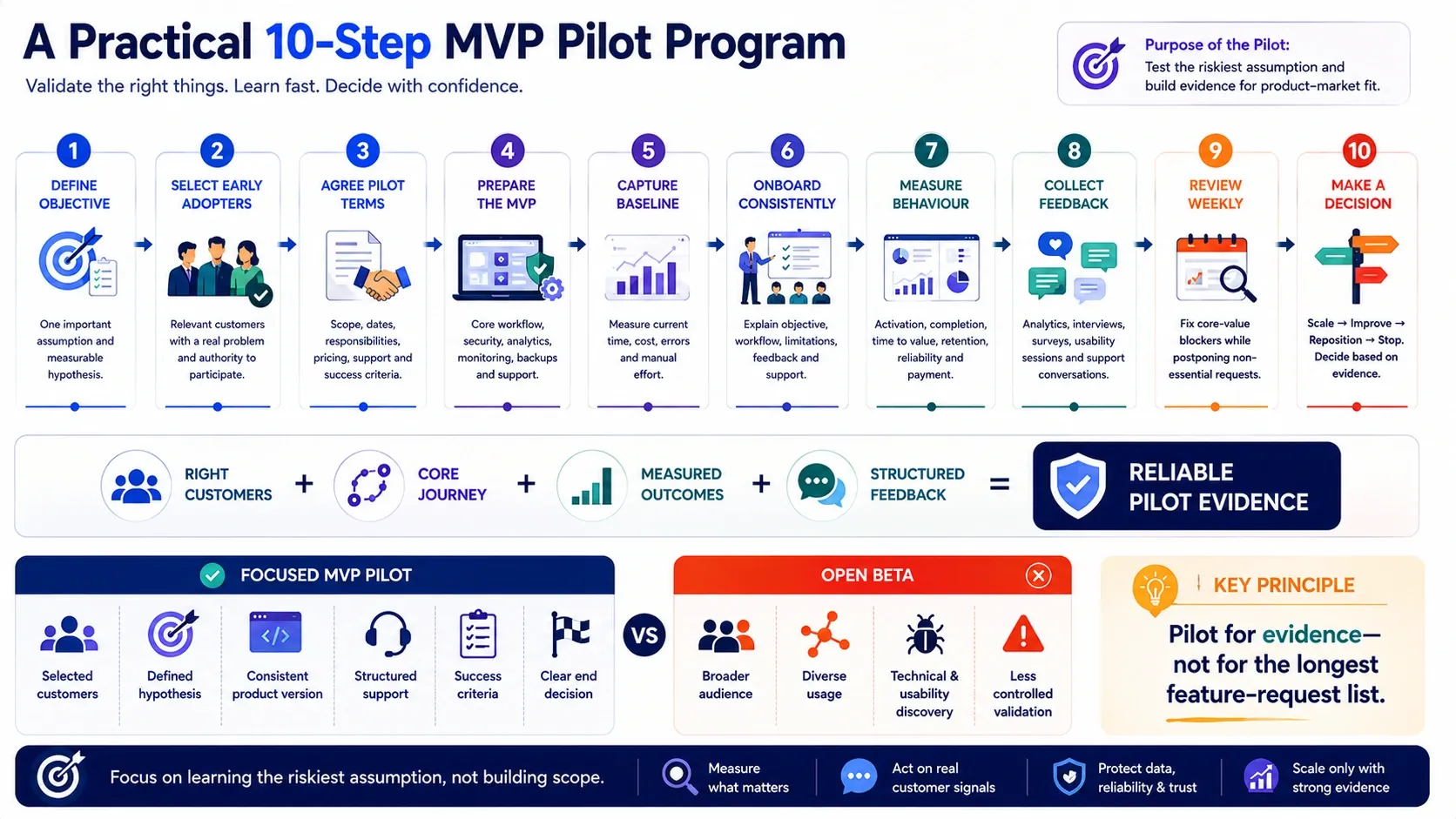
An MVP pilot program allows a small group of real customers to use your product in controlled conditions before a wider launch.
Unlike general beta testing, an effective pilot should test specific business assumptions. It should reveal whether the right customers can reach the core value, continue using the product, and justify further investment.
The objective is not to collect as many suggestions as possible. It is to generate reliable evidence for a clear product decision.
Step 1: Define the Pilot Objective
Begin with one primary question. Examples include: can customers complete the core workflow, does the product reduce processing time, will users return weekly, will businesses pay for the outcome, can the product operate reliably in real conditions, and can the team support customers efficiently?
Convert the objective into a measurable hypothesis: we believe property managers will use the MVP to record and resolve maintenance requests, reducing manual follow-up and improving response visibility.
Decision: Can the pilot produce evidence for one important assumption? If yes, define success metrics. If no, narrow the pilot objective — a pilot trying to validate the entire business model produces unclear results.
Step 2: Select the Right Early Adopters
Choose participants who match the target customer profile, experience the problem regularly, currently use an alternative or workaround, have authority to test or purchase the product, can provide timely feedback, and accept that the product is an early release.
Avoid filling the pilot only with friends, employees, or people attracted by free access. For a focused B2B pilot, five to ten engaged organizations may produce more useful evidence than hundreds of poorly matched users. Consumer products may require a larger group to identify behavioural patterns.
Recommended action: create eligibility criteria and screen every applicant before acceptance.
Step 3: Agree on Pilot Terms
Document the pilot objective, included features, excluded functionality, start and end dates, participant responsibilities, support arrangements, data usage, confidentiality, pricing or fees, feedback expectations, success criteria, and what happens after completion.
Decide whether the pilot will be free or paid. A paid pilot creates stronger commercial evidence, while a free pilot may be appropriate when customer effort or technical uncertainty is high. Free access without participation requirements can attract inactive users.
Step 4: Prepare the MVP for Customer Testing
An MVP pilot is controlled, but the product should still be reliable enough for its intended users.
Before onboarding customers, verify that the core journey works from beginning to end, authentication and permissions are correct, test and production data are separated, important errors are handled, analytics events are configured, monitoring and backups are active, support channels are available, known limitations are documented, and sensitive information is appropriately protected.
“Early-stage” should not become an excuse for exposing customers to unnecessary security or operational risks.
Step 5: Establish Baseline Measurements
Measure the current process before introducing the MVP. Relevant baselines may include time required to complete the task, number of manual steps, error frequency, existing operating cost, current conversion rate, customer response time, support volume, and current tool usage.
Without a baseline, it may be difficult to prove whether the MVP created a meaningful improvement.
Step 6: Onboard Participants Properly
Provide a consistent onboarding experience covering the problem the MVP addresses, the core workflow, what the participant should test, known limitations, how to report issues, when feedback sessions will occur, what data will be collected, and who to contact for support.
Avoid explaining every screen in detail. Observe whether customers can understand and complete the journey independently.
Decision: if users require constant guidance, simplify onboarding or the workflow. If users progress independently, continue measuring real behaviour.
Step 7: Measure Behaviour and Outcomes
Track metrics connected to customer value.
| Evidence area | Example MVP metrics |
|---|---|
| Activation | Percentage reaching the first valuable outcome |
| Completion | Percentage completing the core journey |
| Time to value | Time from onboarding to first result |
| Engagement | Frequency of meaningful product actions |
| Retention | Customers returning during the pilot |
| Reliability | Errors, failures, and downtime |
| Commercial | Paid conversions or purchase commitments |
| Operational | Support time and manual effort |
| Advocacy | Referrals, testimonials, and continued-use requests |
Avoid relying only on registrations, logins, or verbal satisfaction — this same behaviour-first approach is covered in more depth in how to measure product-market fit during the MVP stage.
Step 8: Collect Structured Feedback
Use several feedback methods: product analytics, support conversations, short surveys, scheduled interviews, observed usability sessions, and pilot review meetings.
Ask what outcome they expected, where they became confused, which task remained difficult, what the product replaced, what would prevent continued use, whether they would pay for the product, and which missing capability blocks adoption.
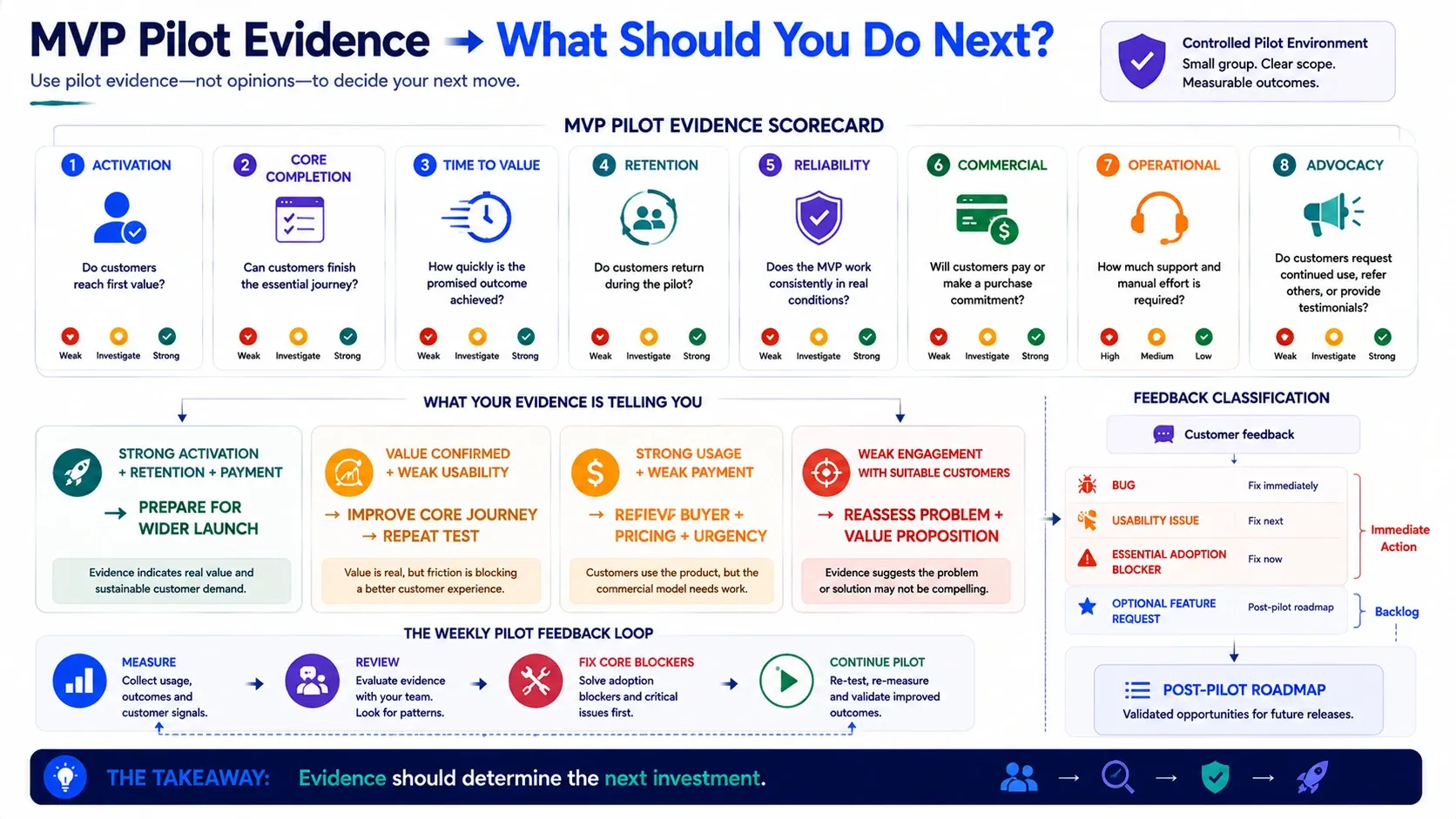
Separate bugs, usability problems, essential gaps, and optional feature requests. Treating every request as essential can expand the MVP into an unfocused product.
Step 9: Review Evidence Regularly
Run short weekly pilot reviews covering activation and completion, drop-off points, product defects, repeated support issues, customer feedback, operational effort, new risks, and changes requiring immediate action.
Fix problems that prevent customers from reaching the core value. Record non-essential improvements in a later roadmap.
Avoid making major changes halfway through the pilot unless they are necessary. Otherwise, different participants will test different versions, and the results become difficult to compare.
Step 10: Make a Clear Post-Pilot Decision
At the end, choose one of four paths.
| Pilot evidence | Recommended action |
|---|---|
| Strong activation, retention, and payment | Prepare for a wider launch |
| Value confirmed but usability weak | Improve the core journey and repeat testing |
| Usage strong but payment weak | Review the buyer, pricing, or urgency |
| Engagement weak across suitable customers | Reassess the problem or value proposition |
Produce a short pilot report containing results, customer evidence, problems, decisions, and the next product priorities.
Pilot Program vs Open Beta Testing
An MVP pilot program usually involves selected customers, defined objectives, structured support, and agreed success criteria.
An open beta involves a broader audience and is better suited to identifying diverse technical issues, usability patterns, and scalability problems.
For early product validation, a focused pilot often produces clearer business evidence than an unrestricted beta launch. If you’re still weighing a pilot against other early-validation methods, Landing Page vs Prototype vs MVP covers where each one fits before a pilot makes sense.
Turn Early Customers Into Reliable Evidence
A successful MVP pilot connects:
Right customers → Core journey → Measured outcomes → Structured feedback → Clear decision
It should help you decide whether to improve, reposition, scale, or stop, not merely generate a longer feature backlog.
Launch Your MVP with the Right Pilot Strategy
MVPHUB helps founders scope, build, deploy, and validate production-ready MVPs using AI-accelerated delivery and professional engineering. Book a free consultation with MVPHUB to design an MVP and pilot program that produces meaningful customer and market evidence.
Book a free consultation with MVPHUBFrequently Asked Questions
How many customers should join an MVP pilot?
A focused B2B pilot may begin with five to ten engaged organizations. Consumer products may require more participants to reveal reliable behavioural patterns.
How long should an MVP pilot program run?
The duration should cover at least one meaningful customer usage cycle. This may be several weeks for frequently used products or longer for monthly and enterprise workflows.
Should early adopters pay for the pilot?
When practical, payment provides stronger evidence of value. A free pilot may be suitable when participants contribute significant time, data, or operational access instead.
What should be measured during MVP customer testing?
Measure activation, core journey completion, time to value, engagement, retention, reliability, operational effort, payment, and customer advocacy.
What should happen after the pilot?
Review the evidence and decide whether to launch more widely, improve and repeat the pilot, adjust positioning or pricing, or reconsider further investment.
