
Landing Page vs Prototype vs MVP: The Best Way to Test an Idea
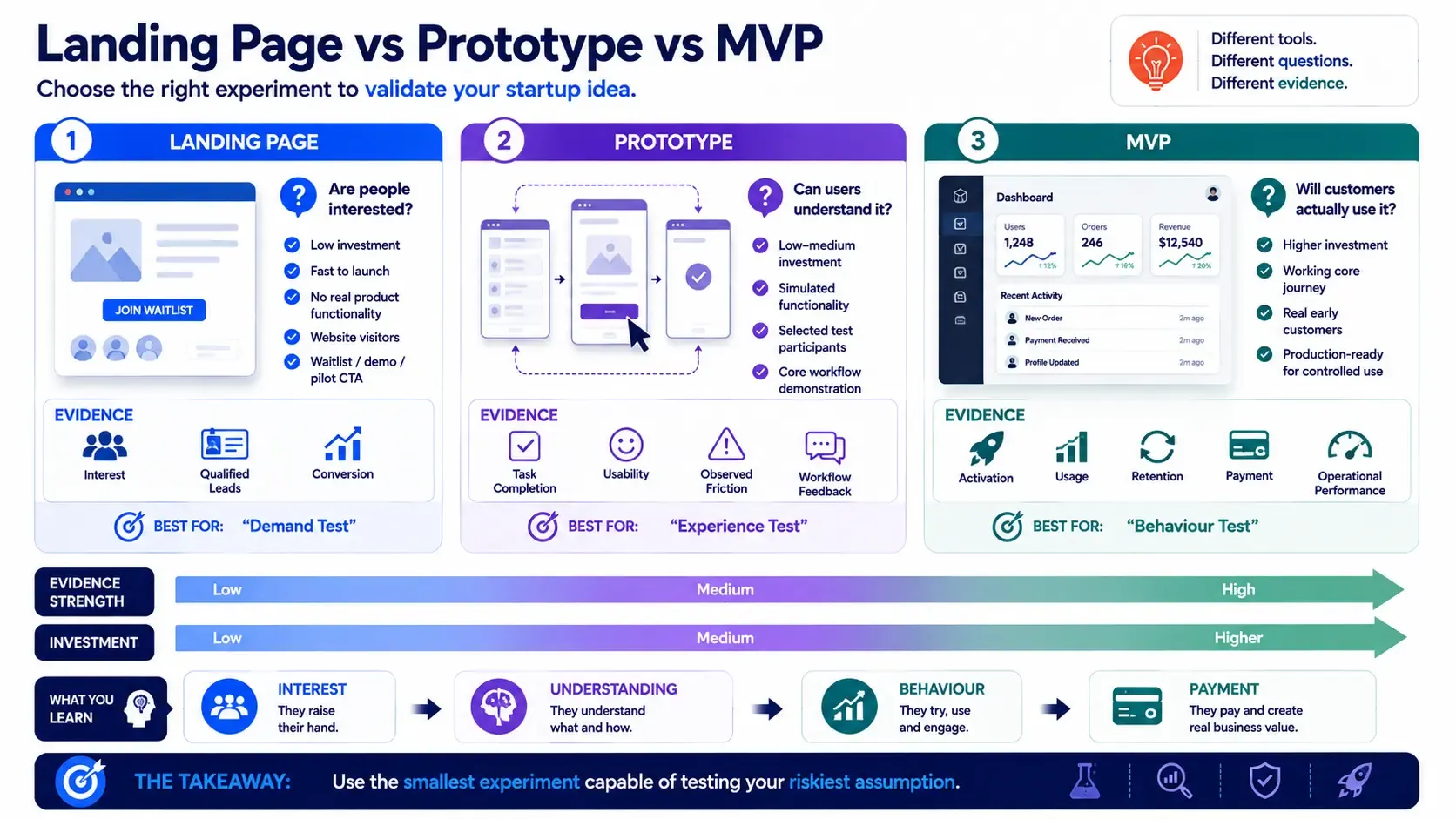
When founders ask how to test a business idea, they often assume they need to build the product immediately.
That is rarely the only option.
A landing page, a prototype, and a Minimum Viable Product (MVP) test different assumptions:
- A landing page tests whether people are interested enough to take an initial action.
- A prototype tests whether users understand and can navigate the proposed experience.
- An MVP tests whether real customers will use, value, and potentially pay for a working product.
The best option depends on what you need to learn next.
Quick Comparison
| Criteria | Landing Page | Prototype | MVP |
|---|---|---|---|
| Main question | Are people interested? | Can users understand it? | Will customers use it? |
| Functionality | None or very limited | Simulated | Working core journey |
| Typical users | Website visitors | Selected test participants | Real early customers |
| Relative cost | Low | Low–medium | Medium–high |
| Delivery speed | Days | Days to weeks | Weeks or longer |
| Evidence produced | Clicks, sign-ups, enquiries | Usability and workflow feedback | Usage, retention, and payment |
| Production-ready | No | No | Yes, for controlled use |
| Best stage | Early demand test | Experience validation | Market validation |
Option 1: Landing Page
A validation landing page explains the proposed product and asks visitors to take a measurable action, such as joining a waitlist, requesting early access, booking a demonstration, applying for a pilot, pre-ordering, or paying a deposit.
A landing page is useful when you need to test:
- Which customer segment responds
- Whether the problem attracts attention
- Which value proposition performs better
- Whether visitors take an initial action
- Whether relevant leads can be acquired affordably
Main limitation: a sign-up does not prove that someone will use or pay for the product. Landing-page visitors may be curious without having a serious problem, so measure qualified conversions rather than raw traffic.
Option 2: Clickable Prototype
A prototype is a visual or interactive representation of the proposed product. It can simulate navigation and workflows without a complete backend, database, or integrations behind it.
A prototype is useful when you need to test:
- Screen structure and navigation
- Whether users understand core workflows
- Information requirements and stakeholder expectations
- Usability before development begins
Observe whether participants can complete defined tasks without extensive guidance — that is stronger evidence than asking whether they liked what they saw.
Main limitation: a prototype tests the proposed experience, not actual market behaviour. Users may successfully navigate a design but still refuse to adopt or pay for the finished product, and a polished prototype can look complete while having no working system behind it.
Option 3: Minimum Viable Product
An MVP is the smallest functional product that delivers meaningful value to real early users and tests an important business assumption. For example, a booking MVP might let customers select a service, view availability, choose a time, confirm a booking, and receive confirmation.
An MVP is useful when you need to test:
- Real product usage and core journey completion
- Willingness to pay and repeat behaviour
- Customer retention
- Operational feasibility and technical reliability
An MVP reduces feature scope, but it should still include appropriate security, testing, error handling, deployment, and technical ownership — cutting corners on those is not the same as cutting scope. If you are still unsure what “minimum” should mean for your product, 10 Signs Your Product Idea Is Ready for an MVP walks through the readiness signals to check first.
Main limitation: an MVP requires the greatest investment of the three. Building one before validating the customer problem can turn it into an expensive experiment rather than a focused test.
How to Choose the Right Test
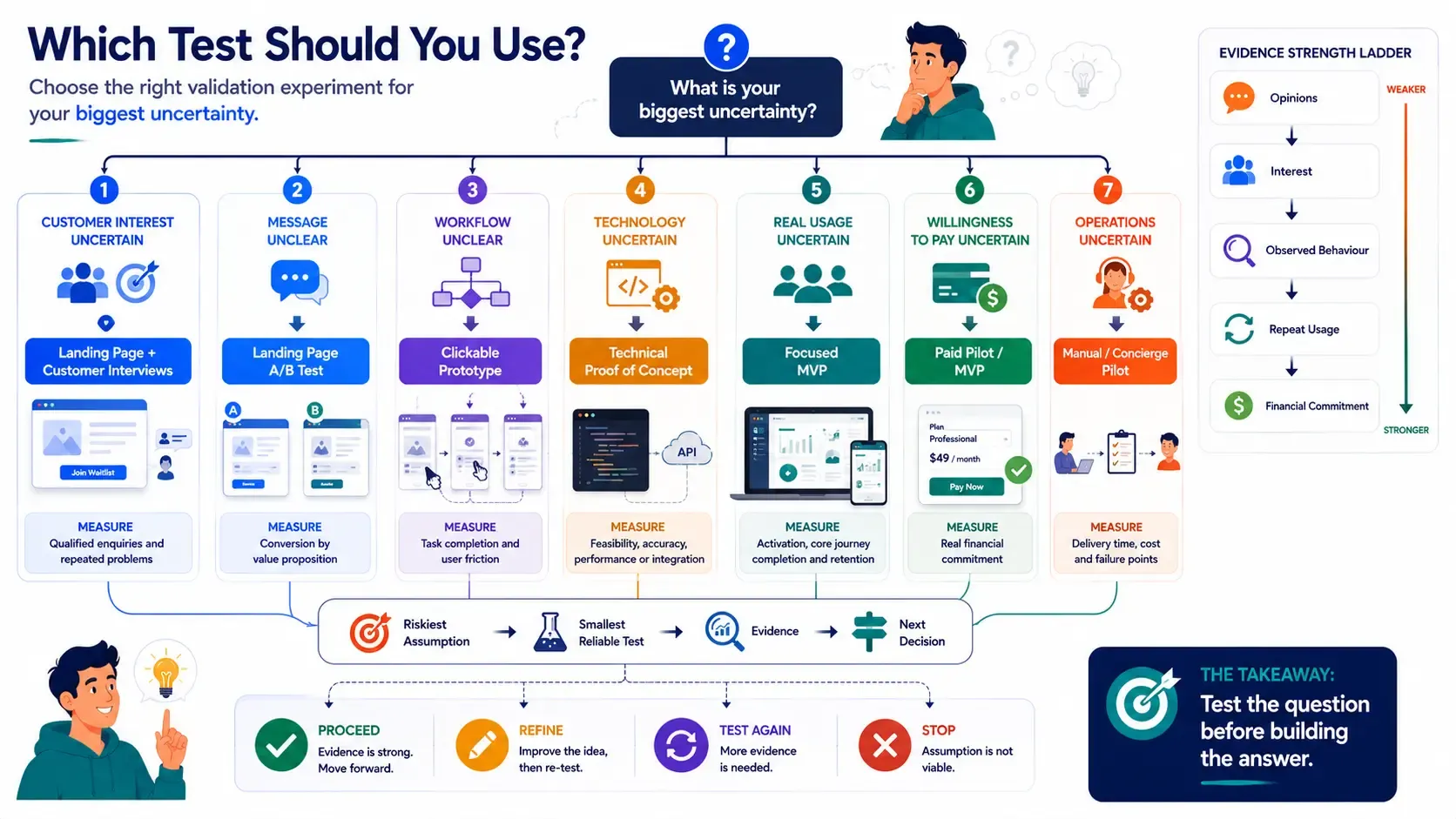
Start by identifying your riskiest assumption, then match it to the smallest experiment capable of testing it reliably.
| Your uncertainty | Recommended option | Evidence to collect |
|---|---|---|
| Customers may not care about the problem | Landing page and interviews | Qualified enquiries and repeated problems |
| Messaging may be unclear | Landing page | Conversion by value proposition |
| Users may not understand the workflow | Prototype | Task completion and observed friction |
| Technical feasibility is uncertain | Proof of concept | Accuracy, performance, or integration results |
| Customers may not use the solution | MVP | Activation and core journey completion |
| Customers may not pay | Paid pilot or MVP | Financial commitment |
| Operations may be difficult | Manual pilot or MVP | Delivery cost, time, and failure points |
If your biggest open question is technical rather than commercial, Proof of Concept vs Prototype vs MVP breaks down when a POC belongs in the sequence.
Can You Use All Three?
Yes. A sensible sequence looks like this:
- Test interest. Launch a landing page, conduct customer interviews, and measure qualified responses.
- Test the experience. Create a clickable prototype and observe whether target users understand the core journey.
- Test real behaviour. Build a focused MVP and measure usage, payment, retention, and operational performance.
Not every idea requires every stage. A technically simple product with committed pilot customers may move directly to an MVP after basic discovery. A complex product may also require a technical proof of concept before either a prototype or an MVP makes sense. For a closer look at when a lightweight test is enough and when it isn’t, see Prototype vs MVP vs Full Product.
Common Mistakes
- Treating sign-ups as complete validation. Waitlist registrations indicate interest, not sustained usage or payment.
- Treating a polished prototype as a finished product. A realistic interface may still lack functionality, security, integrations, and reliable data handling.
- Building an MVP too early. Development should not begin merely because the founder is excited — validate the customer, problem, and riskiest assumptions first. What Is an MVP for Startups? covers the fundamentals if you are still defining what “MVP” means for your idea.
- Testing too many assumptions at once. A test becomes difficult to interpret when it changes the customer segment, price, message, workflow, and product simultaneously.
A Simple Decision Framework
- Choose a landing page when you need evidence of interest.
- Choose a prototype when you need evidence about usability and product understanding.
- Choose an MVP when you need evidence from real usage, retention, operations, or payment.
The progression is:
Interest → Understanding → Behaviour → Payment
Each stage produces stronger evidence but generally requires greater investment.
Turn Uncertainty Into Evidence
The best way to test a business idea is not always to build the product first. Identify the most important uncertainty and choose the smallest reliable experiment that can resolve it.
A landing page can test demand. A prototype can test the experience. An MVP can test real customer behaviour.
Choose the Right Path From Idea to Evidence
MVPHUB helps founders validate ideas, design practical product experiences, and launch focused, production-ready MVPs through AI-accelerated delivery and professional engineering. Book a free consultation with MVPHUB to determine whether your next step should be a landing page, prototype, proof of concept, or MVP.
Book a free consultation with MVPHUBFrequently Asked Questions
Can a landing page validate a business idea?
It can validate initial interest and messaging, especially when visitors take a meaningful action like joining a waitlist or booking a demo. It cannot independently prove long-term usage or willingness to pay, so treat it as a first filter, not a final verdict.
Is a prototype the same as an MVP?
No. A prototype usually simulates the experience without a working backend, database, or integrations, while an MVP is a functional product used by real early customers to complete a genuine task.
Should I create a prototype before an MVP?
A prototype is helpful when the user journey or interface remains uncertain. Testing it with real users can reduce expensive design and development changes once building the MVP begins.
What is the cheapest way to test a business idea?
Customer interviews, a simple landing page, and manual service experiments are generally lower-cost starting points than developing software, and they can be run in days rather than weeks.
When should I build an MVP?
Build an MVP when the customer problem already has credible evidence behind it, the major risks are understood, and you need a working product to test real usage, payment, or retention rather than stated interest.
