
How to Measure Product–Market Fit During the MVP Stage
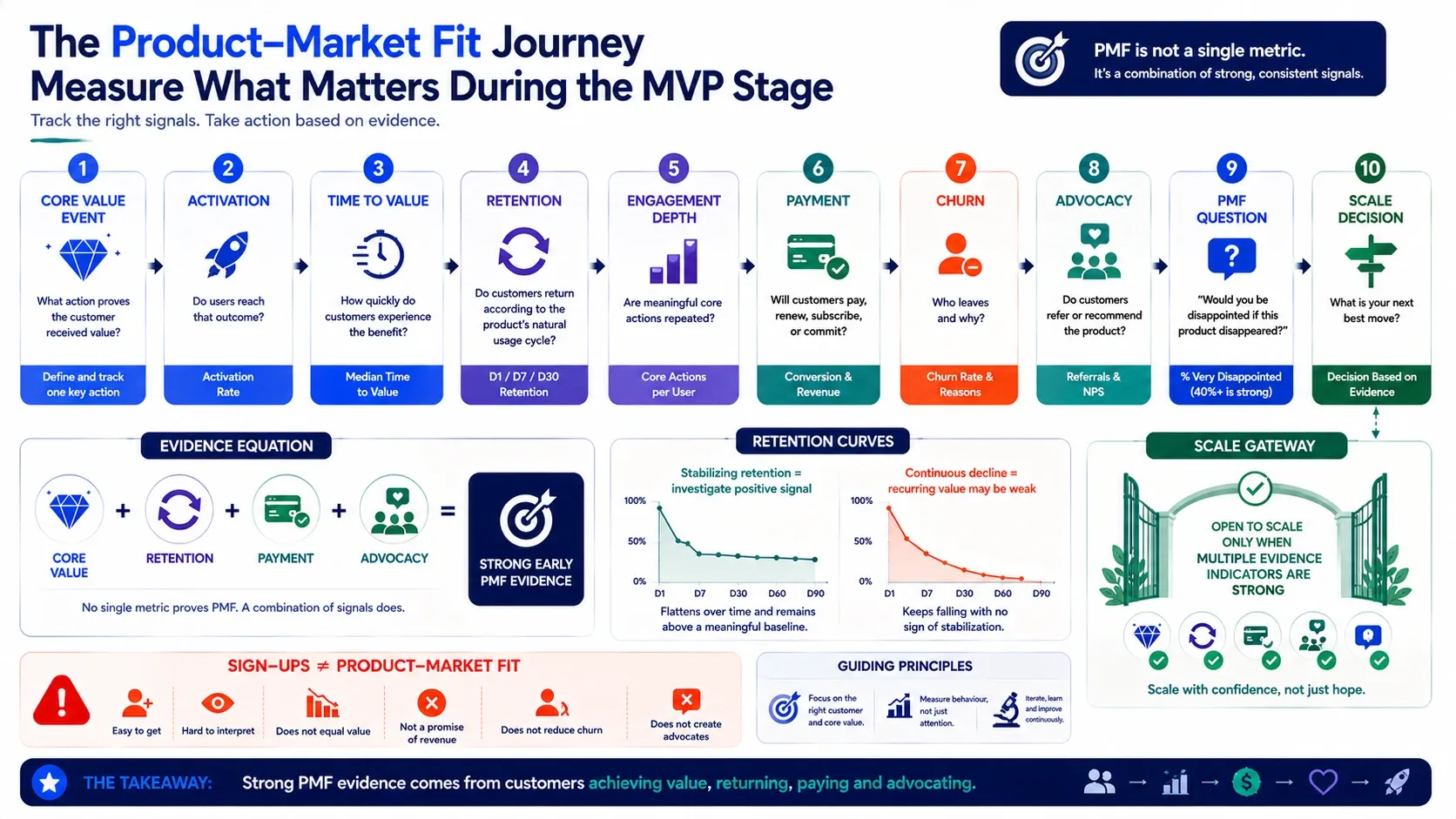
Product–market fit occurs when a specific customer group repeatedly uses and values your product enough to sustain demand.
During the MVP stage, you may not have enough users or time to prove product-market fit conclusively. However, you can identify early evidence through customer behaviour, retention, payment, referrals, and feedback.
Effective product-market fit validation should answer four questions:
- Do customers reach the product’s core value?
- Do they return to it or continue using it?
- Will they pay or make a meaningful commitment?
- Would they be disappointed if the product disappeared?
Step 1: Define the Core Value Event
Before selecting MVP metrics, identify the action that represents genuine customer value.
Examples include completing a booking, sending a paid invoice, publishing a course, receiving a qualified candidate shortlist, generating and using a report, completing a marketplace transaction, or resolving a maintenance request.
Registration is rarely the core value event. It only shows that someone entered the product.
Decision: Can one measurable action demonstrate that the customer received the promised outcome? If yes, track it as the primary activation event. If no, clarify the MVP value proposition and customer journey first — measuring sign-ups instead of value can make weak traction look stronger than it is.
Step 2: Measure Activation
Activation measures how many users reach the first meaningful outcome.
A simple formula is:
Activation rate = Users completing the core value event ÷ Users who started × 100
Track where users abandon the journey: landing page to registration, registration to onboarding, onboarding to first core action, and first action to complete outcome.
Recommended action: if activation is weak, review customer targeting, onboarding, workflow complexity, trust signals, and product reliability before increasing marketing spend.
Step 3: Measure Time to Value
Time to value is how long a new customer takes to experience the main benefit. For some products, this may be minutes. For enterprise products, it could be days or weeks.
Measure the time from registration to activation, the number of steps before the first outcome, the manual setup required, and any waiting time caused by approvals or integrations.
Customers may understand the value but abandon the product because reaching it requires too much effort. Remove unnecessary steps, provide guided setup, use templates, or manually assist early customers.
Step 4: Measure Retention
Retention is one of the strongest early product-market fit signals.
Define retention according to the product’s natural usage cycle — daily for communication or productivity tools, weekly for operational platforms, monthly for reporting or accounting tools, or event-based for booking or transaction products.
A basic formula is:
Retention rate = Active users remaining after a period ÷ Users active at the beginning × 100
Compare groups who started during the same period instead of combining all users. If retention stabilizes, investigate what retained users value. If it continuously declines, the product may deliver curiosity rather than recurring value. If usage is naturally infrequent, measure repeat events, renewals, or continued account activity instead.
Step 5: Track Engagement Depth
Logging in does not always mean the product is valuable. Measure behaviours connected to outcomes: core actions completed, frequency of usage, number of successful transactions, percentage using the primary workflow, teams or users invited, records or bookings created, and continued use of essential features.
Avoid celebrating activity that doesn’t contribute to customer value — feature usage can appear high because users are confused, repeating failed actions, or exploring without achieving an outcome.
Step 6: Test Willingness to Pay
Revenue is stronger evidence than positive feedback. Relevant startup traction metrics include paid conversion rate, trial-to-paid conversion, monthly recurring revenue, renewal rate, expansion revenue, cancellation rate, failed payments, and revenue per active customer.
For early B2B products, paid pilots, deposits, signed contracts, and active procurement may also demonstrate commitment.
Decision: if customers use the product but resist payment, investigate whether the problem is urgent, whether the buyer is correct, or whether the pricing matches the value.
Step 7: Measure Customer Loss
Churn shows how many customers stop using or paying for the product. Separate customers who leave because of missing core value, difficult onboarding, product defects, incorrect pricing, missing integrations, poor support, organizational changes, or wrong customer targeting.
A single churn percentage does not explain the cause — combine analytics with cancellation interviews, and prioritize churn reasons that repeatedly affect your ideal customer, not one-off feature requests from unsuitable users.
Step 8: Measure Advocacy and Referrals
Customers who recommend a product are showing stronger value than those who merely continue using it.
Track customer referrals, organic sign-ups, invitations sent, testimonials, case-study participation, unprompted positive feedback, and customers bringing the product into another team or company. Referral behaviour is generally stronger evidence than a satisfaction score alone.
Step 9: Ask the Product–Market Fit Question
Ask active target customers: how would you feel if you could no longer use this product?
Common responses are very disappointed, somewhat disappointed, not disappointed, or no longer using the product.
This survey can provide a directional signal, but it should not be treated as proof by itself — sample quality, product maturity, customer segment, and response volume all affect the result. Combine the survey with retention, payment, and behavioural evidence, following the same evidence-layering approach in the market validation framework.
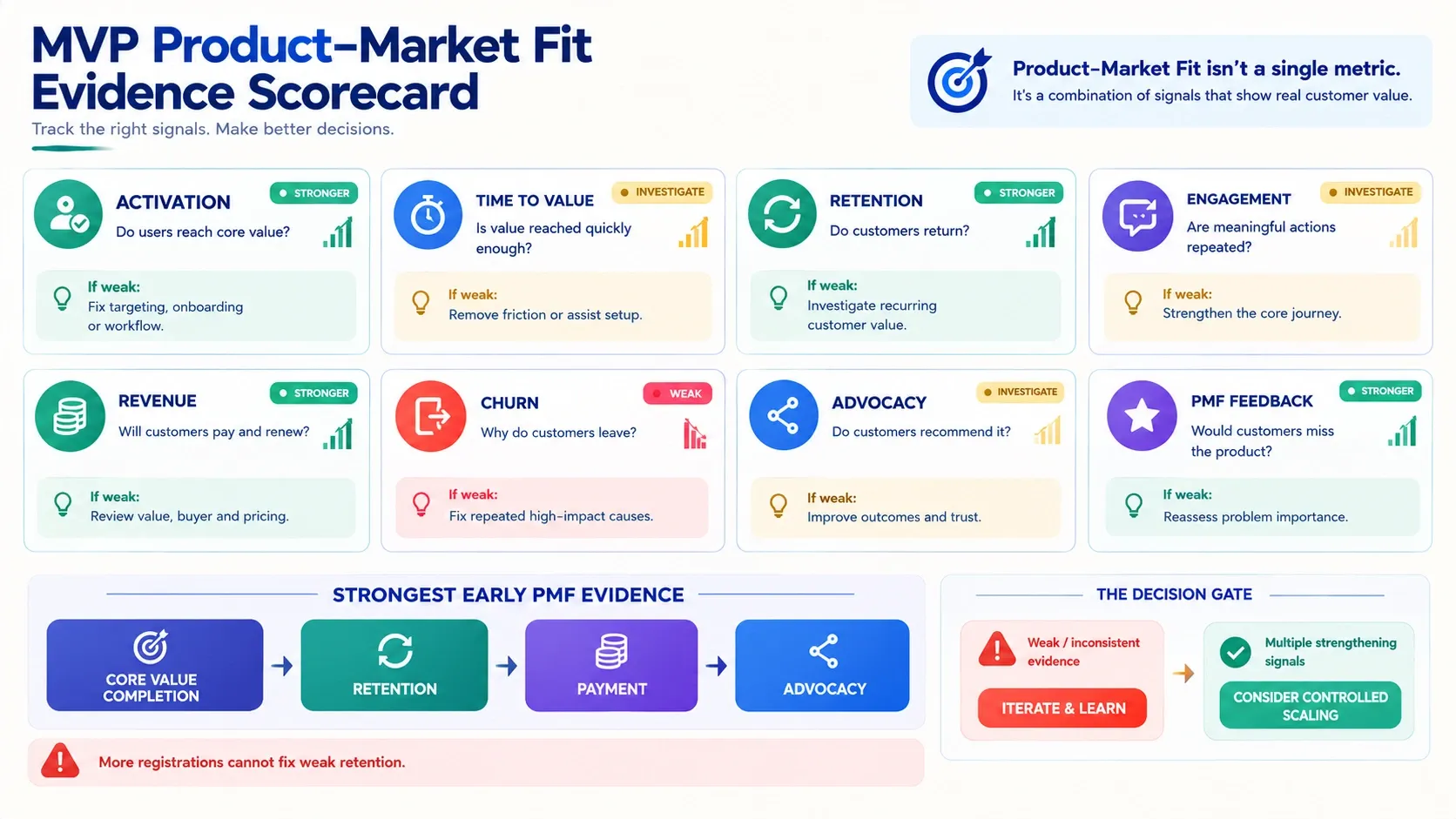
Step 10: Build an MVP Evidence Scorecard
| Evidence area | Key question | Recommended action if weak |
|---|---|---|
| Activation | Do users reach core value? | Fix onboarding and workflow |
| Time to value | Is the value reached quickly enough? | Remove steps or assist setup |
| Retention | Do customers return? | Investigate recurring value |
| Engagement | Are meaningful actions repeated? | Strengthen the core journey |
| Revenue | Will customers pay and renew? | Review value, buyer, and pricing |
| Churn | Why do customers leave? | Fix repeated high-impact causes |
| Advocacy | Do customers recommend it? | Improve outcomes and trust |
| Feedback | Would users miss the product? | Reassess problem importance |
When Should You Scale?
Consider increasing investment when the target customer is clearly defined, activation is improving, retention stabilizes across customer groups, core usage repeats consistently, customers pay or renew, churn reasons are understood, referrals or organic demand appear, and the product operates reliably.
Do not scale acquisition simply because registrations are increasing. More traffic can amplify a weak product journey and increase customer acquisition costs. If you’re not yet confident the underlying problem was validated before building, Why Most Startup Ideas Fail Before Product-Market Fit covers the earlier-stage mistakes that show up as weak MVP metrics later.
Measure Behaviour Before Declaring Product–Market Fit
No single number proves product–market fit. The strongest early evidence combines:
Core value completion + Retention + Payment + Advocacy
During the MVP stage, focus on whether the right customers achieve the promised outcome, return for continued value, and demonstrate commitment.
Turn MVP Usage Into Product Evidence
MVPHUB helps founders define measurable MVP outcomes, launch production-ready products, and improve them using real customer behaviour and market evidence. Book a free consultation with MVPHUB to design an MVP with the right analytics, validation metrics, and growth foundation.
Book a free consultation with MVPHUBFrequently Asked Questions
What is product-market fit validation?
It is the process of measuring whether a clearly defined market repeatedly uses, values, pays for, and recommends a product, rather than relying on opinions or sign-up counts alone.
Which MVP metric is most important?
The most important metric is usually completion and repetition of the core value event. Retention and payment strengthen that evidence further.
Does user growth prove product-market fit?
No. Growth may come from advertising or curiosity. Product-market fit requires evidence that customers receive value and continue using the product afterward.
What is a good retention rate?
There is no universal rate. It depends on the industry, customer type, product maturity, and natural usage frequency, so compare similar customer cohorts over time instead of chasing a fixed number.
When should a startup scale its MVP?
Scale when activation, retention, payment, and reliability show consistent improvement within a clearly defined customer segment, not simply when registrations increase.
