
How to Define a Clear Value Proposition for Your MVP
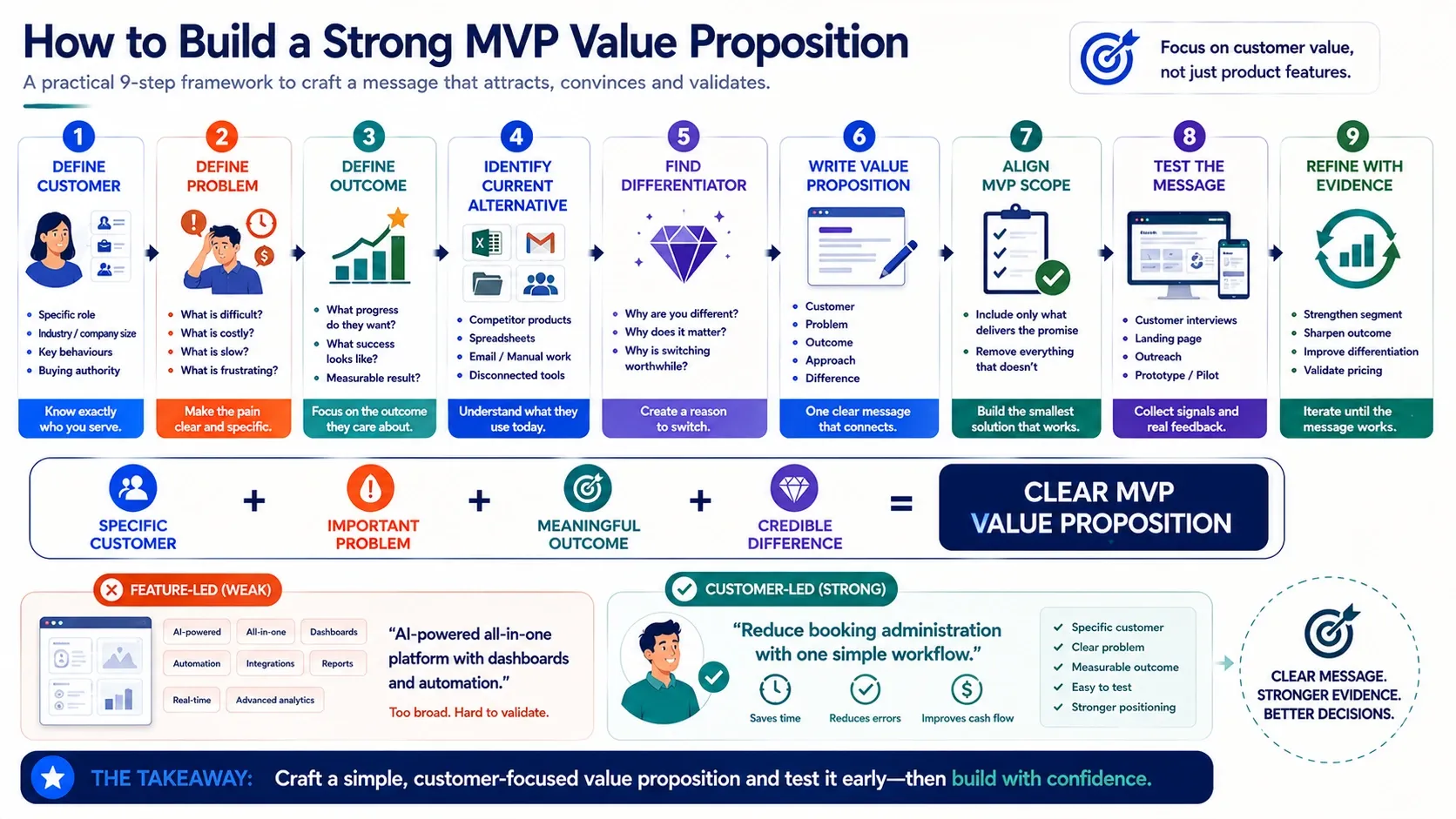
An MVP value proposition explains who your product serves, which problem it solves, what outcome it creates, and why customers should choose it over their current alternative.
It should be clear enough for a potential customer to understand within seconds.
A strong value proposition guides more than marketing. It influences your MVP scope, product positioning, onboarding, pricing, feature priorities, and validation metrics. If the value is unclear, adding more features rarely solves the problem.
Step 1: Define One Target Customer
Avoid trying to serve several audiences through one general message.
“Small businesses” is too broad. A stronger segment might be:
- Independent tutors managing more than 50 students
- Property managers operating several apartment buildings
- Recruitment agencies screening hundreds of applicants
- Accounting firms collecting client documents through email
Define your customer by role, industry, behaviour, problem frequency, and purchasing authority.
Decision: Can you describe the first customer in one specific sentence? If yes, move to the problem. If no, narrow the customer segment — broad targeting creates generic MVP messaging and an unfocused product scope.
Step 2: Identify the Important Problem
Describe the problem from the customer’s perspective, not as the absence of your product.
Weak: Businesses need an AI-powered management platform.
Stronger: Independent tutors spend hours managing enrolments, payments, learning materials, and student communication across disconnected tools.
Determine when the problem occurs, how frequently it happens, how customers manage it today, what it costs in time, money, risk, or missed opportunity, and why existing alternatives are inadequate.
Recommended action: validate the problem through interviews and examples of recent customer behaviour, following the same discovery approach in the market validation framework.
Step 3: Define the Customer Outcome
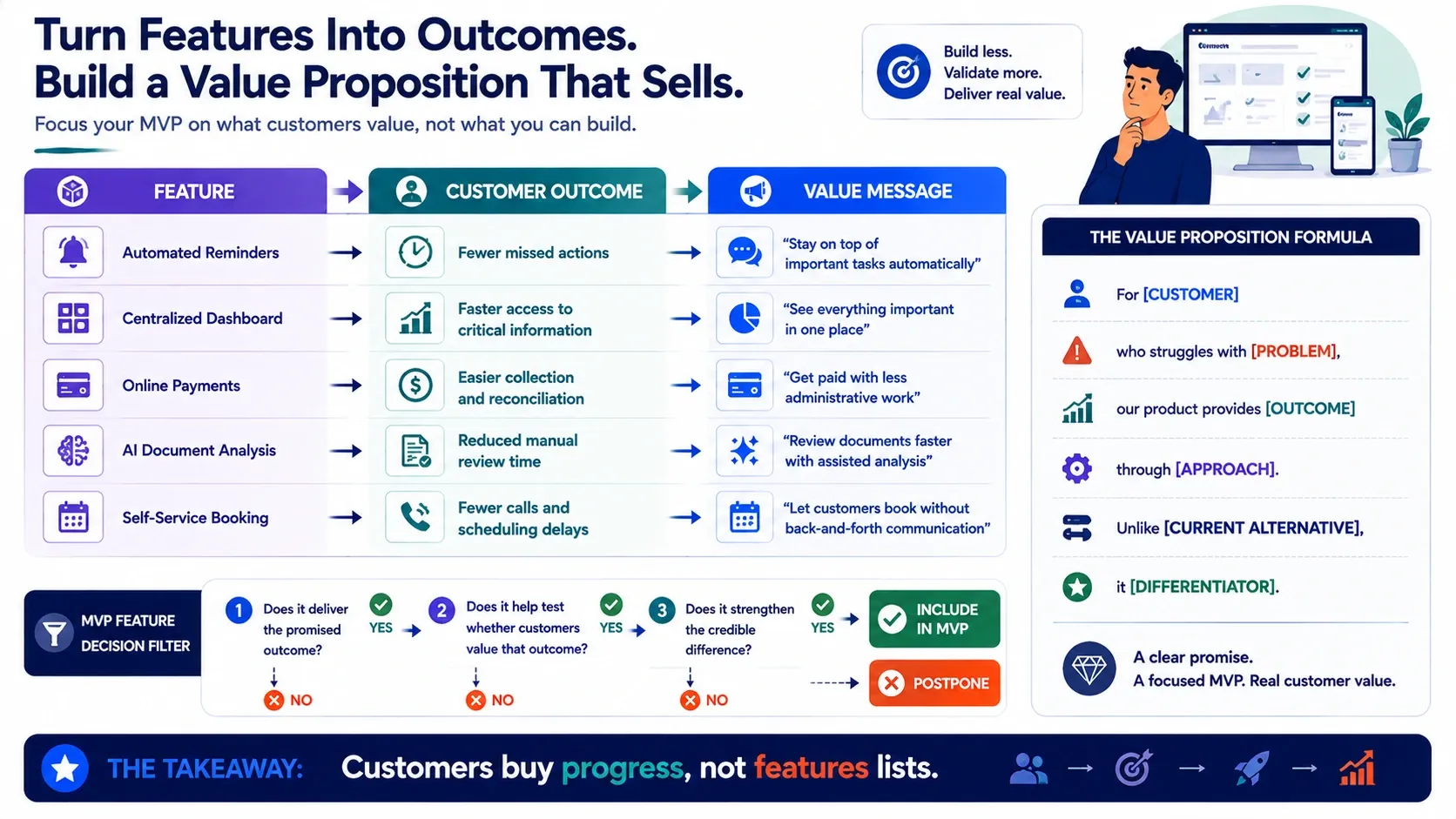
Customers do not primarily buy features. They buy progress — saved time, reduced operational cost, increased revenue, avoided mistakes, improved visibility, faster work, reduced compliance risk, or a better customer experience.
Convert product features into outcomes:
| Feature | Customer outcome |
|---|---|
| Automated reminders | Fewer missed actions |
| Centralized dashboard | Faster access to critical information |
| Online payments | Easier collection and reconciliation |
| AI document analysis | Reduced manual review time |
| Self-service booking | Fewer calls and scheduling delays |
A feature-led message forces customers to interpret the value themselves.
Step 4: Understand the Current Alternative
Your competitor is not always another software product. Customers may currently use spreadsheets, email, messaging applications, paper forms, internal staff, outsourced services, several disconnected tools, or no formal solution at all.
Your product positioning should explain why changing from the current approach is worthwhile. Ask: what does the customer already trust, what would they need to replace, what makes switching difficult, and what advantage is meaningful enough to justify the change?
Step 5: Identify a Credible Differentiator
A differentiator should matter to the customer and be supportable through evidence. Possible differentiators include faster completion, simpler onboarding, a specific industry focus, fewer disconnected tools, better integration, more transparent pricing, improved reliability, stronger support, or a complete workflow rather than a partial tool.
Avoid unsupported phrases such as “revolutionary,” “best-in-class,” or “all-in-one.”
Decision: Does the differentiator improve the customer’s desired outcome? If yes, include it in the value proposition. If no, it is probably a feature, not meaningful positioning.
Step 6: Write the MVP Value Proposition
Use this practical formula:
For [target customer] who struggles with [important problem], [product] provides [meaningful outcome] through [solution approach]. Unlike [current alternative], it [credible differentiator].
Example: For independent tutors struggling to manage classes across spreadsheets and messaging apps, our learning platform centralizes enrolments, payments, materials, and student communication. Unlike disconnected tools, it provides one simple workflow designed specifically for online tutoring.
Create a shorter website version too: Manage your classes, payments, materials, and student communication from one simple platform built for independent tutors.
Step 7: Align the MVP Scope With the Promise
Every essential feature should help deliver or measure the value proposition.
If your promise is “reduce booking administration,” the MVP may need service selection, availability, booking confirmation, customer notification, and basic booking management. It probably does not need loyalty points, social profiles, advanced reports, or multiple payment gateways.
Ask of every proposed feature: does this help deliver the promised outcome or test whether customers value it? If not, postpone it. What Is an MVP for Startups? covers this scoping discipline in more depth if you’re still drawing the line between essential and optional.
Step 8: Test Your MVP Messaging
Test the value proposition before full development through customer interviews, landing pages, direct outreach, advertising variations, clickable prototypes, demo requests, or pilot invitations — see Landing Page vs Prototype vs MVP for how each of those methods compares.
Measure behaviour such as qualified enquiries, conversion, task completion, pilot requests, and willingness to pay. Do not ask only, “Do you like this message?” Instead, ask potential customers to explain who they think the product is for, which problem it solves, what outcome they expect, why they would choose it, and what remains unclear.
Step 9: Refine Based on Evidence
Use test results to choose the next action.
| Evidence | Recommended action |
|---|---|
| Customers understand and take action | Use the message to define the MVP |
| Problem is clear, but outcome feels weak | Strengthen the promised result |
| Different customer groups respond differently | Focus on the strongest segment |
| Customers like the idea but will not switch | Improve differentiation or reduce friction |
| Interest is high, but payment is weak | Revisit urgency, pricing, or buyer |
| Customers misunderstand the product | Simplify the language and positioning |
Your value proposition should evolve as you learn from real customers.
Product Positioning vs MVP Messaging
Product positioning defines where your product belongs in the market, who it serves, and why it is different. MVP messaging communicates that position through headlines, descriptions, calls to action, onboarding, and sales conversations.
Positioning is the strategic foundation. Messaging is how customers experience it.
Make the Value Clear Before Expanding the Product
A strong MVP value proposition connects:
Specific customer → Important problem → Meaningful outcome → Credible difference
It gives your first product release a clear purpose and prevents the MVP from becoming an unrelated collection of features. If you’re still confirming the underlying problem is real before committing to a message, 10 Signs Your Product Idea Is Ready for an MVP is a useful checkpoint to run first.
Turn Your Product Promise Into a Focused MVP
MVPHUB helps founders validate their startup value proposition, define evidence-based product positioning, and launch production-ready MVPs using AI-accelerated delivery and professional engineering. Book a free consultation with MVPHUB to turn your product idea into a clear message, focused scope, and launch-ready MVP.
Book a free consultation with MVPHUBFrequently Asked Questions
What is an MVP value proposition?
It is a concise explanation of who the MVP serves, which problem it solves, the outcome it delivers, and why customers should choose it over their current alternative.
How long should a value proposition be?
The main statement is usually one or two sentences. A shorter headline can communicate the primary outcome, supported by additional details elsewhere on the page or in the pitch.
Should an MVP value proposition mention features?
Only when a feature helps explain how the customer receives value. Lead with the problem and outcome rather than a long feature list.
How can I test startup product positioning?
Use customer interviews, landing-page variations, direct outreach, prototype tests, demo requests, and paid pilots to measure understanding and action, not just opinions.
Can the value proposition change after launch?
Yes. Real usage, customer feedback, conversion data, and willingness to pay may reveal a stronger segment, problem, outcome, or differentiator than the one you started with.
