
Minimum Viable Product Software vs a Regular Build
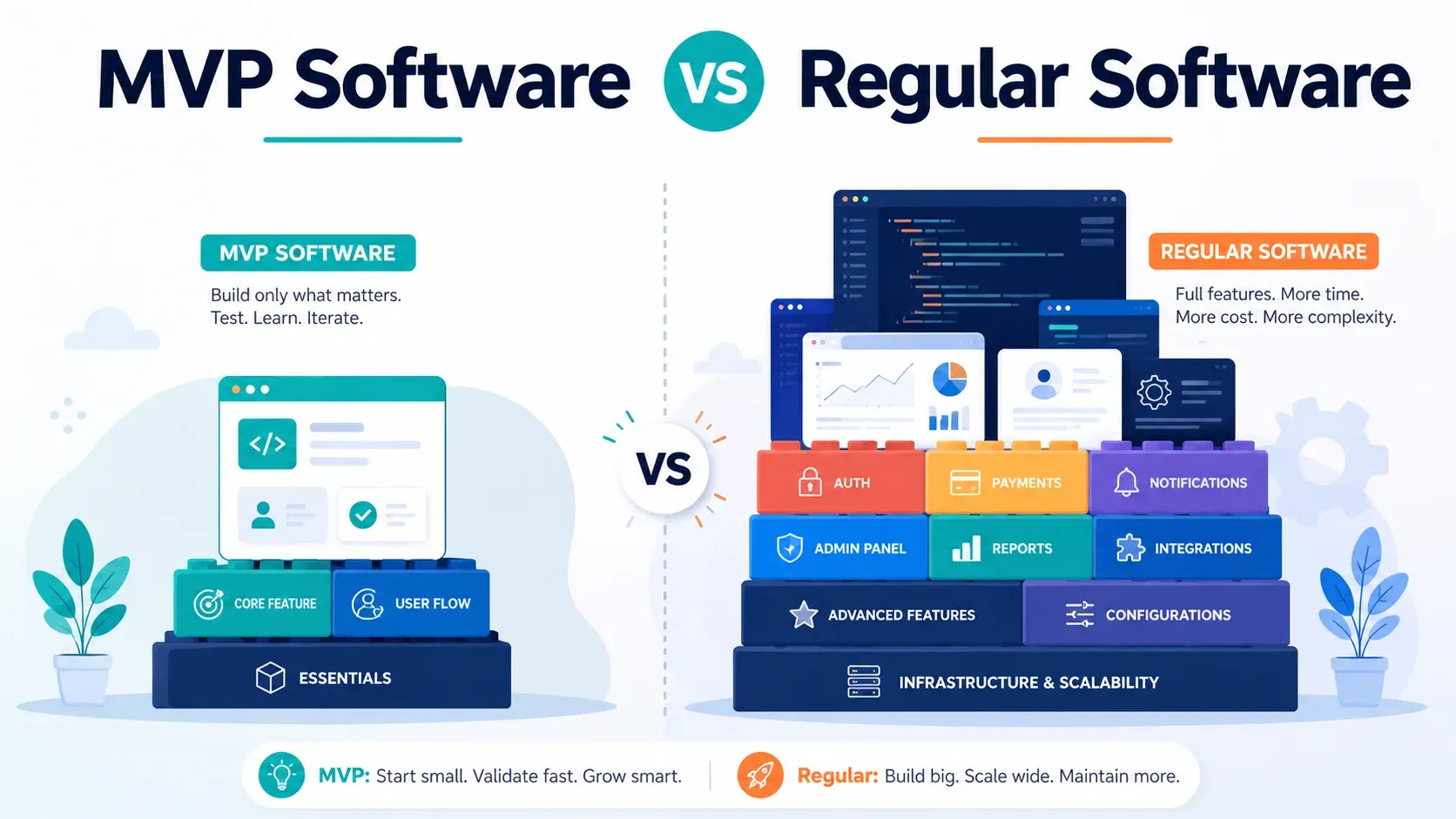
“Minimum viable product software” gets treated, informally, as a synonym for “cheap software” or “a stripped-down version of the real thing.” Neither is quite right, and the confusion causes real problems — founders who expect a smaller price tag for the same requirements document, and teams who cut corners on quality because they think “MVP” means “rough.” For the term’s origin and broader industry usage, Atlassian’s Agile guide to MVPs is a good starting reference.
The actual difference isn’t about size or cost. It’s about purpose.
Regular Software Is Built to Specification
A regular software build typically starts from a reasonably complete set of requirements. The team knows, more or less, what the finished product needs to do, who it’s for, and how it should behave. Development is largely about executing that specification well — architecture, features, integrations, and polish are planned around a known target.
This works well when the underlying assumptions — that customers want this, that this is how they’ll use it, that this business model holds — are already established. It’s a poor fit when those assumptions are still unproven, because a complete specification built on a wrong assumption just produces a complete, well-built product nobody needs.
MVP Software Is Built to Generate Evidence
Minimum viable product software starts from a different question entirely: not “what does the finished product need to do,” but “what’s the smallest version that lets us find out if this assumption is right?”
That reframing changes almost everything downstream:
- Scope is defined by what’s needed to test the assumption, not by a complete feature wishlist
- Requirements are expected to be incomplete and to evolve based on what real users show you
- Success is measured by evidence generated — usage, retention, conversion — not just by shipping the spec
- Timeline is compressed deliberately, because the value of the evidence decreases the longer it takes to get in front of real users
| Dimension | Regular Software | MVP Software |
|---|---|---|
| Starting point | Fairly complete requirements | Validated problem + one core assumption |
| Primary goal | Deliver the specified product | Generate real evidence about the assumption |
| Scope | Full feature set for the intended use case | Minimum needed to test the assumption |
| Requirements stability | Relatively fixed | Expected to change based on real usage |
| Timeline priority | Complete and correct delivery | Speed to real user feedback |
| Success measure | Meets the spec | Assumption confirmed, refined, or disproven |
What Doesn’t Change: Engineering Standards
The word “minimum” describes scope, not quality. A well-built MVP still needs to handle real user data safely, perform reliably for the journey it does support, and be architected in a way that doesn’t collapse the moment you try to extend it. Reducing feature count is a legitimate strategy. Reducing security, reliability, or basic engineering discipline is not an MVP decision — it’s a shortcut that tends to resurface as expensive rework later. See What “Minimum” Means in an MVP for how to draw that line in practice.
Why This Distinction Matters for Founders
Understanding this difference changes how you brief a development team, how you evaluate a proposal, and what you should expect at the end of the engagement.
If you approach MVP software development the way you’d approach a regular build — handing over a long requirements list and expecting all of it delivered — you lose the thing that makes an MVP valuable in the first place: speed to real evidence. You’ll likely end up with a larger, slower, more expensive build that still hasn’t told you whether anyone wants the product.
Conversely, if your core assumptions are already well established — a proven market, an existing customer base, strong prior evidence — treating the build as a regular software project rather than an MVP can be the right call. MVP software earns its value specifically in conditions of real uncertainty.
A Practical Example
Consider two founders building a booking platform for independent tutors. One has already run a manual pilot, has thirty tutors on a waitlist, and knows tutors’ biggest friction point is scheduling conflicts. The other has a strong hunch that tutors need “a better platform” but hasn’t spoken to any yet.
The first founder is in genuine MVP territory — the core assumption (tutors will switch to a tool that solves scheduling conflicts) is specific and testable, and a narrow, fast build focused on that one journey will generate real evidence quickly. The second founder isn’t ready for either MVP or regular software development yet — building anything at this stage, minimal or not, is still a guess. The right next step is validation, not a smaller version of an unvalidated idea.
This is the practical test worth applying before any build starts: are you narrowing scope to test something specific, or just building a smaller version of something still unproven?
It’s a Spectrum, Not a Binary
In practice, few products sit at the extreme ends of “fully validated” or “completely unproven.” Most founders have partial evidence — some customer conversations, a plausible but untested business model, a market that seems promising but hasn’t been directly tested. In that common middle ground, leaning toward MVP software — narrower scope, faster to real users, built to generate evidence rather than complete a spec — is almost always the lower-risk choice.
Choosing the Right Framing
Before starting a build, ask honestly: is the goal here to deliver a known specification, or to find out if an assumption holds? The answer should shape scope, timeline, and how you evaluate the finished product — not the label on the invoice. If you’re still working out where your product sits on that scale, MVP vs MMP vs MLP: Which Product Stage Are You Building? can help place it.
Building Software to Test an Assumption, Not Just Ship a Spec?
MVPHUB helps founders validate, scope, design, develop, and launch focused production-ready MVPs using AI-accelerated delivery and accountable professional engineering. Book a free consultation to scope the right build for where you actually are.
Book a free consultation with MVPHUBFrequently Asked Questions
Is minimum viable product software just a cheaper version of regular software?
No. The difference isn't primarily about cost — it's about purpose. Regular software is built to deliver a defined set of requirements. MVP software is built to generate evidence about an unproven assumption, with scope shaped around that goal.
Does MVP software cut corners on quality?
It shouldn't. A well-built MVP is smaller in scope, not lower in engineering standards. Core journeys should still be reliable, secure, and functional for real users — the reduction is in feature count, not code quality.
How is the requirements process different for MVP software?
Regular software development typically starts from a fairly complete requirements document. MVP development starts from a validated problem and a core assumption, with requirements intentionally kept narrow and expected to change based on what real users show you.
Will MVP software need to be rebuilt later?
Not necessarily. A well-architected MVP can be extended as the product grows, rather than thrown away. Problems arise when MVPs are built with shortcuts that make later extension difficult — which is a build-quality issue, not something inherent to being an MVP.
When should a company skip MVP software and build a full product?
When the core assumptions are already well validated — through a proven market, existing customer base, or strong prior evidence — building toward a fuller product from the start can make sense. MVP software earns its value specifically when uncertainty is high.
