
How to Get an Accurate MVP Cost Estimate Before You Sign a Quote
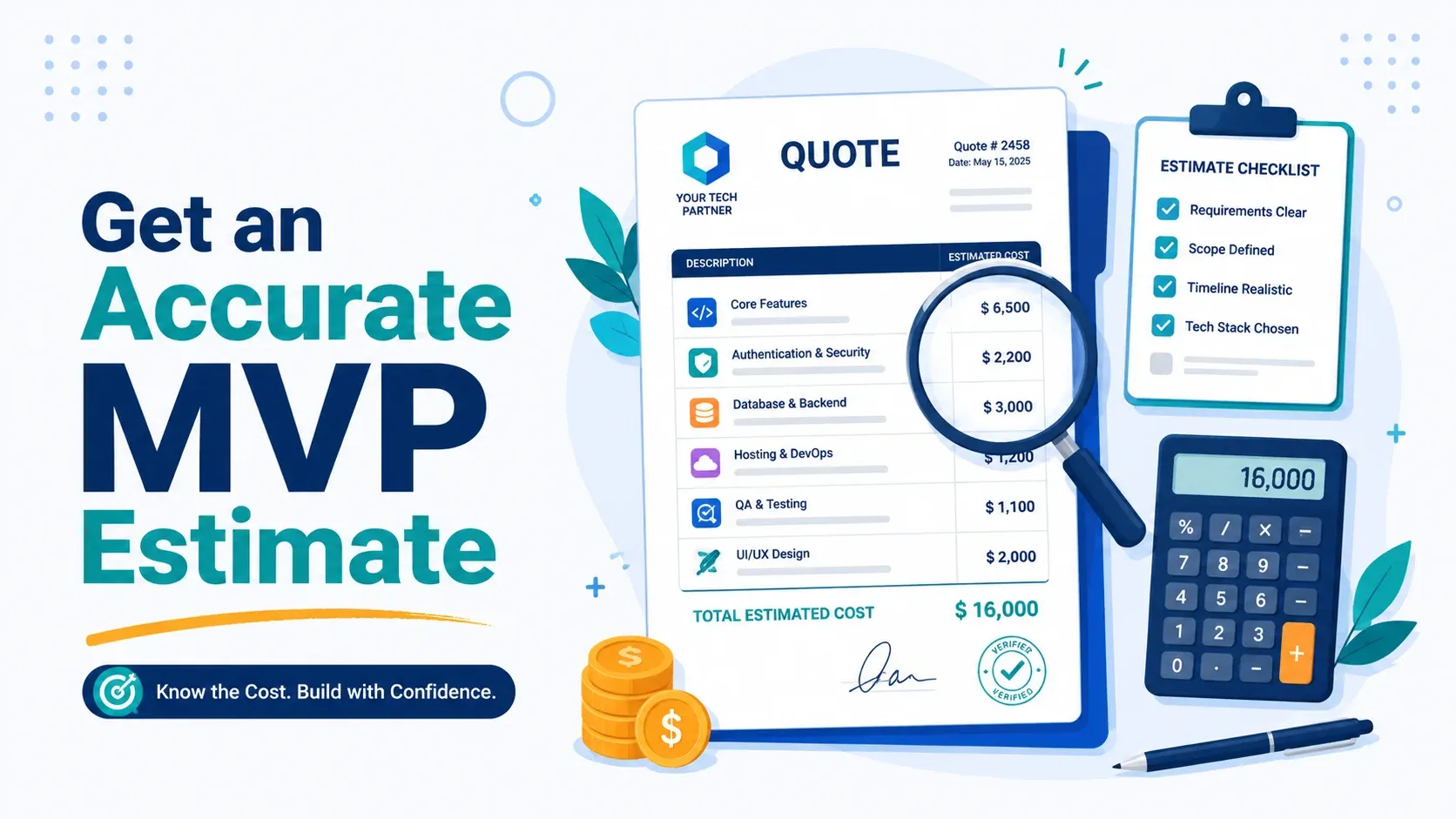
The number a vendor sends you after a 20-minute call is not an estimate — it’s a guess with more confidence than it’s earned. A real MVP cost estimate depends on specific inputs that most founders don’t hand over clearly, which is exactly why two quotes for “the same” product can land tens of thousands of dollars apart.
Before you request quotes — or accept the first one that comes back — it helps to know what actually shapes an estimate, so you can supply better input and sanity-check what you get back.
Why Two MVP Estimates for “the Same Idea” Can Differ So Much
Most of the variance between quotes doesn’t come from one vendor being cheaper. It comes from each vendor scoping a slightly different product, because the founder described the idea differently each time, or left out details that materially change the build. A quote that assumes basic auth is a different product than one that assumes social login, team invites, and two-factor authentication — even though both might get described as “just a login.”
This is the single biggest lever founders have over estimate accuracy: the quality of the scope you hand over, not which vendor you ask.
The Inputs That Actually Shape an Estimate
A vendor giving a responsible estimate needs answers to these before a number means anything:
- The core user journey. Not a feature list — the actual sequence a user follows from arriving to getting value, since scope creep usually hides in steps nobody wrote down.
- Target platform(s). Web, iOS, Android, or all three, since each additional platform is close to its own build, not a small add-on.
- Integrations. Every third-party service — payments, CRM, calendar, messaging, analytics — because integrations are one of the most common sources of underestimated effort.
- User roles and permissions. One user type is simple. Admin/member/guest with different permissions multiplies both the build and the testing.
- Compliance and security requirements. Payment data, health data, or data covered by regulations like GDPR change what “done” means, often substantially.
- Design maturity. Whether you’re arriving with wireframes, a rough sketch, or just an idea changes how much design work sits inside the estimate versus how much is assumed to already exist.
If you can answer all six with specifics, you’ll get a tighter, more trustworthy number. If you can only answer one or two, expect — and ask for — a wider range rather than a single figure.
How to Sanity-Check a Quote You’ve Already Received
Once a quote is in hand, a few checks separate a real estimate from a padded or underscoped one:
Does It List What’s Excluded?
A responsible quote states what’s not included — ongoing maintenance, a specific integration, native mobile apps, advanced analytics — as clearly as what is. A quote with no exclusions listed is usually underscoped, not efficiently priced, and the missing pieces tend to surface as expensive change requests later.
Does It Break Down by Line Item, Not Just a Total?
A single number gives you nothing to negotiate against or compare. A line-item breakdown — design, engineering, QA, infrastructure, project management — lets you see where the money actually goes and spot if one category looks unusually light (a common sign QA or infrastructure got underscoped to make the total look better).
Does the Timeline Match the Price?
A quote with an aggressive price and an aggressive timeline for a non-trivial scope is worth a direct question: what gets cut to hit both? Usually it’s testing depth, error handling, or documentation — all things that don’t show up as missing in a demo but show up fast once real users hit edge cases.
Was the Estimate Given Before or After a Real Scoping Conversation?
An estimate produced from a single paragraph description, with no follow-up questions from the vendor, is a rough placeholder at best. A vendor asking clarifying questions about your user roles, integrations, and edge cases before quoting is doing the work that makes an estimate mean something.
Comparing Quotes Side by Side
| What to check | Weak quote | Strong quote |
|---|---|---|
| Scope basis | Verbal description only | Written scope both sides agreed on |
| Exclusions | Not mentioned | Explicitly listed |
| Breakdown | Single total | Itemized by category |
| Timeline vs. price | Both aggressive, no explanation | Timeline justified against listed scope |
| Change process | Undefined | Documented change-request process |
Run every vendor’s quote through this table before comparing totals — a lower number that fails three of these checks isn’t actually a better deal.
Getting Comparable Quotes From Multiple Vendors
If you’re requesting quotes from more than one vendor — which is worth doing whenever the budget allows — send each one the exact same written scope document, not a slightly different verbal description each time. Small wording differences between conversations are enough to produce quotes for meaningfully different products, which makes the totals impossible to compare honestly.
A simple one-page scope document covering the core journey, platform, integrations, roles, and any compliance needs (the same six inputs above) is enough to get comparable numbers back from three vendors. It also gives you something concrete to reference later if a delivered feature doesn’t match what was quoted.
Using an Estimate as a Planning Tool, Not a Final Number
Even a well-scoped estimate is still an estimate. Treat it as the basis for a budget conversation, not a fixed guarantee, and pair it with your own sense of how much runway the whole project actually needs beyond just the build cost. Y Combinator’s guide to planning an MVP is a useful independent reference for scoping the product itself before you ever get to the pricing conversation — a tighter scope is what makes any estimate more accurate in the first place.
If you’re comparing pricing models rather than just totals, it’s also worth understanding how fixed-price and time & material contracts differ — the same scope can produce very different-looking quotes depending on which model a vendor defaults to.
Want a Quote You Can Actually Trust?
MVPHUB scopes every MVP through a real discovery conversation before quoting, with a line-item breakdown and clearly listed exclusions. Book a free consultation with MVPHUB to get an estimate built on your actual product, not a guess.
Book a free consultation with MVPHUBFrequently Asked Questions
What information does a vendor need to give an accurate MVP estimate?
A clear problem statement, the core user journey, target platform, expected integrations, and any compliance or security requirements. Vague input produces a vague, padded estimate almost every time — the more specific your scope, the tighter the range a vendor can responsibly give.
Why do MVP estimates come back so different from vendor to vendor?
Usually because each vendor is scoping a slightly different product, not because one is simply better priced. Different assumptions about testing depth, infrastructure, and what counts as done all shift the number before price-per-hour even enters the picture.
Is a free MVP cost calculator accurate?
It's a useful ballpark for a first gut-check, not a number to plan a budget around. Online calculators can't account for your specific integrations, compliance needs, or design complexity, all of which move a real quote significantly.
Should I get multiple MVP quotes before deciding?
Yes, ideally 3, using the same written scope for each so the quotes are actually comparable. Sending each vendor a slightly different description of your idea is the most common reason quotes look wildly inconsistent.
What's a red flag in an MVP cost estimate?
A number given before any discovery conversation, with no listed exclusions, and no breakdown by line item. An estimate that can't explain what's included and what isn't is a guess wearing a price tag, not a real estimate.
