
Fixed-Price vs Time & Material: How MVP Pricing Works
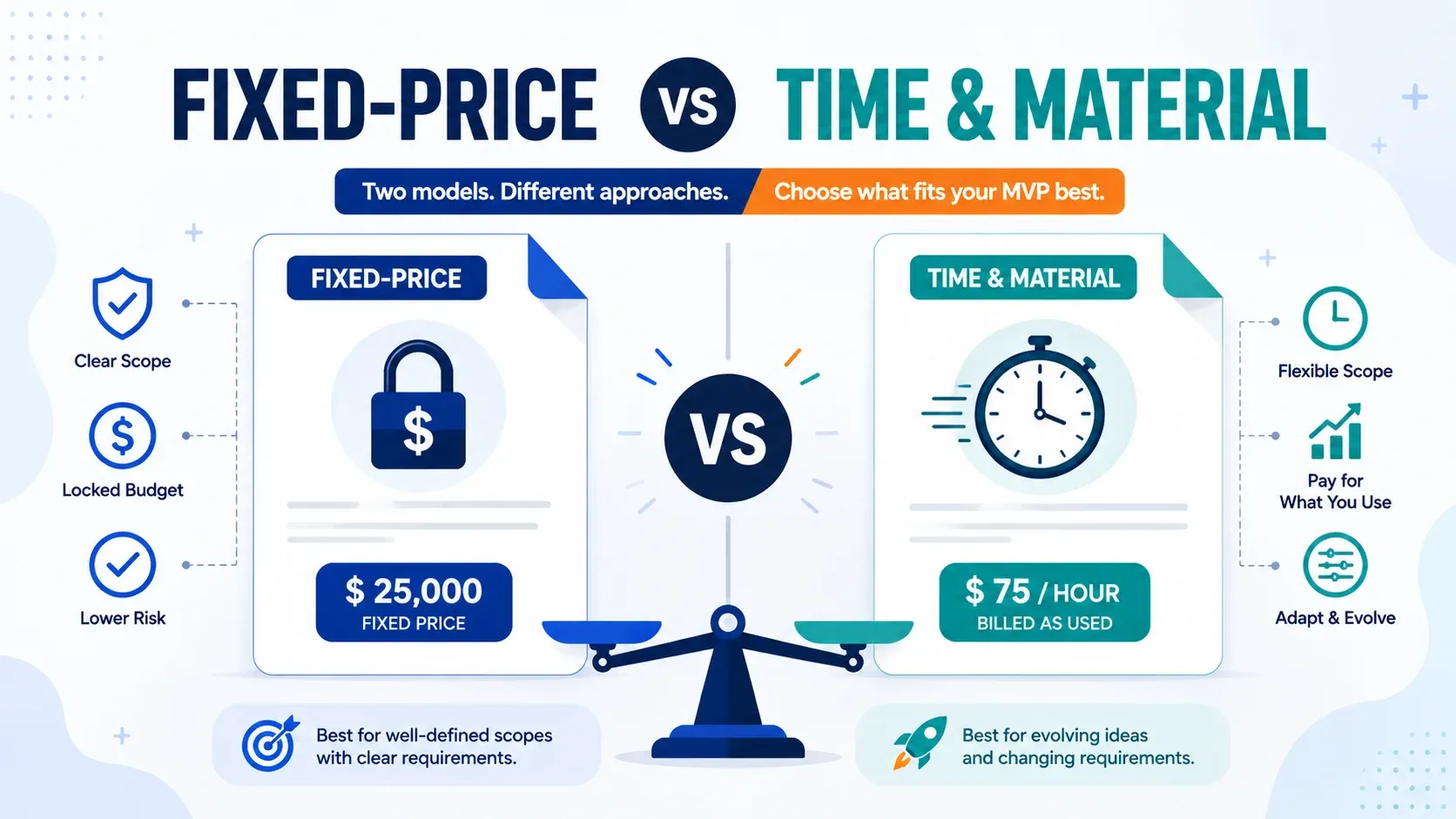
Two founders can get quotes for what looks like the same MVP and walk away with completely different contracts — one a single fixed number, the other an hourly rate with no ceiling. Neither is automatically the better deal. What matters is whether the pricing model matches how well-defined your product actually is, because that’s what decides whether your budget holds or quietly doubles.
Before comparing costs across vendors, it’s worth understanding the two pricing models nearly every quote is built on: fixed-price and time & material (T&M). Getting this wrong is a bigger risk to your runway than picking the “wrong” number on a cost comparison table.
Fixed-Price MVP Development: How It Works
In a fixed-price contract, you and the development team agree on a defined scope — specific features, a specific platform, a specific set of integrations — and the price is locked before work starts. You know the total cost upfront, which makes budgeting and investor conversations simpler.
The trade-off is flexibility. A fixed-price contract only stays fixed if the scope stays fixed. Add a feature mid-project, change a core user flow, or discover a requirement nobody scoped, and the vendor will (or should) issue a change request with an added cost. A fixed price with no documented change-request process is a warning sign, not a bonus.
Fixed-price works best when:
- Your MVP’s core feature set is genuinely settled, not still being debated internally.
- You’ve already validated the problem and are building to test market fit, not to explore what to build.
- You need budget certainty for a specific runway or funding milestone.
Time & Material MVP Development: How It Works
Time & material pricing bills for the actual hours (or sprints) worked, at an agreed rate, rather than a single locked total. You pay for what gets built, and the scope can shift as you learn — a new feature, a pivoted flow, or a scrapped idea doesn’t require renegotiating a fixed contract each time.
The trade-off runs the other way: without discipline, T&M has no natural ceiling. The model only works well when the engagement is broken into short, reviewable cycles — weekly or sprint-based check-ins with visible progress and a running budget total — so you can stop, adjust, or reprioritize before spend gets ahead of you.
Time & material works best when:
- You’re still validating parts of the product and expect the plan to change based on customer interviews or early usage data.
- Speed and adaptability matter more than a locked number.
- You have the discipline (or a vendor that enforces it) to review progress and cost regularly rather than checking in once at the end.
- You’re still running customer interviews and expect the answers to reshape parts of the plan.
Fixed-Price vs Time & Material: Side-by-Side Comparison
| Factor | Fixed-Price | Time & Material |
|---|---|---|
| Budget predictability | High — total cost is locked upfront | Lower — cost tracks actual hours/sprints worked |
| Flexibility to change scope | Low — changes require a formal, priced change request | High — scope can shift between sprints without renegotiation |
| Best suited for | A settled, well-scoped MVP feature set | An MVP where requirements are still evolving |
| Main risk | Underscoped quote leads to disputes or cut corners | Open-ended spend with no natural stopping point |
| How risk is managed | Detailed scope document + defined exclusions | Sprint-based budgets + regular check-ins |
Which Model Fits Your MVP?
The honest answer is: it depends on how much of your product is actually decided. If you’ve already validated your app idea and know exactly which features the first release needs, a fixed price gives you certainty without much downside — the scope isn’t likely to move much anyway.
If you’re still testing assumptions, or your MVP’s first version is deliberately meant to evolve based on what early users do, forcing a fixed-price contract onto that uncertainty usually backfires. Either the quote gets padded to cover the unknowns (so you’re not actually saving anything), or the vendor cuts corners to hit the number once reality diverges from the original scope.
A hybrid approach is common in practice: fix the price for the core, non-negotiable feature set, and run any exploratory or “we’ll decide based on user feedback” features on a capped time & material basis. That way you get budget certainty where it matters and flexibility where you genuinely need it.
Red Flags to Watch For in Either Model
- A fixed price with no written scope document. If “what’s included” isn’t listed in writing, the price isn’t really fixed — it’s a starting point for a dispute later.
- T&M with no budget cap or check-in cadence. An open hourly rate with no review schedule is how MVP budgets quietly double.
- No documented change-request process. Either model needs a clear, agreed way to handle scope changes — without one, every addition becomes a negotiation from scratch.
- A quote that’s dramatically below every other vendor’s. This is usually a sign the scope was written loosely enough that add-on costs are inevitable, not that the vendor is simply more efficient.
How to Decide Before You Sign
Before comparing final numbers, ask each vendor three questions: What exactly is included, and what’s explicitly excluded? What’s the process if we need to change scope mid-build? And how often will we review progress and spend? The answers matter more than which model they’re offering — a well-run T&M engagement with tight check-ins can be more predictable than a fixed-price contract with a vague scope document. For a broader look at what should be in scope regardless of pricing model, see what’s typically included in MVP development services.
If you’re evaluating multiple vendors side by side, it’s worth reading through how to choose an MVP development company alongside this comparison — pricing model is one factor in that decision, not the whole picture.
Not sure which pricing model fits your MVP?
Walk through your scope with our team and get a straight answer on whether fixed-price or time & material makes sense for your product.
Book a free consultation with MVPHUBFrequently Asked Questions
Is fixed-price or time & material better for an MVP?
It depends on how well-defined your scope is. Fixed-price works best when features and requirements are locked in advance. Time & material suits MVPs where the plan is expected to change as you learn from early users.
Can a fixed-price MVP contract still change after it starts?
Yes, through a formal change request. The vendor should document how new features or scope changes are priced and approved, rather than absorbing them silently or refusing them outright.
Does time & material pricing mean costs can spiral out of control?
Not if the vendor works in short, reviewable cycles with a capped budget or sprint-by-sprint sign-off. The risk comes from open-ended engagements with no checkpoints, not from the pricing model itself.
How do I know if a fixed-price quote is realistic?
Ask what happens if a feature takes longer than estimated, whether testing and deployment are included, and what is explicitly excluded. A quote with no listed exclusions is usually underscoped, not efficiently priced.
Is a hybrid pricing model possible for MVP development?
Yes. Many MVP engagements fix the price for a core, well-defined feature set and switch to time & material for exploratory add-ons once early user feedback comes in.
