
What's Driving Your MVP Development Cost? A Breakdown
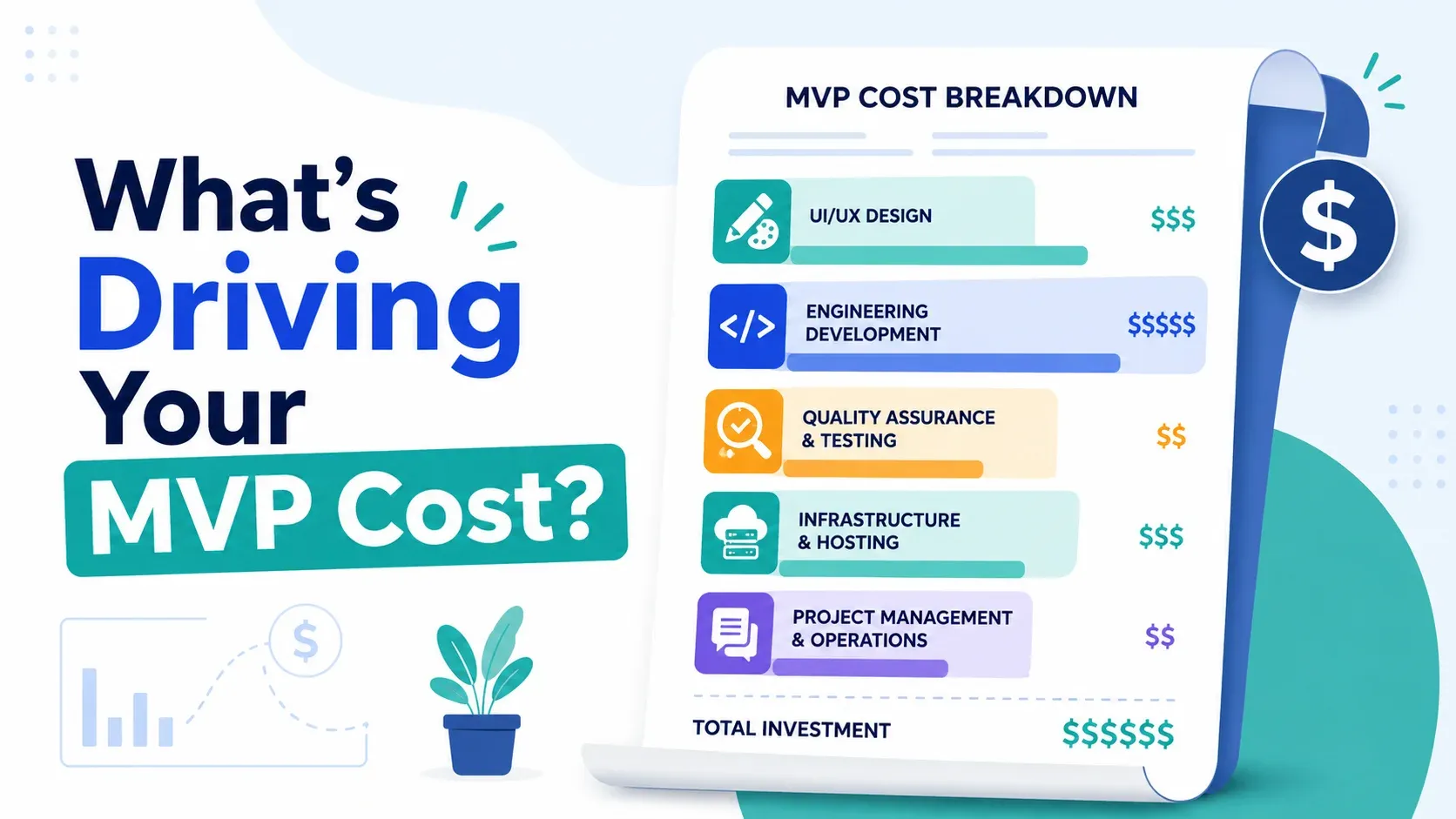
Ask three vendors “how much does an MVP cost?” and you’ll get three different numbers — and the number alone won’t tell you why. A general cost range is useful for a first gut-check on budget, but it doesn’t explain what you’re actually paying for, or why one quote is double another for what looks like the same product on paper. That comes down to which line items are in the quote, and how much of the work each one actually takes.
Why a Single “MVP Costs $X” Number Doesn’t Tell You Much
An MVP quote isn’t one number — it’s a bundle of separate work streams priced together. Two vendors can quote wildly different totals for “the same” MVP because one has scoped in testing, infrastructure setup, and project coordination, while the other has quietly left them out (or plans to handle them informally, on the fly, without pricing them). The lower number isn’t necessarily the better deal; it might just be an incomplete one.
Understanding the line items behind a quote does two things: it lets you compare quotes apples-to-apples instead of just picking the smallest total, and it shows you where you actually have room to trim cost without gutting the product.
The Line Items Behind Every MVP Quote
| Line item | What it covers | Typical share of budget |
|---|---|---|
| Design & UX | Wireframes, UI design, user flows, basic design system | 10-15% |
| Engineering & development | Core feature build, frontend, backend, integrations | 45-55% |
| QA & testing | Manual/automated testing, bug fixing, cross-device checks | 10-15% |
| Infrastructure & deployment | Hosting setup, environments, CI/CD, basic monitoring | 5-10% |
| Project management & communication | Requirement clarification, coordination, progress reviews | 5-10% |
These percentages shift depending on the product — a data-heavy SaaS tool leans more on engineering and infrastructure, while a consumer app with a lot of screens leans more on design. The point isn’t to memorize exact splits; it’s to know these five categories exist so you can ask where your quote’s total actually sits.
Design & UX
This covers everything from wireframes to the visual design of each screen to defining a lightweight design system so new screens don’t need to be designed from scratch later. For an MVP, this line item should stay focused on the core user journey — not a full brand identity or dozens of edge-case screens. If design is quoted unusually low, check whether it only covers a handful of “happy path” screens and nothing else.
Engineering & Development
Usually the largest line item, covering the actual build: frontend, backend, database, and any third-party integrations (payments, auth, analytics). This is where scope creep hits hardest — every “just add one more feature” request adds development hours that a fixed quote either absorbs (unrealistically) or bills separately later. This is also the line item most affected by which pricing model the contract uses.
QA & Testing
Testing the product across the target devices/browsers, checking edge cases, and fixing what breaks. It’s tempting to cut this to save money, but an MVP with untested core flows tends to lose early users to bugs before it ever gets a fair read on product-market fit — the savings show up as churn, not profit.
Infrastructure & Deployment
Setting up hosting, staging/production environments, deployment pipelines, and basic monitoring so the team (and you) can see when something breaks. For an MVP this is usually modest — cloud hosting sized for early users, not for scale — but it’s a real, recurring line item, not a one-time afterthought.
Project Management & Communication
The coordination work: clarifying requirements, running progress check-ins, managing the change-request process if scope shifts. It’s easy to treat this as “free” overhead, but someone is doing it whether or not it’s priced separately — a quote that doesn’t account for it anywhere is likely to under-deliver on communication once the build starts.
Where Line Items Vary Most by Product Type
A content-driven app (blog platform, marketplace listing site) usually skews toward design and frontend work. A data-heavy or workflow-heavy SaaS tool skews toward backend engineering and infrastructure. A product with regulated data (health, finance) adds cost across nearly every line item — extra QA for compliance, extra infrastructure for security, extra design for consent/disclosure flows. Knowing your product’s category helps you sanity-check which line item a quote should be weighted toward, and flag one that looks oddly distributed for what you’re building.
How to Read a Quote Using This Breakdown
When a vendor sends a quote, ask for a rough split across these five categories rather than accepting a single total. If a quote is unusually low, check which line item got thin — it’s rarely engineering (that’s the hardest to fake), and much more often QA, infrastructure, or project management quietly reduced to “we’ll handle it as we go.” That’s not always a red flag on its own, but it should be a deliberate choice you’re making, not one buried in a number. For a fuller list of what a complete MVP engagement typically includes, see what’s actually included in MVP development services — and if you’re trying to bring the total down without cutting corners, this guide to reducing MVP costs covers where real savings usually come from.
A few quick questions turn this breakdown into a practical checklist during vendor conversations: Does the quote name each of these five categories, or just hand you one number? Is testing scoped as its own line, or folded silently into development hours? Is infrastructure a one-time setup cost, or does it include the first few months of hosting and monitoring? Answering these before you sign tells you far more about what you’re actually getting than comparing final totals side by side ever will.
Want a line-item breakdown for your own MVP?
Share your product idea and we'll walk you through where the budget actually goes, category by category, before you commit to a number.
Book a free consultation with MVPHUBFrequently Asked Questions
Why do two MVP quotes for the same idea differ so much?
Usually because they include different line items, not because one vendor is simply cheaper. A lower quote may exclude QA, infrastructure setup, or project management that a higher quote bundles in — compare what's included, not just the total.
What percentage of an MVP budget typically goes to engineering?
Engineering is usually the largest single line item, but rarely more than 50-60% of a well-scoped budget once design, QA, infrastructure, and management are properly accounted for. A quote that's almost entirely coding hours is often underscoping the other work.
Is QA and testing really necessary for an MVP?
Yes, at a scope appropriate to the product. "Minimum" describes feature count, not acceptable quality — skipping QA to save money tends to cost more later in bug fixes, churn, and rework.
Does infrastructure cost more for an MVP than for a full product?
Usually less, since an MVP typically runs on modest, easily scalable infrastructure rather than the redundancy and capacity a proven product needs. But it's still a real line item, not a rounding error, once you factor in hosting, environments, and basic monitoring.
Should project management be a separate line item in an MVP quote?
It should at least be visible, whether billed separately or folded into a team rate. Coordination, requirement clarification, and progress reviews take real time on any multi-person engagement, and a quote that hides this cost tends to under-deliver on communication.
