
Your First 90 Days: An MVP Strategy That Avoids Waste
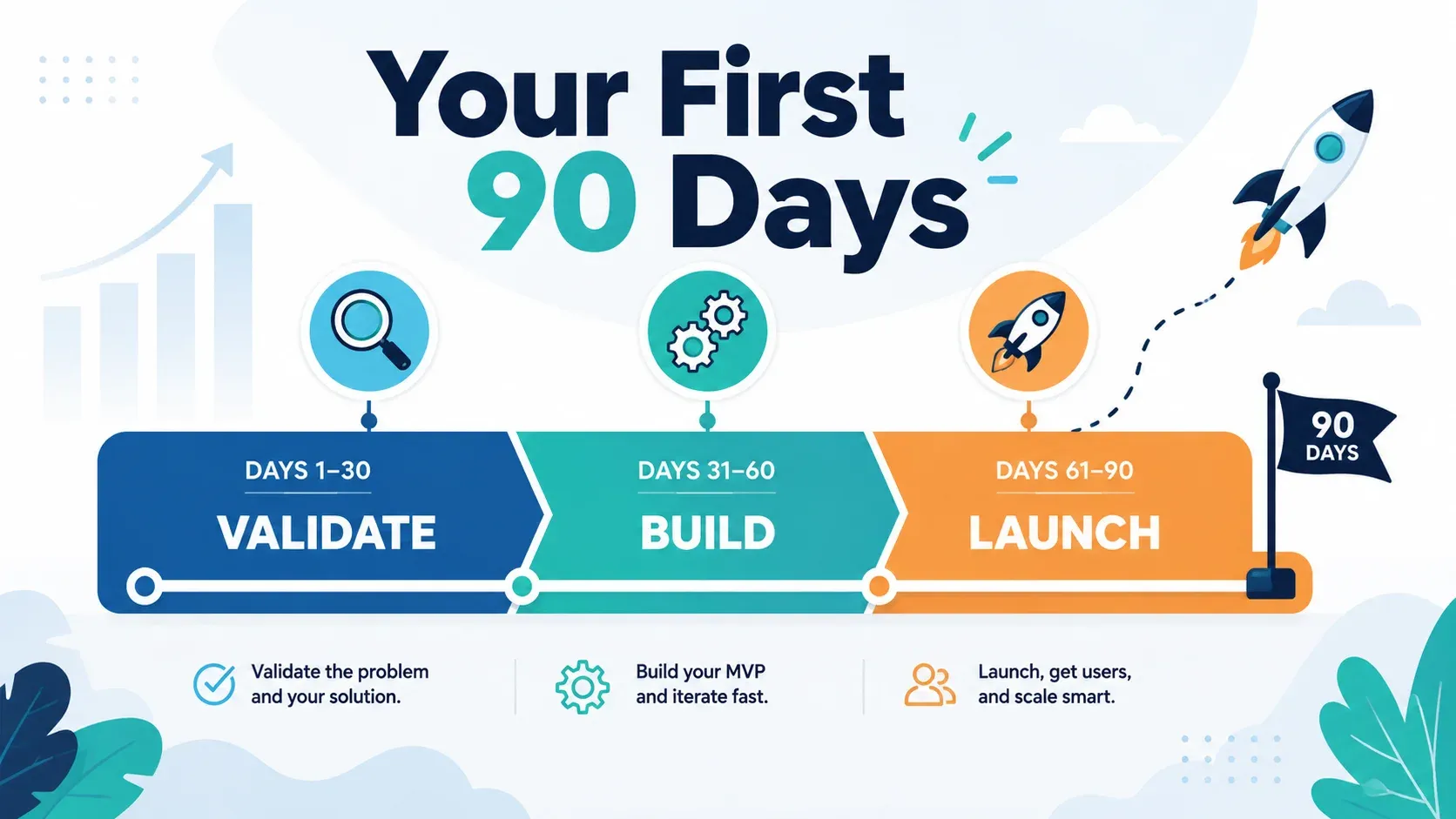
Runway is the real constraint behind most early MVP decisions. With a limited number of months before the next funding conversation or before savings run out, the sequence of what happens in the first 90 days often determines whether an MVP tests something real or quietly burns through budget building the wrong thing well.
Here’s a 90-day sequence that keeps validation ahead of development, instead of skipping it to “move faster.”
Days 1–14: Validate the Problem
Before writing a single requirement, spend the first two weeks confirming the problem is real and specific enough to build for.
- Talk to 10–15 potential customers about the problem, not your solution
- Identify how they currently solve it, and what’s unsatisfying about that
- Look for a specific, reachable first customer segment
- Test demand signals where possible — a landing page, a waitlist, a manual pilot
This phase feels slow when you’re eager to build, but it’s the cheapest 14 days you’ll spend in the entire process. A wrong assumption caught here costs two weeks. The same assumption caught after development costs the whole budget. Customer Interviews Before Building an MVP covers how to structure these conversations so they actually surface evidence instead of just polite agreement, and Y Combinator’s Startup Library is a useful outside reference on early validation more broadly.
Days 15–21: Scope the MVP
With the problem validated, translate it into a defined build. This week should produce:
- A single core user journey the MVP will deliver end to end
- A feature list split into must-have, useful-later, and postpone
- Identification of any real technical risk that needs resolving early
- A rough platform decision — web, mobile, or both — based on customer behaviour
| Week | Focus | Output |
|---|---|---|
| 1–2 | Problem validation | Confirmed customer, problem, and evidence |
| 3 | Scoping | Defined core journey and feature list |
| 4–5 | Design | Clickable flow for the core journey |
| 6–10 | Development | Working MVP, iterative demos |
| 11–12 | Testing and launch prep | QA, analytics, first-user plan |
| 13 | Launch | Real users, first data |
Days 22–35: Design the Core Journey
Design doesn’t need to be extensive at MVP stage, but it needs to be clear enough that development can proceed without guessing. Two weeks is usually enough to produce wireframes or clickable mockups for the full core journey, including edge cases like empty states and errors.
Running this design past a handful of the same people interviewed during validation — even informally — catches usability problems while they’re still a five-minute fix, not a rebuild. This is also the point to lock the platform decision — see Web App vs Mobile App: Which Should Your MVP Be? if that’s still open.
Days 36–70: Build in Iterative Cycles
This is the longest phase, and it should be the most structured one. Rather than one long build with a single reveal at the end, work in short cycles with regular demos — weekly or biweekly — so scope drift and misunderstandings surface early, not at the finish line.
During this window, resist the temptation to add “one more feature” because it seems easy. Every addition during the build extends the runway spent before you have real evidence the core assumption holds.
This is also the window to start building toward your first users — engaging your target community, keeping a waitlist warm, and lining up who will actually try the product on day one of launch, so distribution doesn’t start from zero.
Days 71–84: Test and Prepare to Launch
With the core journey built, this phase covers functional testing of the primary flow, basic security and data-handling checks, analytics set up on key steps, and a documented list of known limitations. This is also when the first-user outreach plan gets finalized — who you’re contacting, how, and what you’re asking them to do.
Days 85–90: Launch
Launch isn’t the finish line — it’s the point where the strategy starts paying off. Real usage data starts answering the assumption you defined back in week one. The goal for these final days is simply getting the product in front of real early users and starting to collect that evidence — see From MVP to Launch for how to run days 85–90 well.
Adjusting the Timeline for Your Reality
Ninety days is a useful default, not a fixed rule. A product with real technical risk — unproven AI accuracy, a complex integration, hardware dependency — may need an extra two to three weeks up front for a proof of concept, pulled from the development window rather than skipped. A founder who has already done substantial customer discovery before day one can compress the first two weeks significantly and move faster into scoping.
What shouldn’t change, regardless of how the timeline flexes, is the order: validation before scoping, scoping before design, design before development. Compressing steps is fine. Skipping their sequence is where 90-day plans quietly turn into 90-day plans that produce nothing usable.
Keeping Momentum Without Cutting Corners
Ninety days can feel long when you’re eager to ship, and short when you look at everything on the list. The way to hold both realities at once is treating each phase as time-boxed rather than open-ended — validation gets two weeks, not “until it feels done,” and scoping gets one week, not an ongoing debate. A deadline on each phase is what keeps momentum without skipping the substance of the phase itself.
Why the Sequence Matters More Than the Speed
A founder eager to “move fast” often skips straight to days 36–70, cutting validation and scoping to save two or three weeks. It rarely works out that way. Without validated groundwork, development frequently loops back mid-build to answer questions that should have been settled in week one — costing far more time than the shortcut saved.
Want a 90-Day Plan Built for Your Product?
MVPHUB helps founders validate, scope, design, develop, and launch focused production-ready MVPs using AI-accelerated delivery and accountable professional engineering. Book a free consultation to map out your first 90 days.
Book a free consultation with MVPHUBFrequently Asked Questions
How much of the first 90 days should go to validation versus building?
A common split is two to three weeks on validation and scoping, followed by four to eight weeks on design and development, leaving the remaining time for testing and launch. The exact split depends on how much validation work has already been done.
Is 90 days enough time to launch an MVP?
For a focused, well-scoped MVP, yes — many teams launch within this window. Products with significant technical risk, regulatory requirements, or a broad initial scope may need longer, which is a sign the scope should likely be reduced.
What's the biggest risk during the first 90 days?
Skipping validation to save time. Jumping straight to development without confirming the problem and target customer often produces a working product with no confirmed demand, which costs far more time to recover from than a proper validation phase would have taken.
Should I start marketing during the 90-day build?
Yes, in a limited way. Building a waitlist, engaging with your target community, and preparing a first-user outreach plan during development means you have real people ready to try the product the moment it launches, rather than starting distribution from zero at launch.
What happens after the first 90 days?
The cycle continues. Real usage data from launch feeds into decisions about what to refine, remove, or build next — the 90-day strategy gets you to a validated starting point, not a finished product.
