
In-House Team vs MVP Agency vs Freelancers: What's Right?
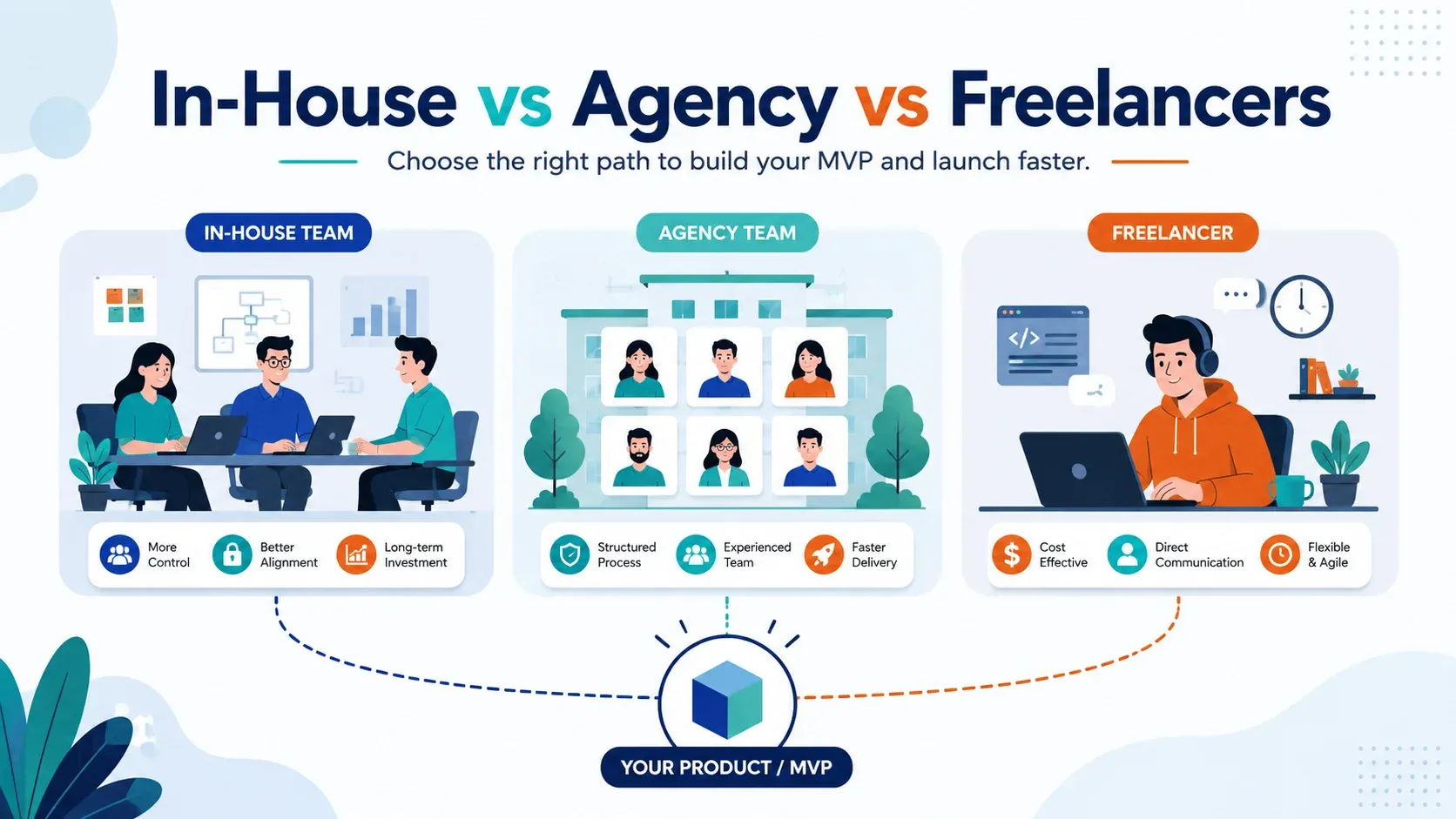
Once you know you’re building an MVP, a second decision sits right behind it: who actually builds it? Founders usually consider three paths — assembling an in-house team, hiring an MVP development agency, or working with freelancers. Each comes with real trade-offs in cost, speed, control, and risk, and the right answer depends on your stage, budget, and how much of the process you want to own.
The Three Options at a Glance
| Factor | In-House Team | MVP Development Agency | Freelancers |
|---|---|---|---|
| Upfront cost | Highest (salaries, hiring time) | Fixed-scope pricing, mid-range | Lowest hourly rate, variable total |
| Speed to start | Slowest (hiring takes weeks) | Fast (existing team ready) | Fast, but coordination-dependent |
| Project management | You own it | Usually included | Usually your responsibility |
| Consistency of quality | Depends on hires | Standardized process | Varies by individual |
| Long-term ownership | Full control | Full control after handover | Full control, but knowledge risk |
| Best for | Proprietary tech, funded teams | Founders wanting a full delivery partner | Narrow, well-defined tasks |
Building In-House
Hiring your own developers, designers, and a product lead gives you the most direct control over the product and the team. It’s the right call when you already have — or can afford to hire — technical leadership, and when the product involves proprietary technology you want deep, long-term ownership over from day one.
The trade-offs are real. Hiring takes time you may not have during early validation. Salaries and benefits are a fixed cost regardless of whether the MVP validates the assumption it was built to test. And without an experienced technical lead already in place, a first-time in-house team can make expensive architectural mistakes that only surface once you try to scale.
In-house works best for: funded startups with runway, products built on proprietary or sensitive technology, and founders who already have a technical co-founder.
Hiring an MVP Development Agency
An agency brings an existing team, a defined process, and — usually — a fixed or capped price for a defined scope. This removes much of the coordination burden from the founder: instead of managing five individual contractors, you manage one relationship and one delivery plan.
Agencies vary widely in quality, so the evaluation matters. Look for a portfolio of comparable MVPs, a scoping process that pushes back on unnecessary features rather than agreeing to everything, clarity on who owns the code after delivery, and a communication cadence that gives you visibility without requiring you to manage the build day to day — see How to Choose an MVP Development Company for a fuller evaluation checklist.
Agencies work best for: founders who want a full delivery partner, teams without in-house technical leadership, and products with a defined scope and a real deadline.
Working With Freelancers
Freelancers offer flexibility and, often, the lowest per-hour cost. For a narrow, well-scoped task — a specific integration, a design pass, a one-off feature — a strong freelancer can be the fastest and cheapest route.
The risk grows with scope. Coordinating multiple freelancers across design, frontend, backend, and QA becomes a project management job in itself — one that usually falls on the founder, who is rarely also a technical project manager. Consistency, documentation, and what happens if a freelancer becomes unavailable mid-project are all risks that don’t show up in the hourly rate.
Freelancers work best for: small, clearly defined pieces of work, founders with technical project management experience, and products where speed on a narrow task matters more than a full delivery process. Non-technical founders weighing this route specifically should also read Can You Build an MVP Without a Technical Co-Founder?
Questions to Ask Before Choosing
Regardless of which path you’re leaning toward, these questions apply across all three:
- Who owns the code and intellectual property once the MVP is delivered?
- What happens if the timeline slips — is there a defined process, or does it just… slip?
- How will progress be communicated during the build?
- What does support look like after launch?
- Is pricing fixed for a defined scope, or open-ended by the hour?
A Hybrid Path Worth Considering
Few founders realize this doesn’t have to be an exclusive choice. A common and effective pattern is starting with an agency or a small in-house core for the product’s foundation — architecture, core journey, data model — and bringing in freelancers later for narrow, well-defined additions once the base is stable and documented.
This works because the riskiest part of an MVP isn’t a single feature — it’s the architectural and product decisions made early, which are hardest to unwind if they’re wrong. Concentrating that early work with one accountable team or partner, and reserving freelancers for smaller, clearly-scoped pieces later, tends to reduce both cost and risk compared to distributing the whole build across independent contractors from day one.
What Founders Regret Most
Across all three paths, a few regrets come up repeatedly. Founders who go in-house without technical leadership often regret not bringing in an experienced advisor sooner — architectural mistakes made early are expensive to unwind later. Founders who hire an agency on price alone often regret not checking references or asking what a “typical” project actually looks like once it’s underway. And founders who spread an MVP across multiple freelancers often regret underestimating how much of the coordination burden would land on them personally, on top of everything else running a startup requires.
Making the Call
There’s no universally right answer — only a right answer for your stage. A well-funded startup with a technical co-founder and a proprietary product has a strong case for building in-house. A founder who wants one accountable partner handling strategy, design, and engineering together usually gets there faster with an agency. A founder who just needs one specific feature built quickly may only need a freelancer.
What matters most is matching the option to how much of the delivery process you actually want to own, and being honest about how much time and technical judgment you have to manage it yourself. Whichever path you lean toward, it’s worth knowing exactly What’s Actually Included in MVP Development Services before you compare quotes.
Not Sure Which Path Fits Your MVP?
MVPHUB helps founders validate, scope, design, develop, and launch focused production-ready MVPs using AI-accelerated delivery and accountable professional engineering — as a single delivery partner. Book a free consultation to talk through the right approach for your product.
Book a free consultation with MVPHUBFrequently Asked Questions
Is it cheaper to build an MVP with freelancers or an agency?
Freelancers often have lower hourly rates, but an agency's fixed scope and built-in project management can reduce the risk of costly rework, missed deadlines, and coordination overhead that raise the effective cost of freelance projects.
When does it make sense to build an MVP in-house?
In-house development makes sense when you already have a technical co-founder or team, the product involves proprietary technology you want to retain deep control over, and you have the runway to absorb a longer, less predictable timeline.
Can I mix freelancers and an agency for one MVP?
It's possible but adds coordination overhead. A common pattern is using an agency or in-house team for the core product and freelancers for narrow, well-defined pieces like a specific integration or a one-off design asset.
What should I check before hiring an MVP development agency?
Check their portfolio of comparable MVPs, how they scope and price projects, what happens to code ownership after delivery, their communication cadence, and whether they offer post-launch support.
Do freelancers offer ongoing support after the MVP is delivered?
It varies significantly by individual. Some freelancers offer retainers or ongoing support, while others complete the project and move on. This should be clarified in the contract before work begins, not assumed.
