
MVP Development Checklist: What to Nail Before You Build
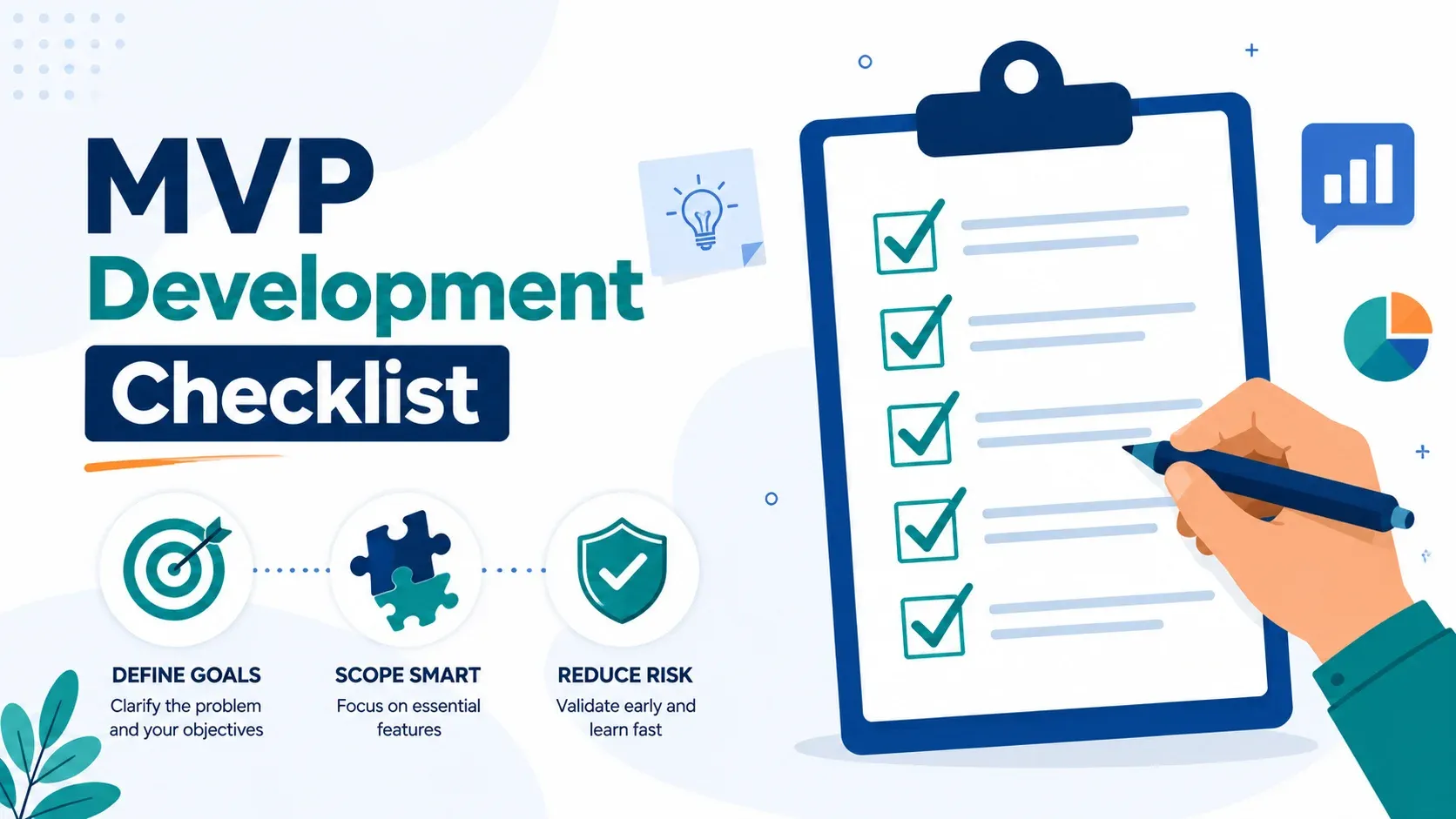
Founders rarely fail at MVP development because the code was bad. They fail because they started building before answering questions that were cheap to answer on paper and expensive to answer in production.
This checklist exists to catch that gap. It’s not a project plan — it’s a readiness gate you run through before committing budget, so the things that are hard to walk back are settled before development starts. If you want the fuller sequence this checklist feeds into, see The MVP Development Process.
Problem and Customer
- You can describe the customer problem in one or two sentences, without listing features
- You’ve identified a specific first customer segment — not “everyone” or “all small businesses”
- You have evidence the problem is real: interviews, waitlist sign-ups, existing workarounds, or paying customers of an alternative
- You know why current alternatives are insufficient for this customer
If you can’t check these, the next step is discovery, not development. Skipping this stage is the single most common reason MVPs launch to silence.
The Core Assumption
- You’ve written down the one business assumption this MVP needs to test
- That assumption is measurable — you’ll know from real user behaviour, not opinions, whether it held
- Every planned feature can be traced back to either the core journey or testing this assumption
An MVP without a clear assumption to test isn’t really an MVP — it’s just a smaller product with the same lack of focus as the big one. If you’re unsure what “minimum” should mean for your product specifically, What “Minimum” Means in an MVP is worth reading before you finalize this section.
Scope
- You’ve defined one complete user journey the MVP delivers, start to finish
- You’ve separated “must include,” “useful but not essential,” and “postpone” features
- Nobody on the team believes every feature on the list is essential
- The scope is small enough to build and learn from within weeks, not many months
| Scope category | Examples | Included in MVP? |
|---|---|---|
| Core journey | Sign-up, primary action, confirmation | Yes |
| Supporting features | Notifications, basic settings | Usually |
| Nice-to-have | Advanced reporting, multiple integrations | Rarely |
| Future scale features | Loyalty programmes, multi-currency, native apps | No |
Technical Risk
- You’ve identified any unproven technical dependency — AI accuracy, unusual integrations, hardware, large-scale data processing
- Where a major technical risk exists, you’ve planned a short proof of concept to resolve it first
- You understand the platforms involved (web, mobile, or both) and why
Technical risk that goes unaddressed before development doesn’t disappear — it resurfaces mid-build as a delay, or after launch as a broken experience. See Proof of Concept vs Prototype vs MVP for when a POC is the right way to resolve it first.
Design and Operations
- You have a design direction, even a simple one, for the core journey
- You know what happens behind the scenes: who manages the product, what stays manual, how exceptions get handled
- You’ve identified what data needs to be collected and what notifications are necessary
Manual operations are perfectly acceptable at MVP stage, as long as they don’t damage the customer experience. What matters is that you’ve thought about them, rather than discovering the gap after real users show up.
Reach and Measurement
- You have a realistic plan to reach real early users — existing network, communities, partnerships, or targeted outreach
- You’ve defined what success looks like before development starts: registration, activation, core journey completion, retention, or payment
- You’re not relying only on page views or downloads as your measure of success
An MVP that nobody sees can’t validate anything, no matter how well it’s built. Reach and measurement should be planned with the same seriousness as the product itself.
Budget and Delivery
- You understand the rough cost range for the scope you’ve defined — see How Much Does MVP Development Cost in 2026? for current ranges
- You know how development progress will be communicated — regular demos, not a single reveal at the end
- You’ve agreed on a realistic timeline given the scope and any technical risk
Red Flags Worth Pausing For
Even a mostly-checked list can hide a problem if one of these shows up:
- The problem statement keeps changing every time you explain it. That usually means it hasn’t been validated yet — it’s still being figured out in real time.
- The feature list has grown since you started reading this checklist. That’s a sign scoping discipline hasn’t actually taken hold, regardless of what’s written down.
- Nobody can name the specific first users who’ll try the MVP. A plan to “post about it and see” isn’t a reach strategy.
- The technical risk item is “we’ll figure it out during development.” For minor uncertainties that’s fine. For a core dependency — an AI model’s accuracy, a critical third-party integration — it’s a proof of concept waiting to happen, not a detail to defer.
- Success is defined as “people like it.” Without a measurable behaviour attached, there’s no way to know afterward whether the assumption actually held.
None of these are disqualifying on their own, but each one is worth resolving before development starts, not after.
If You Can’t Check Every Box
That’s normal, and it doesn’t mean stop. A handful of open items — especially around design detail or minor technical questions — can often be resolved during the early stages of development itself. What matters is that the big-ticket items — problem, customer, assumption, and scope — are settled first, because those are the ones that are expensive to change once development is underway.
Ready to Turn This Checklist Into a Real Build?
MVPHUB helps founders validate, scope, design, develop, and launch focused production-ready MVPs using AI-accelerated delivery and accountable professional engineering. Book a free consultation to review your readiness before you commit budget.
Book a free consultation with MVPHUBFrequently Asked Questions
What should be on an MVP development checklist?
A useful checklist covers problem validation, a specific target customer, a defined core assumption, a scoped feature list, known technical risks, a design direction, and a plan for reaching early users. Skipping any of these tends to surface as costly rework later.
Is a checklist a substitute for a full product plan?
No. A checklist is a readiness gate, not a complete plan. It confirms you have enough clarity to start development responsibly, while the detailed plan continues to evolve as you learn from real users.
How do I know if I'm ready to move from checklist to development?
You're generally ready when you can answer yes to most checklist items without guessing. A few open questions are normal and can often be resolved during design or a short proof of concept rather than blocking the start of development.
What's the biggest mistake founders make before starting MVP development?
Starting development with a feature list but no validated problem or target customer. This produces a product that works technically but has no confirmed reason for anyone to use it.
Should technical risks be resolved before or during MVP development?
Major, unproven technical risks — such as unverified AI accuracy or complex integrations — are best resolved with a small proof of concept before full development. Minor technical uncertainties can usually be handled as they come up during the build.
