
The Complete MVP Development Process: From Idea to Market Launch
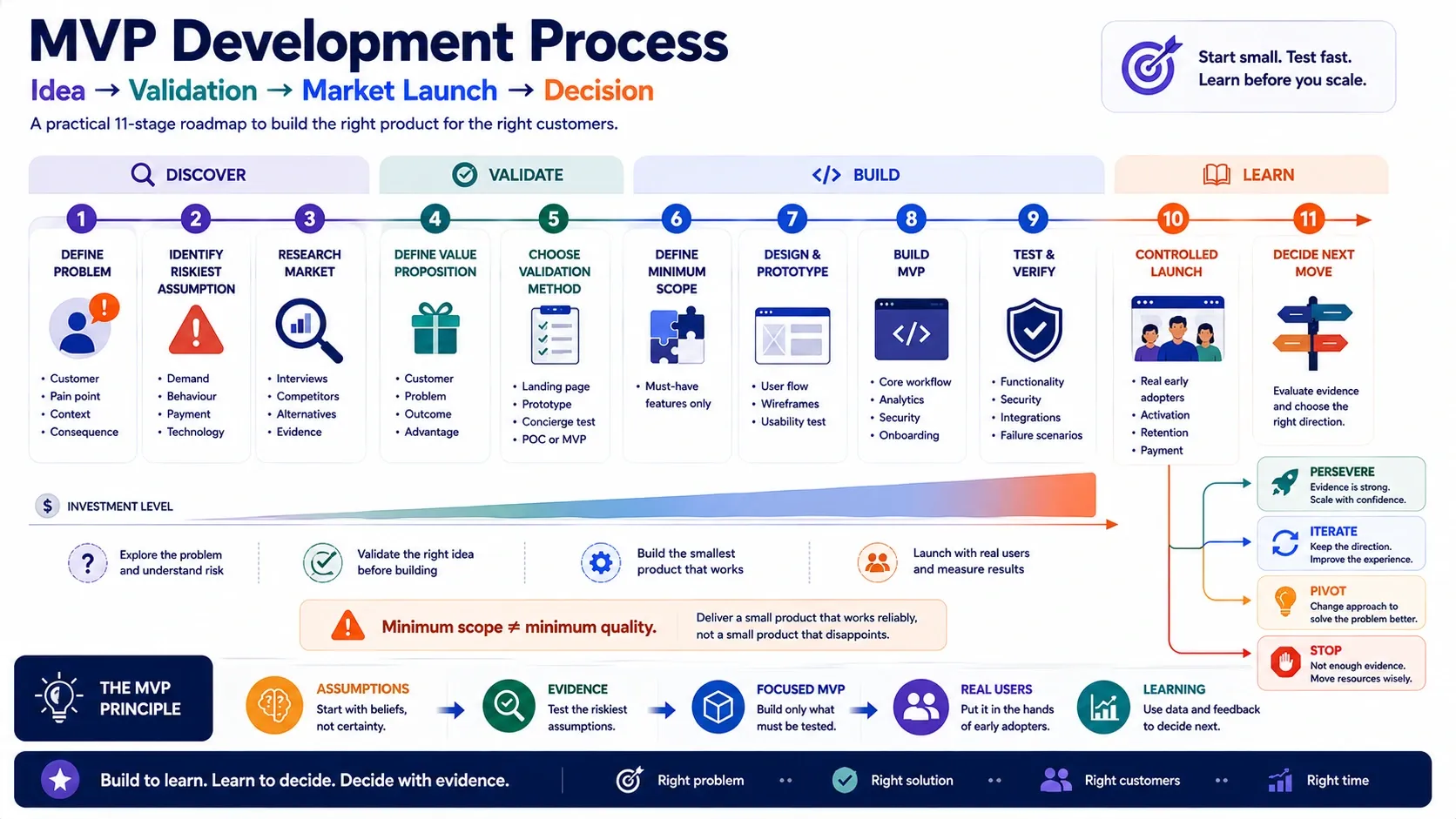
A promising idea is not yet a proven business opportunity. Before investing heavily in a full product, founders need evidence that the problem matters, the proposed solution makes sense, and customers are willing to use or pay for it.
That is the purpose of the MVP development process. A minimum viable product creates the smallest functional version of your solution that can test its most important assumptions with real users.
Here is the complete process from initial idea to market launch.
1. Define the Problem and Target Customer
Begin with the problem, not your feature list. Describe who experiences the problem, when and why it occurs, how customers solve it today, why existing alternatives are inadequate, and what the problem costs in time, money, or frustration.
Avoid targeting “everyone.” A narrow early segment makes customer research, positioning, and product decisions more precise.
Recommended action: write a one-sentence problem statement identifying the customer, problem, context, and consequence.
Risk: building around a problem customers do not consider urgent.
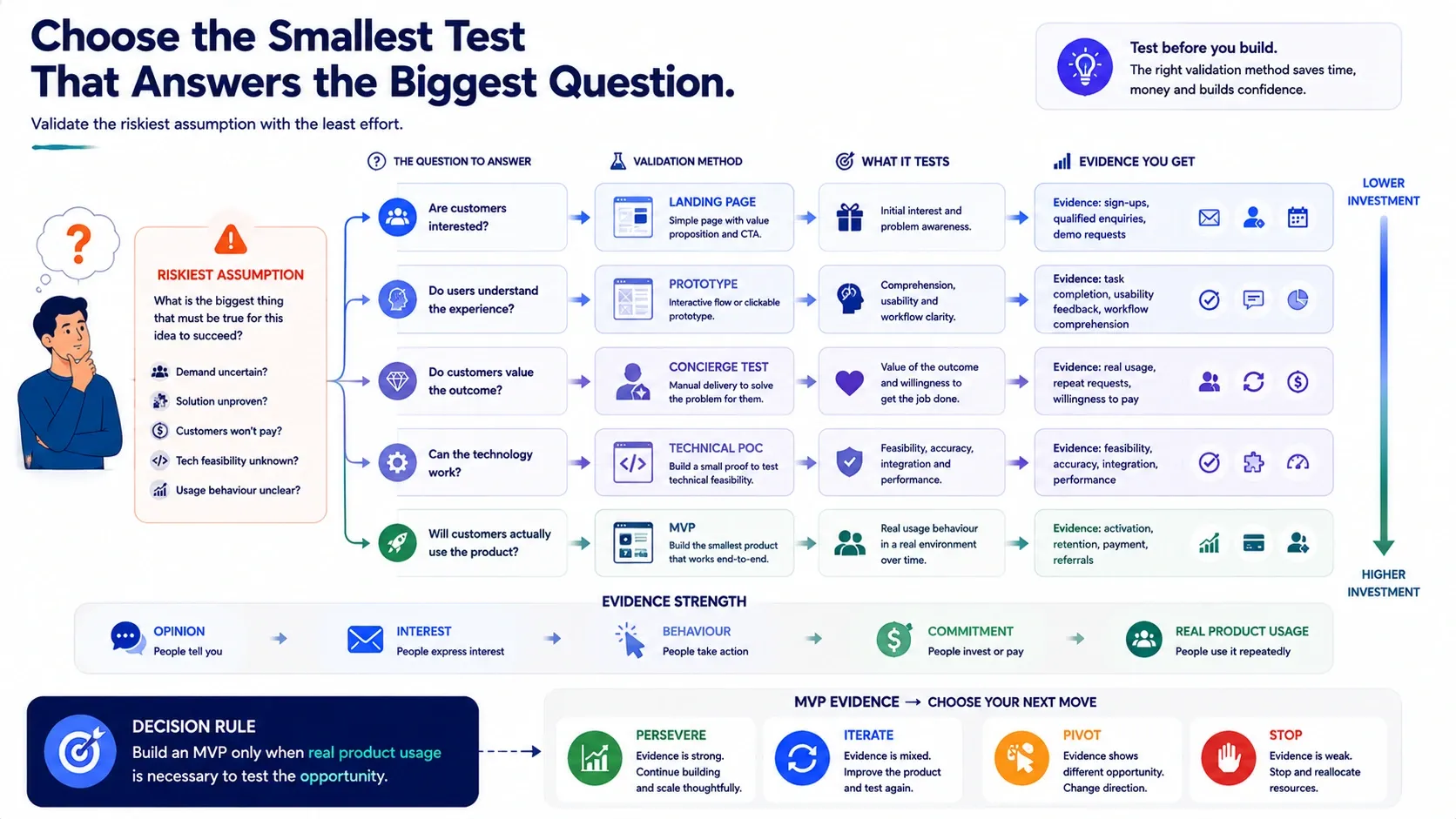
2. Identify Your Riskiest Assumption
Every product idea depends on assumptions. These may concern customer demand, user behaviour, pricing, acquisition, technology, or legal feasibility — for example, that customers will change their current workflow, that businesses will pay monthly for the solution, that users will trust the platform with sensitive information, or that a required integration can work reliably.
Prioritize assumptions by importance and uncertainty. The assumption most likely to invalidate the business should be tested first.
Decision: if the assumption can be tested through interviews, a landing page, or a manual service, do that before building software.
3. Conduct Market and Customer Research
Speak directly with potential customers. Explore their past behaviour rather than asking whether they “like” your idea.
Useful questions include: when did you last experience this problem, how do you currently manage it, what is most frustrating about that solution, have you paid for another option, and who decides whether to purchase a solution?
Combine interviews with competitor research, search trends, reviews, industry reports, and community discussions.
Recommended action: look for repeated problems, existing spending, active workarounds, and requests to try your solution.
Risk: treating polite interest as validated demand.
4. Define the MVP Value Proposition
Your value proposition should explain why the target customer should choose your product. Use this structure:
For [target customer] who struggles with [problem], our product provides [outcome] through [key advantage].
Keep the message focused on one primary outcome. If users cannot quickly understand the benefit, adding more features will not solve the positioning problem — see How to Define a Clear Value Proposition for Your MVP for the full process behind this step.
5. Choose the Right Validation Method
You may not need a functioning product immediately.
| Validation method | Best for testing |
|---|---|
| Landing page | Interest, messaging, and sign-up intent |
| Prototype | Usability, workflows, and solution comprehension |
| Concierge service | Customer outcomes and willingness to pay |
| Technical proof of concept | Technical feasibility |
| MVP | Real usage, retention, and commercial demand |
Build an MVP only when real product usage is necessary to test the opportunity. Landing Page vs Prototype vs MVP breaks down how to choose between the first two before committing to a full build.
6. Define the Minimum Feature Set
List the complete user journey from discovering the product to achieving the promised outcome. Include only features essential to that journey.
Classify potential features as must have, useful later, or unnecessary for validation. A strong MVP usually serves one customer segment, solves one important problem, and supports one core workflow.
Risk: expanding scope to satisfy hypothetical future users.
Recommended action: give every feature a validation purpose. If a feature does not test an assumption or deliver the core outcome, postpone it.
7. Create the User Flow and Prototype
Before development, map the screens, actions, and decisions required to complete the core task. Then create a clickable prototype.
Test it with representative users. Observe where they hesitate, misunderstand instructions, or abandon the journey. Do not guide them unless they become completely stuck.
This stage catches expensive usability problems before code is written.
8. Build an MVP
Select technology based on speed, reliability, security, scalability requirements, and available expertise — not trends.
During development, prioritize the core customer workflow, basic analytics, secure authentication and data handling, responsive performance, error monitoring, simple onboarding, and a feedback channel.
To build an MVP efficiently, use short development cycles and review working features regularly. This keeps implementation aligned with the original validation goals.
9. Test Before Launch
Quality assurance should cover functionality, usability, security, integrations, device compatibility, and failure scenarios.
Test the complete customer journey with realistic data. Resolve issues that prevent users from reaching the core outcome before spending time on cosmetic improvements.
“Minimum” means minimum scope, not minimum quality.
10. Run a Controlled MVP Launch Process
Start with a small group of relevant early adopters. A controlled launch produces clearer feedback and makes customer support manageable — see How to Run a Successful MVP Pilot with Early Customers for the full pilot process.
Set expectations that the product is an early release. Provide onboarding, observe user behaviour, and schedule feedback conversations.
Track metrics connected to your assumptions, such as activation rate, time to first value, core feature usage, retention, conversion to paid plans, customer acquisition cost, and referral or recommendation behaviour. Avoid relying on downloads, page views, or registrations alone.
11. Decide What Happens Next
After launch, compare the evidence against predefined success criteria. You can:
- Persevere — continue when users repeatedly achieve value.
- Iterate — improve messaging, onboarding, features, or pricing.
- Pivot — change the segment, problem, or solution.
- Stop — end the idea when evidence consistently contradicts its assumptions.
The goal of the MVP development stages is not to prove that your original idea was correct. It is to discover the strongest opportunity before committing larger resources.
Build and Validate Your MVP with MVPHUB
MVPHUB helps founders transform validated opportunities into focused, production-ready MVPs. From scope and wireframes to engineering, testing, and launch, our team keeps development aligned with the assumptions your business needs to test. Book a free consultation with MVPHUB and define the fastest responsible path from idea to market.
Book a free consultation with MVPHUBFrequently Asked Questions
How long does the MVP development process take?
Timelines depend on scope and complexity, but a focused MVP commonly takes several weeks to a few months from discovery through launch.
What is the first stage of MVP development?
The first stage is defining the customer problem and identifying the assumptions that must be validated before any design or development work begins.
How many features should an MVP include?
There is no ideal number. Include only the features required to deliver the core outcome and test the critical assumptions you set out to validate.
Should an MVP be launched publicly?
Not necessarily. Many startups begin with a controlled pilot before expanding to a public launch, which produces clearer feedback and keeps customer support manageable.
How do you know whether an MVP is successful?
Success is demonstrated through meaningful behaviour — activation, repeated usage, retention, payment, or referrals — not positive feedback alone.
