
Can You Build a Real MVP on a Startup Budget? What's Realistic
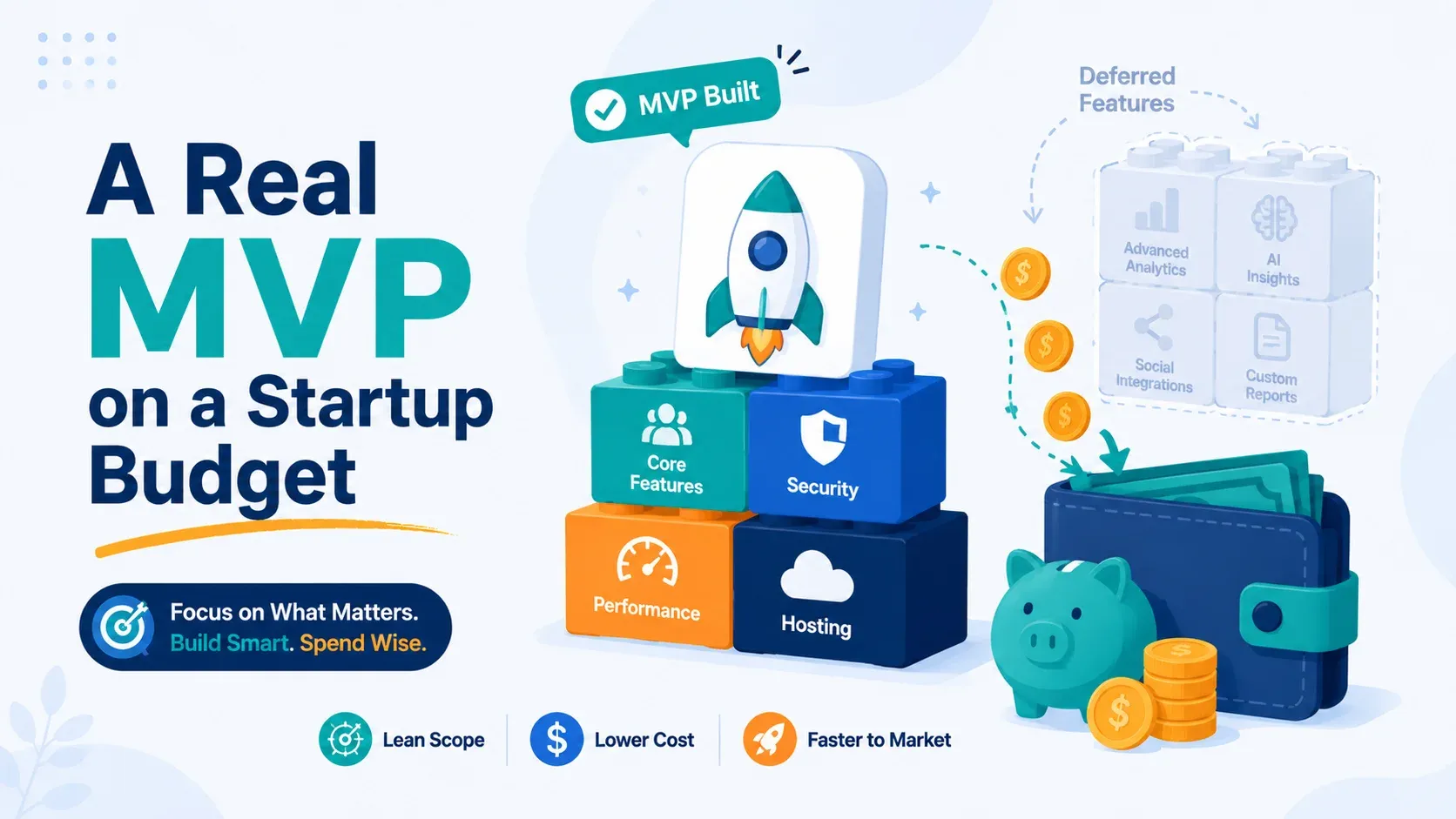
“Can I build a real MVP on a startup budget?” is a fair question, and the honest answer is yes — but “real” and “full-featured” aren’t the same thing, and a low budget only works if you’re clear about which one you’re actually building.
A low-budget MVP is not a cut-price version of the product you’d build with more money. It’s a narrower product, built to the same engineering standard, that tests one thing instead of five. Confusing the two is where low-budget MVPs go wrong.
What “Low Budget” Actually Means for an MVP
There’s no universal dollar figure that defines a low budget — it’s relative to your idea’s inherent complexity. A single-workflow tool for a narrow audience can be genuinely low-budget in absolute terms. A multi-role SaaS platform with billing and third-party integrations cannot, no matter how tightly you scope it, because the components that make it SaaS have a cost floor of their own.
The useful question isn’t “what’s the cheapest MVP possible” — it’s “what’s the cheapest version of my specific idea that’s still real enough to test.”
What Actually Gets Cut at a Low Budget
Scope, Not Quality
The safe cut is narrowing what the product does: one user type instead of three, one core journey instead of several, one platform (usually web) instead of web plus native mobile. This is the correct lever, and it’s the one most cost-reduction guidance points toward first.
Polish and Nice-to-Haves
Custom animations, an extensive design system, advanced reporting, and multiple integrations are reasonable things to defer. None of them affect whether the core validation works.
What Should Not Get Cut
Basic security practices, input validation, error handling on the core journey, and enough testing to confirm the main path actually works — these aren’t “extra,” they’re what makes the MVP a real product instead of a demo that breaks the first time a real user does something unexpected. Cutting here doesn’t save money; it just moves the cost to later, usually with interest, once bugs or a security issue surface in front of actual customers.
A Realistic Picture by Budget Tier
| Tier | What’s realistic | What’s not realistic |
|---|---|---|
| Very tight (validation-only) | Single workflow, manual backend processes, no-code or low-code build | Multiple user roles, custom integrations, native mobile |
| Modest | One platform, basic auth, one core workflow, professionally coded | Complex billing, multiple integrations, advanced admin tooling |
| Standard | Multiple user roles, one or two integrations, proper QA cycle | Enterprise-scale infrastructure, compliance-heavy features |
| Well-funded | Multi-platform, several integrations, dedicated QA and infra | — |
Most low-budget conversations belong in the first two rows. The mistake founders make is asking for row three’s feature list at row one’s price — that gap doesn’t get closed by finding a cheaper vendor, it gets closed by narrowing the ask.
Manual-First: The Underused Low-Budget Strategy
One of the most effective ways to stretch a tight budget is deciding what doesn’t need to be software yet. A booking confirmation can be a manual email instead of an automated system. Customer support can be a shared inbox instead of a built-in chat widget. Admin tasks can be handled by directly editing a database instead of building an admin panel.
This isn’t cutting corners on the product experience your test users see — it’s moving invisible backend work to a human, temporarily, so engineering budget goes entirely toward the customer-facing journey being validated. Y Combinator’s guide to planning an MVP makes a similar case for keeping the build minimal while the operational reality stays real.
When a Low Budget Signals “Not Yet,” Not “Build Cheaper”
Sometimes the honest answer isn’t a cheaper build — it’s that MVP development is premature. If you haven’t yet confirmed people want the thing at all, a lighter validation step — interviews, a landing page test, a manual pilot — can answer the demand question for a fraction of even a low-budget MVP’s cost, and tell you whether the MVP spend is worth committing at all.
It’s also worth sizing the number against your actual runway before treating any budget as fixed. Budgeting for an MVP isn’t just about the build cost — it includes enough runway afterward to act on what you learn, which sometimes means the “low budget” you set was never really about the MVP price at all, but about how much of your total runway you’re willing to commit before you have evidence.
Where Founders Overspend Even on a Low Budget
Tight budgets don’t only get eaten by underscoping — they also get eaten by spending in the wrong place. Two common patterns:
- Paying for infrastructure sized for scale you don’t have yet. A brand-new MVP with a handful of early users doesn’t need enterprise-grade hosting redundancy or a dedicated DevOps setup. Modest, easily-scalable infrastructure is not just cheaper, it’s the appropriate choice at this stage.
- Building for a future feature list instead of the current test. It’s tempting to architect for the roadmap you imagine six months out. On a low budget, that instinct is expensive — every hour spent generalizing for features you haven’t validated yet is an hour not spent finishing the one workflow you’re actually testing.
Both patterns come from planning for the product you hope to have, rather than the test you need to run right now. Redirecting that instinct is often worth more budget headroom than any vendor negotiation.
A Quick Gut-Check Before You Commit
- Can you describe the one thing this MVP needs to prove, in a single sentence?
- Have you cut scope (features) rather than quality (security, testing, error handling)?
- Would a vendor’s quote for this scope survive a real discovery conversation, not just a rough guess?
- Have you set aside runway for what happens after the build, not just the build itself?
If you can answer yes to all four, a low-budget MVP is a realistic plan. If not, the gap usually isn’t the vendor — it’s the scope or the timing.
Not Sure What's Realistic at Your Budget?
MVPHUB scopes MVPs around what actually needs to be tested, so budget goes toward real validation instead of features that can wait. Book a free consultation with MVPHUB to find out what's realistic for your idea and budget.
Book a free consultation with MVPHUBFrequently Asked Questions
Is it actually possible to build a real MVP on a low budget?
Yes, but only for a tightly scoped product — one core workflow, one user type, minimal integrations. A low budget doesn't build a full-featured product cheaply; it builds a narrow, real product cheaply, which is enough to validate demand.
What's the cheapest way to build an MVP?
Narrowing scope to a single workflow and skipping non-essential polish, not skipping engineering fundamentals like security, error handling, or basic testing. Cutting scope is safe; cutting quality on what remains usually costs more later.
What should never be cut to save money on an MVP?
Basic security practices, data handling that protects users, and error handling for the core journey. These aren't polish — skipping them tends to produce a product that fails in front of real users, which defeats the point of validating with an MVP at all.
Can I use no-code tools to build an MVP cheaply?
For very simple, low-integration products, yes. No-code tools hit limits quickly with custom logic, complex integrations, or scale, so they suit an early validation pass more than a product you expect to grow directly from.
How do I know if my budget is too low for what I'm asking for?
If every vendor you talk to wants to cut the same core feature to hit your number, that's a signal the scope needs to shrink further or the budget needs to grow — not that you've found an unusually efficient vendor.
