
What Does It Actually Cost to Build a SaaS MVP?
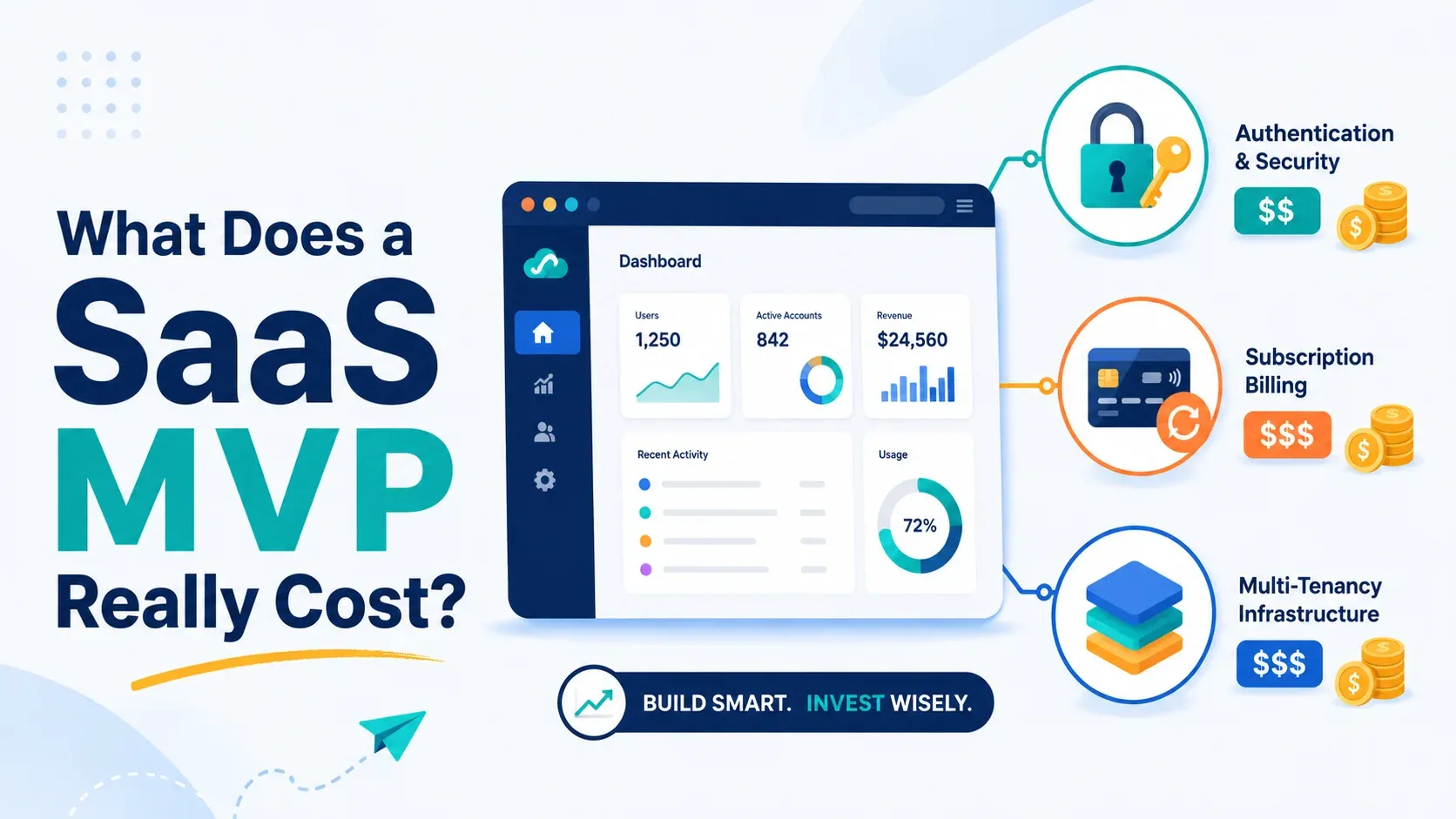
Ask “how much does an MVP cost” and you’ll get a wide answer, because the question is missing the one detail that matters most for a SaaS product: SaaS isn’t just software with a login page. It’s a multi-tenant, subscription-billed system that has to work correctly for every customer at once, and that shape shows up in the cost even at the smallest possible scope.
A general MVP cost range is a reasonable starting point for a first gut-check, but it’s built around a generic feature set. SaaS has a specific one — and three or four of its components exist in almost no other type of MVP.
Why a Generic MVP Cost Figure Doesn’t Work for SaaS
Most MVP cost guides talk about “core features,” design, and QA as the main cost drivers, then treat everything else as extras. For a SaaS product, three things that get treated as extras elsewhere are actually part of the baseline:
- Account and access management — sign-up, sign-in, password resets, and usually role-based permissions, because SaaS customers expect to invite teammates, not just log in themselves.
- Subscription billing — recurring charges, plan tiers, upgrades/downgrades, and failed-payment handling, because “free forever” isn’t a SaaS business model.
- Multi-tenancy — keeping every customer’s data separated and secure while running on shared infrastructure, because a SaaS product serves many customers from one codebase, not one deployment per customer.
None of these are “nice to have later.” A SaaS MVP without working billing can’t validate willingness to pay, and a SaaS MVP without proper tenant isolation is a security incident waiting to happen the moment a second paying customer signs up.
What Makes SaaS Different From a Simple MVP
Authentication and User Management
A basic app MVP might get away with a single login. A SaaS MVP usually needs account creation, email verification, password reset flows, and often an “invite a teammate” flow from the first release, because most B2B SaaS products are used by more than one person per customer account. This is usually the smallest of the SaaS-specific cost items, but it’s rarely zero.
Subscription Billing
Integrating a payment processor for one-time purchases is a few days of work. Recurring subscription billing — plan tiers, proration when someone upgrades mid-cycle, dunning for failed payments, and syncing subscription status back into the app — is a meaningfully larger scope. Even a “just get it working” version of this needs webhook handling and edge-case testing, because billing bugs directly cost you revenue or trust.
Multi-Tenancy
This is the item most first-time SaaS founders underestimate. At minimum, every database query needs to be scoped to the correct tenant, and that discipline has to be built into the data model from the first schema, not retrofitted later. Depending on scale, tenant isolation can be handled at the application layer (shared database, tenant ID on every table) or the infrastructure layer (separate databases per customer) — the former is far cheaper for an MVP and is the right call for almost every early-stage SaaS product.
Onboarding and Admin Tooling
SaaS products also tend to need a lightweight admin view — even just enough to see which accounts exist, manually adjust a subscription, or unblock a stuck user — because “fix it in the database” isn’t sustainable once you have real customers you can’t afford to lose to a support delay.
A Line-Item View of SaaS MVP Costs
| Component | Typical share of a SaaS MVP budget | Why it costs what it does |
|---|---|---|
| Core product workflow | 35–45% | The actual feature the customer is paying for |
| Auth & account management | 10–15% | Sign-up, sessions, roles, invites |
| Subscription billing | 10–20% | Plan logic, webhooks, failed-payment handling |
| Multi-tenant data model | 10–15% | Isolation built into the schema and queries |
| Admin tooling | 5–10% | Minimal internal visibility and control |
| QA, infrastructure, PM | remainder | Covered in more detail in the full cost breakdown |
The exact split moves depending on how complex your core workflow is, but the pattern holds: a meaningful chunk of a SaaS MVP budget goes to plumbing that has nothing to do with your product’s unique value, and all of it is still necessary.
What Drives the Range Up or Down
A few factors swing a SaaS MVP’s cost more than almost anything else:
- Number of user roles. A single “user” role is cheap. Adding “admin,” “member,” and “viewer” with different permissions multiplies the testing surface, not just the code.
- Billing complexity. A single flat monthly price is simple. Usage-based billing, multiple tiers, add-ons, or annual discounts each add real engineering time.
- Integrations. Every third-party API — a CRM, an accounting tool, a calendar, a messaging platform — adds its own edge cases, rate limits, and failure modes to handle.
- Compliance requirements. If your SaaS product touches payment data, health data, or EU personal data, security and audit requirements add cost even at MVP scope, because these aren’t corners you can safely cut.
A Realistic Cost Range by SaaS Complexity Tier
| Tier | What it looks like | Typical driver of cost |
|---|---|---|
| Narrow single-workflow SaaS | One core workflow, single user role, one billing plan | Mostly the core feature itself |
| Standard team SaaS | Multiple roles, teammate invites, 2-3 pricing tiers | Auth and billing logic |
| Integration-heavy SaaS | Connects to 1+ external platforms, more complex data sync | Third-party API handling |
| Regulated or compliance-sensitive SaaS | Payment/health/EU data, audit logging required | Security review and compliance work |
Each tier up typically adds a meaningful percentage to the total, not a fixed dollar amount — which is exactly why a single “SaaS MVP costs $X” headline number is close to meaningless without knowing which tier a given product sits in.
How to Keep a SaaS MVP Lean Without Cutting Corners
The instinct to cut cost by skipping billing or tenant isolation “for now” usually backfires, because both are expensive to retrofit and cheap to build in from the start compared to that. The actual levers that keep a SaaS MVP lean without weakening it:
- Launch with one pricing plan, not three. Add tiers once you know what customers actually value enough to pay more for.
- Pick a billing provider that handles the hard parts (subscription state, proration, dunning) instead of building that logic yourself.
- Scope integrations to the one that unlocks adoption, and treat the rest as a post-launch roadmap item, not a launch requirement.
- Use application-layer tenant isolation (shared infrastructure, tenant ID scoping) rather than per-customer infrastructure, unless a specific customer or compliance requirement demands otherwise.
If you’re still deciding whether an MVP is the right move at all for a SaaS idea, it’s worth checking whether a lighter validation step can prove demand first before committing to any of this scope. And once you have a sense of your tier, comparing vendor pricing models will tell you more about your actual out-the-door number than any generic range can.
Not Sure Which SaaS MVP Tier You're In?
MVPHUB scopes SaaS MVPs around the auth, billing, and multi-tenancy your product actually needs — not a padded generic estimate. Book a free consultation with MVPHUB to get a realistic cost range for your specific SaaS idea.
Book a free consultation with MVPHUBFrequently Asked Questions
Why does a SaaS MVP cost more than a simple app MVP?
A SaaS product needs account management, subscription billing, and usually multi-tenant data separation from day one — none of which a single-user app or an internal tool needs. These aren't optional polish; they're what makes it a SaaS product at all, so they show up in the cost even at MVP scope.
Can I skip subscription billing in a SaaS MVP?
Only if you're validating with a manual or free pilot first. If the MVP needs to prove people will actually pay, some form of billing has to be in scope, even if it's a simpler integration than the full pricing-tier system you'll eventually want.
Does multi-tenancy always need to be built from the start?
Not always at full scale, but the data model needs to separate tenants from day one even if the infrastructure is simple. Retrofitting tenant isolation into a single-tenant database later is a much larger rebuild than building it in from the start.
What's a realistic starting budget for a SaaS MVP?
A narrowly scoped SaaS MVP with one core workflow, basic auth, and simple billing typically starts in the low five figures with a professional team, and scales up from there with more integrations, roles, and compliance requirements.
Should I build a SaaS MVP with a no-code tool to save money?
No-code can work for a very early validation pass, but multi-tenant billing and account security are exactly the areas where no-code platforms tend to hit limits fastest. Many founders end up rebuilding on custom code once the SaaS MVP needs real paying tenants.
