
How to Validate a SaaS Idea Without Building the Full Product
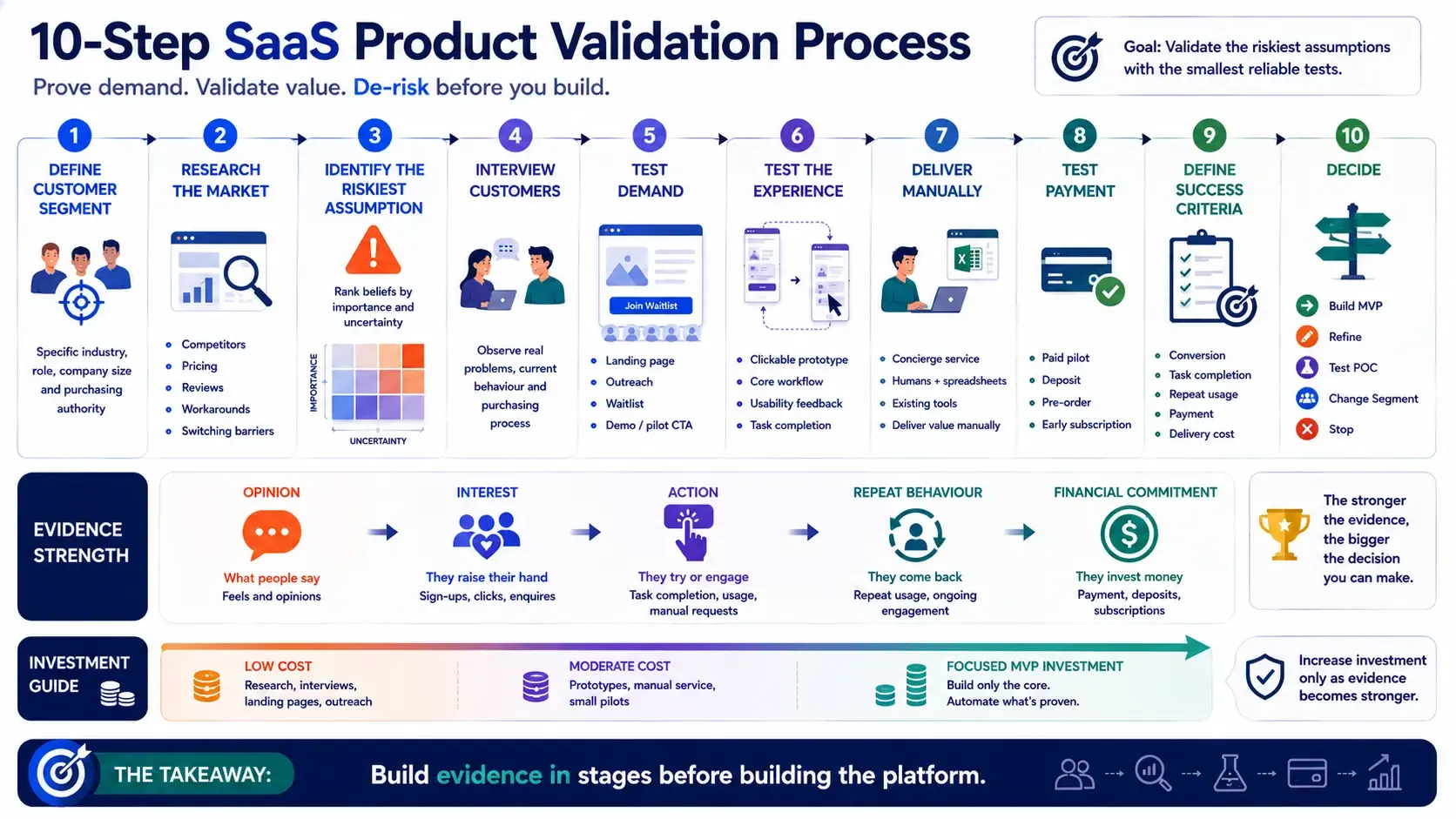
You do not need to build a complete software platform to determine whether a SaaS idea deserves investment.
Before development, you can test whether the problem exists, the target audience is reachable, the proposed solution is understandable, and customers are willing to take action or pay.
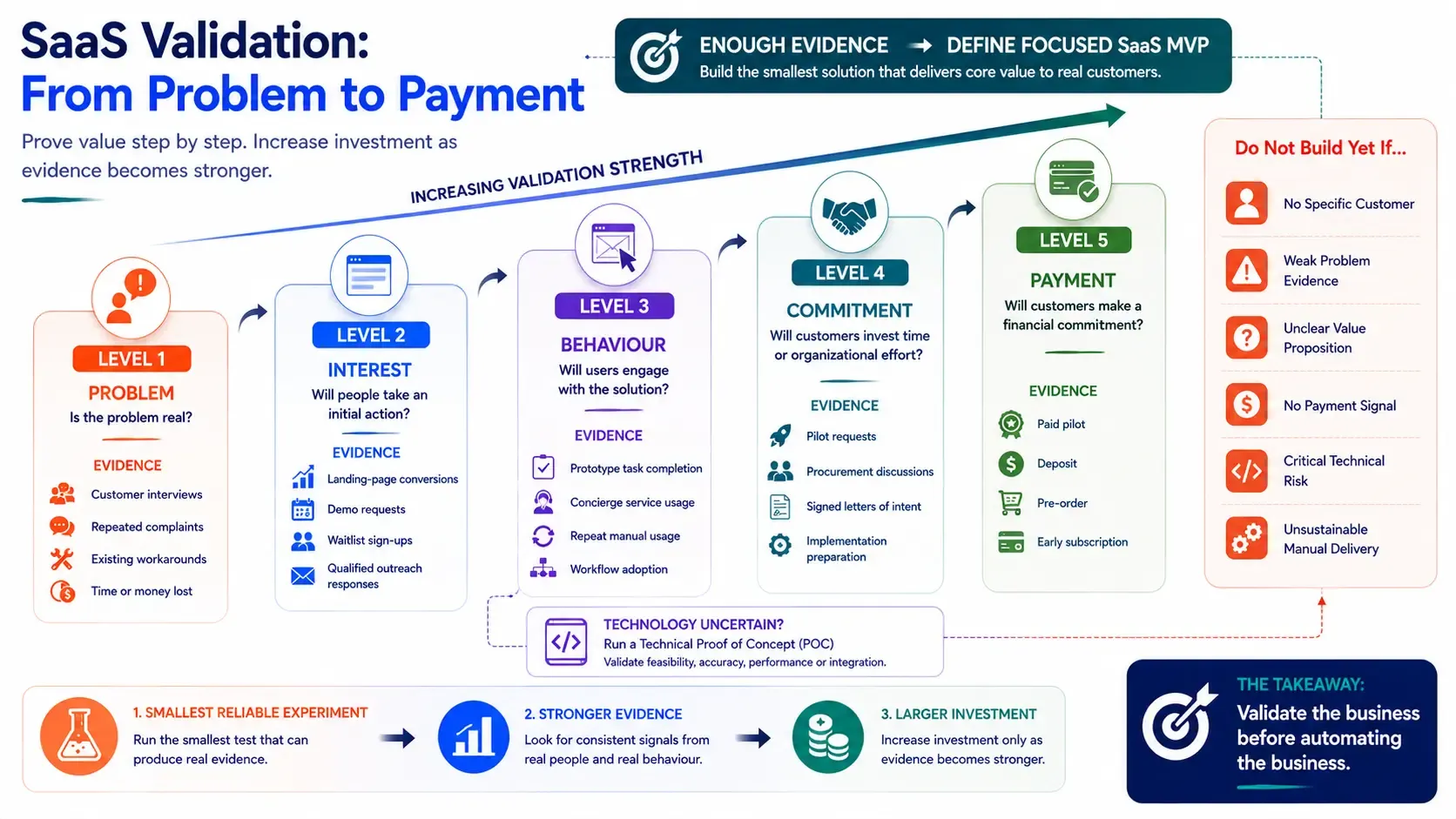
Effective SaaS product validation moves from opinions toward stronger evidence:
Problem → Interest → Behaviour → Commitment → Payment
Here is a practical process for validating a SaaS idea without building the full product.
Step 1: Define a Specific Customer Segment
Avoid broad audiences such as “small businesses” or “marketing teams.”
A stronger segment might be:
- Recruitment agencies processing more than 100 applications monthly
- Independent tutors managing classes through spreadsheets
- Property managers operating multiple apartment buildings
- Accounting firms collecting documents through email
Define the customer by industry, role, company size, current behaviour, problem frequency, and purchasing authority.
Decision: Can you identify and contact a specific group? If yes, begin problem research. If no, narrow the segment before testing the solution — a broad segment produces conflicting feedback and unclear product requirements.
Step 2: Conduct SaaS Market Research
Study how customers currently solve the problem.
Review direct and indirect competitors, product features, pricing models, customer reviews, common complaints, market positioning, free alternatives, manual workarounds, and switching barriers.
Competition does not automatically make the idea unattractive. It may confirm that customers already spend money on the problem. The opportunity may exist in serving a neglected segment, simplifying a difficult workflow, offering better integration, or producing a more valuable outcome.
Recommended action: create a competitor table comparing audience, promise, pricing, strengths, and repeated complaints. This same discovery work feeds directly into the market validation framework most of the following steps build on.
Step 3: Identify the Riskiest Assumption
List what must be true for the SaaS business to succeed. Typical assumptions include:
- Customers experience the problem regularly
- The problem is important enough to solve
- Existing tools are inadequate
- Users will change their current workflow
- Buyers will trust the platform with their data
- Customers will accept subscription pricing
- Required integrations are technically possible
- Customers can be acquired at a sustainable cost
Score every assumption by importance and uncertainty, and test the highest-risk item first. Testing interface preferences while customer demand remains uncertain wastes time and creates false confidence.
Step 4: Interview Potential Customers
Start with approximately 10 to 15 relevant interviews per important customer segment. Ask about past behaviour:
- When did the problem last occur?
- How do you solve it today?
- How frequently does it happen?
- What does it cost in time or money?
- Which products have you tried, and why were they insufficient?
- Who approves software purchases?
- What could prevent adoption?
Avoid asking, “Would you use my SaaS product?” People often express interest without changing behaviour.
Decision: Do the same problem, consequences, and workarounds appear repeatedly? If yes, test your proposed value. If no, refine the segment or reconsider the problem.
Step 5: Test Demand With a Landing Page
Create a landing page that explains who the product serves, which problem it solves, the promised outcome, how it would work, the expected price or pricing model, and one clear call to action — join the waitlist, request a demo, apply for a pilot, reserve early access, or start a paid trial.
Send relevant traffic through direct outreach, communities, partnerships, or targeted advertising, and measure qualified conversions rather than traffic alone. A large number of visitors with no serious enquiries may indicate poor targeting, weak messaging, or low problem urgency. If you’re still weighing a landing page against a prototype at this stage, Landing Page vs Prototype vs MVP breaks down what each one actually proves.
Step 6: Create a Clickable Prototype
A prototype can demonstrate the core workflow without a functional backend. Give target users tasks to complete and observe whether they understand the product, where they become confused, what information they expect, whether the workflow matches current behaviour, and whether the promised outcome feels valuable.
Do not explain every screen. If the user requires continuous guidance, the proposed experience may need improvement.
Decision: Can target users complete the core journey and explain the value? If yes, test actual delivery. If no, refine the workflow before development.
Step 7: Deliver the Outcome Manually
Before automating the entire SaaS workflow, deliver the service manually behind a simple interface. You might generate reports manually, match users with providers, review documents with human assistance, process approvals through existing tools, send outputs by email, or track operations in a spreadsheet.
This concierge approach tests whether customers value the result before you build the automation. Manual delivery can hide an unsustainable operating cost, so record the time, skills, and expense required for every customer outcome.
Step 8: Test Willingness to Pay
Waitlist registrations and positive feedback are useful but limited. Stronger SaaS product validation requires financial commitment.
Test paid pilots, deposits, pre-orders, setup fees, discounted early subscriptions, signed letters of intent, or procurement discussions. Present realistic pricing rather than asking customers what they might pay.
Decision: Will qualified customers accept the price or begin a purchasing process? If yes, define a focused MVP. If no, reassess the audience, urgency, value proposition, or pricing.
Step 9: Define Success Criteria
Set thresholds before evaluating the results. Measure repeated problem evidence, qualified landing-page conversion, demo or pilot requests, prototype task completion, paid commitments, repeat manual usage, expected monthly revenue, estimated acquisition cost, and manual delivery cost.
Predetermined criteria reduce the temptation to interpret weak results positively.
Step 10: Choose the Next Action
| Evidence | Recommended action |
|---|---|
| Strong problem, demand, and payment evidence | Build a focused SaaS MVP |
| Strong problem but weak solution response | Redesign the value proposition |
| High interest but no payment | Revisit pricing or urgency |
| Product value but unsustainable operations | Simplify delivery or test automation |
| Critical technical uncertainty | Build a technical proof of concept |
| Weak problem evidence | Stop or explore another segment |
When Is the SaaS Idea Ready for an MVP?
Begin development when you have a specific target customer, repeated evidence of an important problem, a clear value proposition, a validated core workflow, manageable technical risks, evidence of willingness to pay, and defined success metrics. If you want a broader readiness check before committing, 10 Signs Your Product Idea Is Ready for an MVP covers the signals that apply beyond SaaS specifically.
Build one complete journey, not the full future platform.
Validate Demand Before Investing in the Full Build
A SaaS idea does not need a finished platform to be tested. Market research, interviews, a landing page, a prototype, a manual pilot, and a payment test can each remove a specific layer of uncertainty before engineering work begins.
Validate Demand Before Investing in the Full Build
MVPHUB helps founders validate SaaS opportunities, define evidence-based product scopes, and launch production-ready MVPs using AI-accelerated delivery and professional engineering. Book a free consultation with MVPHUB to turn your SaaS validation evidence into a focused, launch-ready MVP.
Book a free consultation with MVPHUBFrequently Asked Questions
Can I validate a SaaS idea without coding?
Yes. Customer interviews, competitor research, landing pages, clickable prototypes, manual services, and paid pilots can all test critical assumptions before development starts.
How many customers should I interview?
Start with approximately 10 to 15 relevant people per major segment and continue until the same problems, objections, and buying patterns start to repeat.
Does a waitlist prove SaaS demand?
A waitlist indicates interest, not necessarily usage or payment. Paid pilots, deposits, and repeated use provide stronger evidence than sign-up counts alone.
Should I show pricing during validation?
Yes. Presenting a realistic price helps test commercial demand and prevents feedback based on the assumption that the product will be free.
When should I build the SaaS MVP?
Build it once the customer problem, target segment, value proposition, and willingness to pay have credible evidence, and a working product is required to test real usage or retention.
