
How MVP Development Agencies Price Their Projects
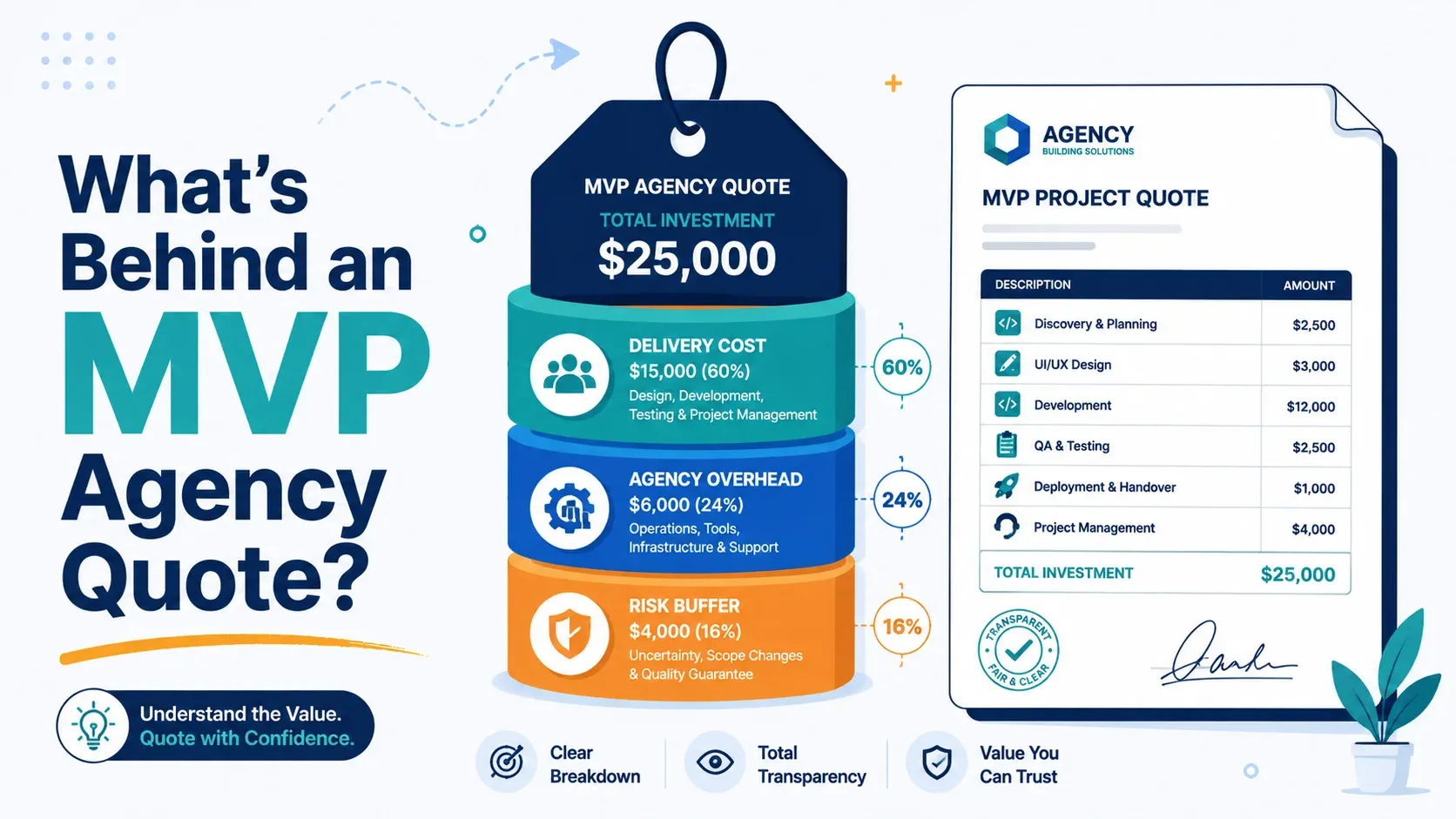
An agency quote for an MVP is rarely just “hours × rate.” It’s a number built from a specific team mix, a margin that funds things you’ll never see itemized, and a risk buffer the agency adds because MVP scope has a habit of growing mid-project. Understanding that structure is what lets you evaluate a quote instead of just reacting to the total.
This isn’t about what drives the feature-level cost — that’s a different, equally useful question. This is about what happens behind the quote before it reaches you.
The Three Layers Behind an Agency Quote
1. Direct Delivery Cost
This is the closest thing to the “hours × rate” intuition — the actual cost of the designers, engineers, and QA staff who’ll build your product, based on how the agency staffs projects like yours. A more senior team mix costs more here, but often needs fewer total hours to hit the same quality bar.
2. Overhead and Margin
On top of direct cost, agencies add a margin that covers costs that don’t map to any single project: account management, sales, business development, internal tooling, ongoing team training, and simple business sustainability. This is the layer founders sometimes assume is “pure profit,” but a chunk of it is what funds the accountability structure — someone answering when something goes wrong — that a freelancer’s rate typically doesn’t include.
3. Risk Buffer
Experienced agencies price in a buffer for the reality that MVP scope shifts once real requirements surface during discovery, and that some features take longer than estimated. This buffer is why a well-run agency’s fixed-price quote tends to hold, while an underpriced quote either blows past its number or quietly cuts corners to stay within it.
Common Agency Pricing Models
| Model | How it works | Best suited to |
|---|---|---|
| Role-based team pricing | Priced by the specific mix of designers/engineers/QA and their seniority | Custom scopes with a clear feature list |
| Fixed packages | Set price for a common scope tier (e.g. “starter MVP package”) | Founders who fit a common pattern and want price certainty fast |
| Time & material | Billed by actual hours across the team, tracked per sprint | Scope expected to evolve as you learn |
| Value/outcome-based | Priced around the business outcome rather than hours (less common for MVPs) | Rare at MVP stage, more common for later-stage growth work |
Most MVP agencies default to role-based pricing or fixed packages, because MVP scope is usually specific and bounded enough to quote confidently, unlike open-ended ongoing product work.
Why Two Agencies Can Quote Wildly Different Numbers for the Same Idea
It’s rarely because one agency is simply more expensive. More often:
- Different team mixes. One agency scopes a senior-heavy team for speed and reliability; another scopes a junior-heavy team supervised by one senior lead, at a lower blended cost.
- Different scope interpretation. The same one-paragraph pitch gets scoped differently by each team unless you hand over a genuinely detailed scope — this is the single largest source of quote variance, more than pricing philosophy.
- Different overhead structures. A boutique studio with lower overhead can genuinely charge less for the same delivery quality; a larger agency’s overhead funds more account support and process, which shows up in price.
- Different risk tolerance. A leaner buffer produces a lower quote today, but higher odds of a change-request conversation mid-project.
What to Actually Ask When Comparing Agency Quotes
Rather than asking “why is your number higher,” ask questions that surface the structure behind it:
- What’s the team composition for this project, and what’s each role’s seniority?
- What happens if a feature takes longer than estimated — is that absorbed or billed separately?
- What’s explicitly excluded from this quote?
- What does post-launch support look like, and is it included or separate?
- How is project management handled, and is it a named person or shared across the team?
An agency that can answer all five clearly is usually pricing from real process, not a guess. One that can’t is a bigger risk than a slightly higher number.
How Payment Schedules Interact With Pricing
Agency pricing isn’t just a total number — the payment schedule attached to it changes how much risk each side carries. A common structure splits payment across milestones: an upfront deposit to begin discovery and design, a mid-project payment at a working prototype, and a final payment at launch. This protects both sides — the agency isn’t fully exposed if a client stalls midway, and the client isn’t paying in full before seeing working software.
Be cautious of two extremes: a large upfront payment before any discovery work is scoped (which shifts nearly all the risk onto you), and an agency willing to bill entirely at the end (which is rare for good reason — most agencies need working capital to staff a project responsibly). A reasonable milestone structure, tied to visible deliverables rather than just calendar dates, is a sign of a mature pricing process.
What a Quote Doesn’t Tell You
Two agency quotes that look identical on paper can lead to very different experiences, because a quote doesn’t capture communication cadence, how change requests get handled mid-project, or what happens if a key team member becomes unavailable. Before signing, it’s worth asking to see a past client reference for a project of similar scope, and specifically asking that reference how closely the final cost matched the original quote — that answer tells you more about an agency’s pricing discipline than the quote itself ever could.
Agency Pricing vs. Other Delivery Models
Agency pricing only makes sense in context of the alternatives. If you haven’t settled on an agency as the right delivery model yet, comparing in-house, agency, and freelance paths is worth doing before evaluating any specific quote — the “right” price only means something relative to the model you’ve actually decided fits your stage and risk tolerance. And separately from how an agency structures its margin, it’s worth checking how to choose the right agency in the first place, since price is only one factor in that decision.
Want a Quote You Can See Through, Not Just Read?
MVPHUB shows the team mix, scope, and exclusions behind every quote — no hidden margin, no mystery number. Book a free consultation with MVPHUB to get pricing you can actually evaluate.
Book a free consultation with MVPHUBFrequently Asked Questions
Why is an agency quote usually higher than a freelancer's?
Agency pricing bundles project management, QA, design coordination, and backup coverage into the number, whereas a freelancer's rate is usually just their own time. The higher total often reflects more roles being covered, not just markup.
What's included in an agency's margin?
Typically overhead like account management, sales, tooling, ongoing training, and business risk buffer, on top of the direct cost of the people doing the work. A reasonable margin funds the coordination and accountability a solo freelancer doesn't provide.
Do all MVP agencies price the same way?
No. Some price by role mix (how many designers, engineers, QA hours), others by fixed packages for common scopes, and others by value or outcome. Two agencies quoting the same product can arrive at very different numbers using different pricing logic, not just different rates.
Is a lower agency quote always a red flag?
Not always, but it's worth asking what's excluded. A lower quote may reflect a leaner team mix, a narrower scope, or genuinely lower overhead — but it can also mean QA, PM, or infrastructure got quietly left out.
Can I negotiate an MVP agency's pricing?
Often yes, especially around scope, payment schedule, or team composition, though the underlying rate structure is usually fixed. Asking what changes if you narrow the scope tends to be more productive than asking for a flat discount on the same scope.
